Event submissions
Published
This submission belongs to the session S6. Teacher Education of the event The 1st International Online Conference on Education Sciences
Published date
10 Jun, 2026
Academic Editor
'%3e%3cpath%20d='M12.6657%2010.9104C12.4185%2010.325%2012.0599%209.79327%2011.6097%209.34482C11.1609%208.89508%2010.6293%208.5365%2010.0442%208.28888C10.0389%208.28626%2010.0337%208.28495%2010.0285%208.28233C10.8446%207.69279%2011.3752%206.73249%2011.3752%205.64904C11.3752%203.8542%209.92103%202.39999%208.1262%202.39999C6.33136%202.39999%204.87715%203.8542%204.87715%205.64904C4.87715%206.73249%205.40774%207.69279%206.22393%208.28364C6.21869%208.28626%206.21345%208.28757%206.20821%208.29019C5.62129%208.5378%205.09463%208.89284%204.64265%209.34613C4.1929%209.79493%203.83432%2010.3266%203.58671%2010.9117C3.34345%2011.4845%203.21226%2012.0987%203.20023%2012.7209C3.19988%2012.7349%203.20233%2012.7488%203.20744%2012.7619C3.21255%2012.7749%203.22022%2012.7867%203.22998%2012.7968C3.23975%2012.8068%203.25142%2012.8147%203.26431%2012.8202C3.2772%2012.8256%203.29105%2012.8284%203.30504%2012.8284H4.09109C4.14874%2012.8284%204.19459%2012.7825%204.1959%2012.7262C4.2221%2011.7148%204.62823%2010.7676%205.34617%2010.0497C6.08899%209.30683%207.0755%208.89808%208.1262%208.89808C9.17689%208.89808%2010.1634%209.30683%2010.9062%2010.0497C11.6242%2010.7676%2012.0303%2011.7148%2012.0565%2012.7262C12.0578%2012.7838%2012.1037%2012.8284%2012.1613%2012.8284H12.9474C12.9613%2012.8284%2012.9752%2012.8256%2012.9881%2012.8202C13.001%2012.8147%2013.0126%2012.8068%2013.0224%2012.7968C13.0322%2012.7867%2013.0398%2012.7749%2013.0449%2012.7619C13.0501%2012.7488%2013.0525%2012.7349%2013.0522%2012.7209C13.0391%2012.0947%2012.9094%2011.4855%2012.6657%2010.9104ZM8.1262%207.9024C7.52486%207.9024%206.9589%207.6679%206.53312%207.24211C6.10733%206.81633%205.87283%206.25037%205.87283%205.64904C5.87283%205.0477%206.10733%204.48174%206.53312%204.05596C6.9589%203.63018%207.52486%203.39567%208.1262%203.39567C8.72753%203.39567%209.29349%203.63018%209.71927%204.05596C10.1451%204.48174%2010.3796%205.0477%2010.3796%205.64904C10.3796%206.25037%2010.1451%206.81633%209.71927%207.24211C9.29349%207.6679%208.72753%207.9024%208.1262%207.9024Z'%20fill='%235D1EE1'/%3e%3c/g%3e%3c/svg%3e) Daniel Muijs
Daniel MuijsCitation
Vanessa Vinodhen, Hwey Miin Chian, Enhancing Assessment Literacy in Polytechnic Educators Through Structured Pre‑Service Training, in Proceedings of The 1st International Online Conference on Education Sciences, 15 June–17 June 2026, MDPI: Basel, Switzerland
Share
Email
Facebook
Twitter
LinkedIn
Enhancing Assessment Literacy in Polytechnic Educators Through Structured Pre‑Service Training
'%3e%3cpath%20d='M12.6647%2010.9104C12.4176%2010.325%2012.0589%209.7933%2011.6088%209.34485C11.16%208.89511%2010.6283%208.53653%2010.0432%208.28891C10.038%208.28629%2010.0327%208.28498%2010.0275%208.28236C10.8437%207.69282%2011.3743%206.73252%2011.3743%205.64907C11.3743%203.85423%209.92005%202.40002%208.12522%202.40002C6.33038%202.40002%204.87618%203.85423%204.87618%205.64907C4.87618%206.73252%205.40677%207.69282%206.22296%208.28367C6.21772%208.28629%206.21248%208.2876%206.20724%208.29022C5.62031%208.53783%205.09365%208.89287%204.64167%209.34616C4.19192%209.79496%203.83334%2010.3266%203.58573%2010.9117C3.34247%2011.4846%203.21128%2012.0987%203.19925%2012.721C3.1989%2012.735%203.20135%2012.7489%203.20646%2012.7619C3.21157%2012.7749%203.21924%2012.7868%203.22901%2012.7968C3.23877%2012.8068%203.25045%2012.8148%203.26334%2012.8202C3.27623%2012.8256%203.29007%2012.8284%203.30406%2012.8284H4.09012C4.14776%2012.8284%204.19362%2012.7825%204.19493%2012.7262C4.22113%2011.7148%204.62726%2010.7676%205.34519%2010.0497C6.08802%209.30686%207.07452%208.89811%208.12522%208.89811C9.17592%208.89811%2010.1624%209.30686%2010.9052%2010.0497C11.6232%2010.7676%2012.0293%2011.7148%2012.0555%2012.7262C12.0568%2012.7839%2012.1027%2012.8284%2012.1603%2012.8284H12.9464C12.9604%2012.8284%2012.9742%2012.8256%2012.9871%2012.8202C13%2012.8148%2013.0117%2012.8068%2013.0214%2012.7968C13.0312%2012.7868%2013.0389%2012.7749%2013.044%2012.7619C13.0491%2012.7489%2013.0515%2012.735%2013.0512%2012.721C13.0381%2012.0947%2012.9084%2011.4856%2012.6647%2010.9104ZM8.12522%207.90243C7.52388%207.90243%206.95792%207.66793%206.53214%207.24215C6.10636%206.81636%205.87185%206.2504%205.87185%205.64907C5.87185%205.04773%206.10636%204.48177%206.53214%204.05599C6.95792%203.63021%207.52388%203.3957%208.12522%203.3957C8.72655%203.3957%209.29252%203.63021%209.7183%204.05599C10.1441%204.48177%2010.3786%205.04773%2010.3786%205.64907C10.3786%206.2504%2010.1441%206.81636%209.7183%207.24215C9.29252%207.66793%208.72655%207.90243%208.12522%207.90243Z'%20fill='%235D1EE1'/%3e%3c/g%3e%3c/svg%3e)
Vanessa Vinodhen 1
Hwey Miin Chian 2
1. Centre for Teaching and Learning Development, Nanyang Polytechnic, Singapore, 569830, Singapore., Singapore
2. School of Applied Science, Nanyang Polytechnic, Singapore, 569830, Singapore., Singapore
Abstract
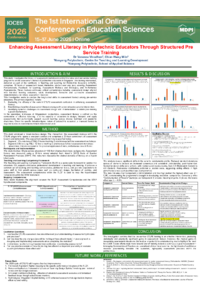
This study investigates the impact of a structured pre-service assessment training programme on the assessment literacy of polytechnic educators in Singapore. The training intervention, delivered as part of the Certificate in Teaching and Learning for Polytechnic Educators (CTLPE), comprised 18 hours of interactive tutorials over 6 months, covering Assessment Fundamentals, Feedback for Learning, Assessment Methods and Strategies, and Performance Assessments. These modules addressed critical competencies including assessment design aligned with intended learning outcomes, rubric development, formative and summative assessment implementation, and ethical assessment practices.
Using a mixed-methods research design, the study evaluated 58 pre-service educators from multiple disciplinary backgrounds through pre- and post-training surveys adapted from the Scale of Teacher Assessment Practices (STAP). The survey measured five domains of assessment literacy: selection and development of assessment methods, administering and scoring assessments, using assessment results for instructional decisions, ethical use of assessment, and communication of results to stakeholders.
Quantitative analysis revealed statistically significant improvements across all five domains, with effect sizes ranging from medium to large (Cohen's d = 0.61 to 0.96). The most substantial gains occurred in assessment administration and scoring (d = 0.96, large effect), where participants reporting certainty or high certainty increased from 20% to 60%. Assessment development and selection showed marked improvement (d = 0.72, medium-large effect), with confident participants rising from 22% to 61.3%. Mean scores increased significantly across all components: Component 1 (+0.63), Component 2 (+0.85), Component 3 (+0.59), Component 4 (+0.64), and Component 5 (+0.57), with all medians shifting from "moderately certain" to "certain" post-training. Qualitative findings revealed enhanced understanding of assessment principles, increased confidence in rubric design, and intentions to improve assessment practices through better alignment with learning outcomes.
The study demonstrates that structured pre-service training can meaningfully enhance assessment literacy among polytechnic educators. The findings support expanding practical application components, integrating technology tools, and establishing post-training support, including communities of practice and assessment clinics to sustain and further develop assessment competencies in practice-oriented tertiary education contexts.
Keywords
Assessment literacy
Professional development
Pre-service training
Polytechnic
Poster
171429_Enhancing Assessment Literacy in Polytechnic Educators Through Structured Pre‑Service Training.pdf
Arab Teachers' Attitudes in Israel Toward Facts and Neuromyths About the Brain
Implementing culturally responsive and sustaining teaching practice through primary science in Aotearoa New Zealand