Event submissions
Published
This submission belongs to the session S6. Teacher Education of the event The 1st International Online Conference on Education Sciences
Published date
10 Jun, 2026
Academic Editor
'%3e%3cpath%20d='M12.6657%2010.9104C12.4185%2010.325%2012.0599%209.79327%2011.6097%209.34482C11.1609%208.89508%2010.6293%208.5365%2010.0442%208.28888C10.0389%208.28626%2010.0337%208.28495%2010.0285%208.28233C10.8446%207.69279%2011.3752%206.73249%2011.3752%205.64904C11.3752%203.8542%209.92103%202.39999%208.1262%202.39999C6.33136%202.39999%204.87715%203.8542%204.87715%205.64904C4.87715%206.73249%205.40774%207.69279%206.22393%208.28364C6.21869%208.28626%206.21345%208.28757%206.20821%208.29019C5.62129%208.5378%205.09463%208.89284%204.64265%209.34613C4.1929%209.79493%203.83432%2010.3266%203.58671%2010.9117C3.34345%2011.4845%203.21226%2012.0987%203.20023%2012.7209C3.19988%2012.7349%203.20233%2012.7488%203.20744%2012.7619C3.21255%2012.7749%203.22022%2012.7867%203.22998%2012.7968C3.23975%2012.8068%203.25142%2012.8147%203.26431%2012.8202C3.2772%2012.8256%203.29105%2012.8284%203.30504%2012.8284H4.09109C4.14874%2012.8284%204.19459%2012.7825%204.1959%2012.7262C4.2221%2011.7148%204.62823%2010.7676%205.34617%2010.0497C6.08899%209.30683%207.0755%208.89808%208.1262%208.89808C9.17689%208.89808%2010.1634%209.30683%2010.9062%2010.0497C11.6242%2010.7676%2012.0303%2011.7148%2012.0565%2012.7262C12.0578%2012.7838%2012.1037%2012.8284%2012.1613%2012.8284H12.9474C12.9613%2012.8284%2012.9752%2012.8256%2012.9881%2012.8202C13.001%2012.8147%2013.0126%2012.8068%2013.0224%2012.7968C13.0322%2012.7867%2013.0398%2012.7749%2013.0449%2012.7619C13.0501%2012.7488%2013.0525%2012.7349%2013.0522%2012.7209C13.0391%2012.0947%2012.9094%2011.4855%2012.6657%2010.9104ZM8.1262%207.9024C7.52486%207.9024%206.9589%207.6679%206.53312%207.24211C6.10733%206.81633%205.87283%206.25037%205.87283%205.64904C5.87283%205.0477%206.10733%204.48174%206.53312%204.05596C6.9589%203.63018%207.52486%203.39567%208.1262%203.39567C8.72753%203.39567%209.29349%203.63018%209.71927%204.05596C10.1451%204.48174%2010.3796%205.0477%2010.3796%205.64904C10.3796%206.25037%2010.1451%206.81633%209.71927%207.24211C9.29349%207.6679%208.72753%207.9024%208.1262%207.9024Z'%20fill='%235D1EE1'/%3e%3c/g%3e%3c/svg%3e) Daniel Muijs
Daniel MuijsCitation
Juan Luis Cabanillas García, Sociodemographic Differences in Teachers’ Rationales for Using Active Learning Methodologies: A Descriptive Phenomenological Qualitative Study in Spain, in Proceedings of The 1st International Online Conference on Education Sciences, 15 June–17 June 2026, MDPI: Basel, Switzerland
Share
Email
Facebook
Twitter
LinkedIn
Sociodemographic Differences in Teachers’ Rationales for Using Active Learning Methodologies: A Descriptive Phenomenological Qualitative Study in Spain

Juan Luis Cabanillas García 1
1. Department: Department of Education Sciences, University of Extremadura, Badajoz, 06006, Spain., Spain
Abstract
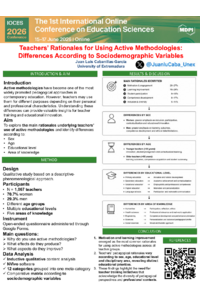
Active learning methodologies have become a key approach to addressing contemporary educational challenges. However, teachers’ rationales for implementing these methodologies are not uniform and may differ depending on sociodemographic and professional characteristics. This study explores the purposes and underlying rationales teachers attribute to active learning and examines differences by sex, age, educational level, and disciplinary field. A qualitative study with a descriptive phenomenological design was conducted using an open-ended survey. A total of 1,067 Spanish teachers participated through non-probability snowball sampling. Data were collected via an online questionnaire (Google Forms) and analyzed inductively through qualitative content analysis supported by NVivo. Twelve categories were identified within a central meta-category on rationales for active learning. Comparative matrices were then developed to examine patterns across sociodemographic variables. Student motivation and improved learning outcomes emerged as the most frequent rationales across all groups. Male teachers placed stronger emphasis on motivation, achievement, and competency development and expressed greater concern about ethical issues and risks associated with technology use. Female teachers more often highlighted contextualized learning, inclusion, student-centered participation, and pedagogical innovation. Age-based differences showed that teachers under 35 prioritized student agency, innovation, and relevance to contemporary contexts, whereas older groups emphasized effectiveness, academic performance, and competency development, with the oldest group also stressing personalization and autonomy. Disciplinary differences revealed that Health Sciences and Engineering emphasized professional preparation, performance, and practical relevance, while Arts/Humanities and Social/Legal Sciences favored participatory, reflective, and meaning-oriented purposes. By educational level, primary education focused on inclusion and holistic development, vocational education on applied competencies and employability, and official language schools on contextualization, communication, and interaction. Teachers’ rationales for active learning vary systematically across sociodemographic and contextual factors, supporting the need for differentiated professional development policies aligned with teacher profiles and institutional contexts.
Keywords
Active learning methodologies
teachers
qualitative content analysis
sociodemographic variables
educational innovation
inclusion
student engagement
competency-based learning.
Poster
sciforum-170087.pdf
The Instrument of Discursive Analysis: a heuristic tool supporting the educational community
Qualitative Study on Workplace Challenges, Mental Health and Well-Being of Indian School Teachers