Event submissions
Published
This submission belongs to the session S6. Teacher Education of the event The 1st International Online Conference on Education Sciences
Published date
10 Jun, 2026
Academic Editor
'%3e%3cpath%20d='M12.6657%2010.9104C12.4185%2010.325%2012.0599%209.79327%2011.6097%209.34482C11.1609%208.89508%2010.6293%208.5365%2010.0442%208.28888C10.0389%208.28626%2010.0337%208.28495%2010.0285%208.28233C10.8446%207.69279%2011.3752%206.73249%2011.3752%205.64904C11.3752%203.8542%209.92103%202.39999%208.1262%202.39999C6.33136%202.39999%204.87715%203.8542%204.87715%205.64904C4.87715%206.73249%205.40774%207.69279%206.22393%208.28364C6.21869%208.28626%206.21345%208.28757%206.20821%208.29019C5.62129%208.5378%205.09463%208.89284%204.64265%209.34613C4.1929%209.79493%203.83432%2010.3266%203.58671%2010.9117C3.34345%2011.4845%203.21226%2012.0987%203.20023%2012.7209C3.19988%2012.7349%203.20233%2012.7488%203.20744%2012.7619C3.21255%2012.7749%203.22022%2012.7867%203.22998%2012.7968C3.23975%2012.8068%203.25142%2012.8147%203.26431%2012.8202C3.2772%2012.8256%203.29105%2012.8284%203.30504%2012.8284H4.09109C4.14874%2012.8284%204.19459%2012.7825%204.1959%2012.7262C4.2221%2011.7148%204.62823%2010.7676%205.34617%2010.0497C6.08899%209.30683%207.0755%208.89808%208.1262%208.89808C9.17689%208.89808%2010.1634%209.30683%2010.9062%2010.0497C11.6242%2010.7676%2012.0303%2011.7148%2012.0565%2012.7262C12.0578%2012.7838%2012.1037%2012.8284%2012.1613%2012.8284H12.9474C12.9613%2012.8284%2012.9752%2012.8256%2012.9881%2012.8202C13.001%2012.8147%2013.0126%2012.8068%2013.0224%2012.7968C13.0322%2012.7867%2013.0398%2012.7749%2013.0449%2012.7619C13.0501%2012.7488%2013.0525%2012.7349%2013.0522%2012.7209C13.0391%2012.0947%2012.9094%2011.4855%2012.6657%2010.9104ZM8.1262%207.9024C7.52486%207.9024%206.9589%207.6679%206.53312%207.24211C6.10733%206.81633%205.87283%206.25037%205.87283%205.64904C5.87283%205.0477%206.10733%204.48174%206.53312%204.05596C6.9589%203.63018%207.52486%203.39567%208.1262%203.39567C8.72753%203.39567%209.29349%203.63018%209.71927%204.05596C10.1451%204.48174%2010.3796%205.0477%2010.3796%205.64904C10.3796%206.25037%2010.1451%206.81633%209.71927%207.24211C9.29349%207.6679%208.72753%207.9024%208.1262%207.9024Z'%20fill='%235D1EE1'/%3e%3c/g%3e%3c/svg%3e) Federico Corni
Federico CorniCitation
Michael Braima, Contemporary Teaching Methodologies, Their Effectiveness, and the Challenges of Physics Instruction in Secondary Schools in Sierra Leone, in Proceedings of The 1st International Online Conference on Education Sciences, 15 June–17 June 2026, MDPI: Basel, Switzerland
Share
Email
Facebook
Twitter
LinkedIn
Contemporary Teaching Methodologies, Their Effectiveness, and the Challenges of Physics Instruction in Secondary Schools in Sierra Leone
'%3e%3cpath%20d='M12.6647%2010.9104C12.4176%2010.325%2012.0589%209.7933%2011.6088%209.34485C11.16%208.89511%2010.6283%208.53653%2010.0432%208.28891C10.038%208.28629%2010.0327%208.28498%2010.0275%208.28236C10.8437%207.69282%2011.3743%206.73252%2011.3743%205.64907C11.3743%203.85423%209.92005%202.40002%208.12522%202.40002C6.33038%202.40002%204.87618%203.85423%204.87618%205.64907C4.87618%206.73252%205.40677%207.69282%206.22296%208.28367C6.21772%208.28629%206.21248%208.2876%206.20724%208.29022C5.62031%208.53783%205.09365%208.89287%204.64167%209.34616C4.19192%209.79496%203.83334%2010.3266%203.58573%2010.9117C3.34247%2011.4846%203.21128%2012.0987%203.19925%2012.721C3.1989%2012.735%203.20135%2012.7489%203.20646%2012.7619C3.21157%2012.7749%203.21924%2012.7868%203.22901%2012.7968C3.23877%2012.8068%203.25045%2012.8148%203.26334%2012.8202C3.27623%2012.8256%203.29007%2012.8284%203.30406%2012.8284H4.09012C4.14776%2012.8284%204.19362%2012.7825%204.19493%2012.7262C4.22113%2011.7148%204.62726%2010.7676%205.34519%2010.0497C6.08802%209.30686%207.07452%208.89811%208.12522%208.89811C9.17592%208.89811%2010.1624%209.30686%2010.9052%2010.0497C11.6232%2010.7676%2012.0293%2011.7148%2012.0555%2012.7262C12.0568%2012.7839%2012.1027%2012.8284%2012.1603%2012.8284H12.9464C12.9604%2012.8284%2012.9742%2012.8256%2012.9871%2012.8202C13%2012.8148%2013.0117%2012.8068%2013.0214%2012.7968C13.0312%2012.7868%2013.0389%2012.7749%2013.044%2012.7619C13.0491%2012.7489%2013.0515%2012.735%2013.0512%2012.721C13.0381%2012.0947%2012.9084%2011.4856%2012.6647%2010.9104ZM8.12522%207.90243C7.52388%207.90243%206.95792%207.66793%206.53214%207.24215C6.10636%206.81636%205.87185%206.2504%205.87185%205.64907C5.87185%205.04773%206.10636%204.48177%206.53214%204.05599C6.95792%203.63021%207.52388%203.3957%208.12522%203.3957C8.72655%203.3957%209.29252%203.63021%209.7183%204.05599C10.1441%204.48177%2010.3786%205.04773%2010.3786%205.64907C10.3786%206.2504%2010.1441%206.81636%209.7183%207.24215C9.29252%207.66793%208.72655%207.90243%208.12522%207.90243Z'%20fill='%235D1EE1'/%3e%3c/g%3e%3c/svg%3e)
Michael Braima 1
1. Institute of Foreign Languages, Department of Foreign Languages in Theory and Practice, Peoples’ Friendship University of Russia Named after Patrice Lumumba, Moscow, Russia., Sierra Leone
Abstract
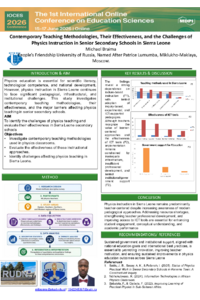
Physics education plays a critical role in developing scientific literacy, technological competence, and problem-solving skills among secondary school students. However, persistent challenges in pedagogy, resources, and institutional support continue to undermine effective physics instruction in many developing contexts. This study investigates contemporary teaching methodologies, their effectiveness, and the challenges of teaching physics in Sierra Leonean secondary schools. Using a mixed-methods approach, data were collected from 66 physics teachers across four geographic regions of the country through structured questionnaires and semi-structured interviews. Descriptive statistics were applied to survey responses, and qualitative insights from interviews were used to enrich interpretation. Findings reveal that group discussion was employed by approximately 61% of teachers, while problem-solving and critical-thinking exercises were used by 50%, suggesting partial integration of learner-centered strategies. Practically oriented methods, such as demonstrations and experiments, were reported by fewer than half of respondents (43.9%), indicating limited hands-on engagement in physics instruction.
Although teachers acknowledge the pedagogical value of practical, inquiry-driven, and ICT-supported instruction, their implementation is constrained by systemic barriers. The most frequently reported challenges include inadequate laboratory equipment and teaching resources (80.3%), large class sizes (68.2%), insufficient training in modern instructional methodologies (54.5%), limited instructional time (48.5%), and minimal access to ICT tools. Teachers who reported using digital tools and interactive strategies consistently perceived these tools and strategies as effective in enhancing student understanding and engagement (100%), suggesting that low adoption is driven by structural limitations rather than resistance to innovation. The study highlights a clear gap between recommended best practices in physics education and actual classroom implementation in Sierra Leone. Addressing these gaps requires coordinated policy interventions that provide resources, sustain teacher professional development, and support institutional frameworks. The findings provide evidence-based insights to inform educational reform efforts to improve the quality of physics instruction and student learning outcomes.
Keywords
Inquiry-Based Learning
Flipped Classroom
Physics Education
ICT tools
Demonstration method
Poster
Poster Doc Final.pdf
The Catalyst for Change: Preservice Educators' Transformative Learning Through a Short-Term Singapore Exchange Program: Insights from a UAE Context
Teach One, Do One, Then Do It Again: Preparing a Practice-Ready Social Work Workforce Through Online Education