Event submissions
Published
This submission belongs to the session S5. STEM Education of the event The 1st International Online Conference on Education Sciences
Published date
10 Jun, 2026
Academic Editor
'%3e%3cpath%20d='M12.6657%2010.9104C12.4185%2010.325%2012.0599%209.79327%2011.6097%209.34482C11.1609%208.89508%2010.6293%208.5365%2010.0442%208.28888C10.0389%208.28626%2010.0337%208.28495%2010.0285%208.28233C10.8446%207.69279%2011.3752%206.73249%2011.3752%205.64904C11.3752%203.8542%209.92103%202.39999%208.1262%202.39999C6.33136%202.39999%204.87715%203.8542%204.87715%205.64904C4.87715%206.73249%205.40774%207.69279%206.22393%208.28364C6.21869%208.28626%206.21345%208.28757%206.20821%208.29019C5.62129%208.5378%205.09463%208.89284%204.64265%209.34613C4.1929%209.79493%203.83432%2010.3266%203.58671%2010.9117C3.34345%2011.4845%203.21226%2012.0987%203.20023%2012.7209C3.19988%2012.7349%203.20233%2012.7488%203.20744%2012.7619C3.21255%2012.7749%203.22022%2012.7867%203.22998%2012.7968C3.23975%2012.8068%203.25142%2012.8147%203.26431%2012.8202C3.2772%2012.8256%203.29105%2012.8284%203.30504%2012.8284H4.09109C4.14874%2012.8284%204.19459%2012.7825%204.1959%2012.7262C4.2221%2011.7148%204.62823%2010.7676%205.34617%2010.0497C6.08899%209.30683%207.0755%208.89808%208.1262%208.89808C9.17689%208.89808%2010.1634%209.30683%2010.9062%2010.0497C11.6242%2010.7676%2012.0303%2011.7148%2012.0565%2012.7262C12.0578%2012.7838%2012.1037%2012.8284%2012.1613%2012.8284H12.9474C12.9613%2012.8284%2012.9752%2012.8256%2012.9881%2012.8202C13.001%2012.8147%2013.0126%2012.8068%2013.0224%2012.7968C13.0322%2012.7867%2013.0398%2012.7749%2013.0449%2012.7619C13.0501%2012.7488%2013.0525%2012.7349%2013.0522%2012.7209C13.0391%2012.0947%2012.9094%2011.4855%2012.6657%2010.9104ZM8.1262%207.9024C7.52486%207.9024%206.9589%207.6679%206.53312%207.24211C6.10733%206.81633%205.87283%206.25037%205.87283%205.64904C5.87283%205.0477%206.10733%204.48174%206.53312%204.05596C6.9589%203.63018%207.52486%203.39567%208.1262%203.39567C8.72753%203.39567%209.29349%203.63018%209.71927%204.05596C10.1451%204.48174%2010.3796%205.0477%2010.3796%205.64904C10.3796%206.25037%2010.1451%206.81633%209.71927%207.24211C9.29349%207.6679%208.72753%207.9024%208.1262%207.9024Z'%20fill='%235D1EE1'/%3e%3c/g%3e%3c/svg%3e) Daniel Muijs
Daniel MuijsCitation
Veera Gnaneswar Gude, Xiuling Wang, Mohammad Marufuzzaman, Cultivating the Future Agricultural Workforce through Interdisciplinary Innovation, in Proceedings of The 1st International Online Conference on Education Sciences, 15 June–17 June 2026, MDPI: Basel, Switzerland
Share
Email
Facebook
Twitter
LinkedIn
Cultivating the Future Agricultural Workforce through Interdisciplinary Innovation

Veera Gnaneswar Gude 1
'%3e%3cpath%20d='M12.6647%2010.9104C12.4176%2010.325%2012.0589%209.7933%2011.6088%209.34485C11.16%208.89511%2010.6283%208.53653%2010.0432%208.28891C10.038%208.28629%2010.0327%208.28498%2010.0275%208.28236C10.8437%207.69282%2011.3743%206.73252%2011.3743%205.64907C11.3743%203.85423%209.92005%202.40002%208.12522%202.40002C6.33038%202.40002%204.87618%203.85423%204.87618%205.64907C4.87618%206.73252%205.40677%207.69282%206.22296%208.28367C6.21772%208.28629%206.21248%208.2876%206.20724%208.29022C5.62031%208.53783%205.09365%208.89287%204.64167%209.34616C4.19192%209.79496%203.83334%2010.3266%203.58573%2010.9117C3.34247%2011.4846%203.21128%2012.0987%203.19925%2012.721C3.1989%2012.735%203.20135%2012.7489%203.20646%2012.7619C3.21157%2012.7749%203.21924%2012.7868%203.22901%2012.7968C3.23877%2012.8068%203.25045%2012.8148%203.26334%2012.8202C3.27623%2012.8256%203.29007%2012.8284%203.30406%2012.8284H4.09012C4.14776%2012.8284%204.19362%2012.7825%204.19493%2012.7262C4.22113%2011.7148%204.62726%2010.7676%205.34519%2010.0497C6.08802%209.30686%207.07452%208.89811%208.12522%208.89811C9.17592%208.89811%2010.1624%209.30686%2010.9052%2010.0497C11.6232%2010.7676%2012.0293%2011.7148%2012.0555%2012.7262C12.0568%2012.7839%2012.1027%2012.8284%2012.1603%2012.8284H12.9464C12.9604%2012.8284%2012.9742%2012.8256%2012.9871%2012.8202C13%2012.8148%2013.0117%2012.8068%2013.0214%2012.7968C13.0312%2012.7868%2013.0389%2012.7749%2013.044%2012.7619C13.0491%2012.7489%2013.0515%2012.735%2013.0512%2012.721C13.0381%2012.0947%2012.9084%2011.4856%2012.6647%2010.9104ZM8.12522%207.90243C7.52388%207.90243%206.95792%207.66793%206.53214%207.24215C6.10636%206.81636%205.87185%206.2504%205.87185%205.64907C5.87185%205.04773%206.10636%204.48177%206.53214%204.05599C6.95792%203.63021%207.52388%203.3957%208.12522%203.3957C8.72655%203.3957%209.29252%203.63021%209.7183%204.05599C10.1441%204.48177%2010.3786%205.04773%2010.3786%205.64907C10.3786%206.2504%2010.1441%206.81636%209.7183%207.24215C9.29252%207.66793%208.72655%207.90243%208.12522%207.90243Z'%20fill='%235D1EE1'/%3e%3c/g%3e%3c/svg%3e)
Xiuling Wang 2
Mohammad Marufuzzaman 3
1. Purdue University Northwest Water Institute, Purdue University Northwest, Hammond, IN 46323, USA, USA
2. Mechanical and Civil Engineering Department, Purdue University Northwest, Hammond, IN, USA, USA
3. Industrial and Systems Engineering Department, Mississippi State University, Mississippi State, MS, USA, USA
Abstract
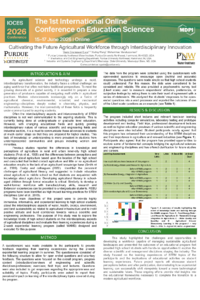
As agricultural science and technology undergo a rapid, interdisciplinary transformation, the industry faces a critical challenge: an aging workforce that often maintains traditional perspectives. To meet the growing demands of a global society, it is essential to prepare a new generation of producers capable of navigating swift shifts in agricultural practices. Modern advancements increasingly rely on a fusion of agricultural, chemical, environmental, industrial, and mechanical engineering—disciplines deeply rooted in chemistry, physics, and mathematics. However, the interconnectivity of these fields is frequently under-communicated to aspiring students.
A cohort-based undergraduate research program provided students with rich STEM learning experiences on topics such as mass and energy balances, heat and mass transfer phenomena, environmental sciences, and engineering related to wastewater treatment and environmental remediation. The generation of scientific data and inquiry in groups have offered diverse perspectives and allowed students to work across scales. The problem-solving approach is strengthened by the participation and teamwork of interdisciplinary teams in more realistic research. By designing a dynamic, cohort-based summer undergraduate research experience, these programs provided enriching activities that occur along the active learning continuum.
This presentation examines the challenges and opportunities in developing a workforce capable of managing sustainable agricultural landscapes. We highlight three research and education programs funded by USDA-NIFA that provided high school, community college, and undergraduate students with hands-on opportunities to explore the diverse scientific and management disciplines shaping the industry. The focus will be on the learning experiences of STEM topics of the participants and the implications of educational activities on student learning experiences. The presentation will showcase student perceptions before and after participation, demonstrating how experiential learning can successfully shift viewpoints toward a more technological and sustainable future. These ongoing efforts provide vital insights into the educational frameworks necessary to complete the transition to a modern agricultural workforce.
Keywords
Agriculture
Education
Experiential Learning
STEM
Workforce
Poster
Poster IOCES Gude.pdf
From Compliance to Reconfiguration: Reflective Writing and the Re-Education of Ethnic-Racial Relations in Pre-Service Teacher Formation at the Federal University of São Carlos (UFSCar), Brazil
The Chair to Chairperson Role of AI in Teaching and Learning: A Comprehensive Theoretical Academic Article