Event submissions
Published
This submission belongs to the session S1. Technology Enhanced Education of the event The 1st International Online Conference on Education Sciences
Published date
10 Jun, 2026
Academic Editor
'%3e%3cpath%20d='M12.6657%2010.9104C12.4185%2010.325%2012.0599%209.79327%2011.6097%209.34482C11.1609%208.89508%2010.6293%208.5365%2010.0442%208.28888C10.0389%208.28626%2010.0337%208.28495%2010.0285%208.28233C10.8446%207.69279%2011.3752%206.73249%2011.3752%205.64904C11.3752%203.8542%209.92103%202.39999%208.1262%202.39999C6.33136%202.39999%204.87715%203.8542%204.87715%205.64904C4.87715%206.73249%205.40774%207.69279%206.22393%208.28364C6.21869%208.28626%206.21345%208.28757%206.20821%208.29019C5.62129%208.5378%205.09463%208.89284%204.64265%209.34613C4.1929%209.79493%203.83432%2010.3266%203.58671%2010.9117C3.34345%2011.4845%203.21226%2012.0987%203.20023%2012.7209C3.19988%2012.7349%203.20233%2012.7488%203.20744%2012.7619C3.21255%2012.7749%203.22022%2012.7867%203.22998%2012.7968C3.23975%2012.8068%203.25142%2012.8147%203.26431%2012.8202C3.2772%2012.8256%203.29105%2012.8284%203.30504%2012.8284H4.09109C4.14874%2012.8284%204.19459%2012.7825%204.1959%2012.7262C4.2221%2011.7148%204.62823%2010.7676%205.34617%2010.0497C6.08899%209.30683%207.0755%208.89808%208.1262%208.89808C9.17689%208.89808%2010.1634%209.30683%2010.9062%2010.0497C11.6242%2010.7676%2012.0303%2011.7148%2012.0565%2012.7262C12.0578%2012.7838%2012.1037%2012.8284%2012.1613%2012.8284H12.9474C12.9613%2012.8284%2012.9752%2012.8256%2012.9881%2012.8202C13.001%2012.8147%2013.0126%2012.8068%2013.0224%2012.7968C13.0322%2012.7867%2013.0398%2012.7749%2013.0449%2012.7619C13.0501%2012.7488%2013.0525%2012.7349%2013.0522%2012.7209C13.0391%2012.0947%2012.9094%2011.4855%2012.6657%2010.9104ZM8.1262%207.9024C7.52486%207.9024%206.9589%207.6679%206.53312%207.24211C6.10733%206.81633%205.87283%206.25037%205.87283%205.64904C5.87283%205.0477%206.10733%204.48174%206.53312%204.05596C6.9589%203.63018%207.52486%203.39567%208.1262%203.39567C8.72753%203.39567%209.29349%203.63018%209.71927%204.05596C10.1451%204.48174%2010.3796%205.0477%2010.3796%205.64904C10.3796%206.25037%2010.1451%206.81633%209.71927%207.24211C9.29349%207.6679%208.72753%207.9024%208.1262%207.9024Z'%20fill='%235D1EE1'/%3e%3c/g%3e%3c/svg%3e) Mike Joy
Mike JoyCitation
DR. JYOTINDRA MIRDDA, Dr. Kriti Ranjan Sahu, Technology-Enhanced Learning through Smartphone Experiments: Teaching Optical Absorption in Resource-Limited Classrooms, in Proceedings of The 1st International Online Conference on Education Sciences, 15 June–17 June 2026, MDPI: Basel, Switzerland
Share
Email
Facebook
Twitter
LinkedIn
Technology-Enhanced Learning through Smartphone Experiments: Teaching Optical Absorption in Resource-Limited Classrooms
'%3e%3cpath%20d='M12.6647%2010.9104C12.4176%2010.325%2012.0589%209.7933%2011.6088%209.34485C11.16%208.89511%2010.6283%208.53653%2010.0432%208.28891C10.038%208.28629%2010.0327%208.28498%2010.0275%208.28236C10.8437%207.69282%2011.3743%206.73252%2011.3743%205.64907C11.3743%203.85423%209.92005%202.40002%208.12522%202.40002C6.33038%202.40002%204.87618%203.85423%204.87618%205.64907C4.87618%206.73252%205.40677%207.69282%206.22296%208.28367C6.21772%208.28629%206.21248%208.2876%206.20724%208.29022C5.62031%208.53783%205.09365%208.89287%204.64167%209.34616C4.19192%209.79496%203.83334%2010.3266%203.58573%2010.9117C3.34247%2011.4846%203.21128%2012.0987%203.19925%2012.721C3.1989%2012.735%203.20135%2012.7489%203.20646%2012.7619C3.21157%2012.7749%203.21924%2012.7868%203.22901%2012.7968C3.23877%2012.8068%203.25045%2012.8148%203.26334%2012.8202C3.27623%2012.8256%203.29007%2012.8284%203.30406%2012.8284H4.09012C4.14776%2012.8284%204.19362%2012.7825%204.19493%2012.7262C4.22113%2011.7148%204.62726%2010.7676%205.34519%2010.0497C6.08802%209.30686%207.07452%208.89811%208.12522%208.89811C9.17592%208.89811%2010.1624%209.30686%2010.9052%2010.0497C11.6232%2010.7676%2012.0293%2011.7148%2012.0555%2012.7262C12.0568%2012.7839%2012.1027%2012.8284%2012.1603%2012.8284H12.9464C12.9604%2012.8284%2012.9742%2012.8256%2012.9871%2012.8202C13%2012.8148%2013.0117%2012.8068%2013.0214%2012.7968C13.0312%2012.7868%2013.0389%2012.7749%2013.044%2012.7619C13.0491%2012.7489%2013.0515%2012.735%2013.0512%2012.721C13.0381%2012.0947%2012.9084%2011.4856%2012.6647%2010.9104ZM8.12522%207.90243C7.52388%207.90243%206.95792%207.66793%206.53214%207.24215C6.10636%206.81636%205.87185%206.2504%205.87185%205.64907C5.87185%205.04773%206.10636%204.48177%206.53214%204.05599C6.95792%203.63021%207.52388%203.3957%208.12522%203.3957C8.72655%203.3957%209.29252%203.63021%209.7183%204.05599C10.1441%204.48177%2010.3786%205.04773%2010.3786%205.64907C10.3786%206.2504%2010.1441%206.81636%209.7183%207.24215C9.29252%207.66793%208.72655%207.90243%208.12522%207.90243Z'%20fill='%235D1EE1'/%3e%3c/g%3e%3c/svg%3e)
DR. JYOTINDRA MIRDDA 1
Dr. Kriti Ranjan Sahu 2
1. Physics, Naraharipur Primary School, Khudi, 721429, India, India
2. Physics, Bhatter College, Dantan, 721426, India, India
Abstract
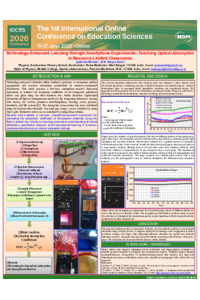
Introduction: Technology-enhanced education offers inclusive pathways to strengthen student engagement and research orientation, particularly in resource-constrained laboratories. This study presents a low-cost, smartphone-assisted classroom experiment to estimate the absorption coefficient (α) of transparent polymeric sheets and glass using the Beer–Lambert law, which describes exponential attenuation of light in homogeneous media [1]. By integrating luminance sensing with theory, the activity promotes interdisciplinary learning across physics, chemistry, and life sciences.
Methods: A compact setup was built using a paper box, colored transparent poly-paper of varying thicknesses (x), a black circular ring/disc target, and a smartphone running the phyphox (free) app [2]. Reflected luminance was recorded without (I₀) and with (I) the sample covering the target. The absorption coefficient was computed as α = ln(I₀/I)/x. Measurements were repeated for different colors and thicknesses to probe wavelength-dependent attenuation.
Results and Discussion: The observed attenuation followed the Beer–Lambert trend, and estimated α values showed clear wavelength dependence, reinforcing concepts of optical absorption and material response. Students demonstrated gains in conceptual clarity, quantitative reasoning, and experimental design. The approach also shows promise for low-cost exploratory screening of surface changes in plant leaves, indicating potential for interdisciplinary extensions in biology and environmental science.
Conclusions: The proposed method provides an accessible, inclusive, and cost-effective pathway to teach optical absorption using everyday devices. It supports inquiry-based learning, boosts engagement in under-resourced settings, and aligns with technology-enhanced education for Special and Inclusive Education contexts.
References:
[1] Born, M., & Wolf, E. (1999). Principles of optics: Electromagnetic theory of propagation, interference and diffraction of light (7th ed.). Cambridge University Press.
[2] Staacks, S., Hütz, S., Heinke, H., & Stampfer, C. (2018). phyphox: A smartphone-based experimental toolbox for physics education. Physics Education, 53(4), 045009. https://doi.org/10.1088/1361-6552/aac05e
Keywords
Smartphone-based learning
Physics education research
Optical absorption measurement
Inquiry-based learning
Inclusive education
Poster
173222 Mirdda & Sahu IOCES 2026.pdf
PREPARED OR UNPREPARED? EXAMINING THE EFFECTIVENESS OF SPECIAL EDUCATIONAL NEEDS TEACHER TRAINING PROGRAMS IN INCLUSIVE EDUCATION CONTEXT
Educational Time and Knowledge: Between Chronos and Kairós