Event submissions
Published
This submission belongs to the session S2. Higher Education of the event The 1st International Online Conference on Education Sciences
Published date
10 Jun, 2026
Academic Editor
'%3e%3cpath%20d='M12.6657%2010.9104C12.4185%2010.325%2012.0599%209.79327%2011.6097%209.34482C11.1609%208.89508%2010.6293%208.5365%2010.0442%208.28888C10.0389%208.28626%2010.0337%208.28495%2010.0285%208.28233C10.8446%207.69279%2011.3752%206.73249%2011.3752%205.64904C11.3752%203.8542%209.92103%202.39999%208.1262%202.39999C6.33136%202.39999%204.87715%203.8542%204.87715%205.64904C4.87715%206.73249%205.40774%207.69279%206.22393%208.28364C6.21869%208.28626%206.21345%208.28757%206.20821%208.29019C5.62129%208.5378%205.09463%208.89284%204.64265%209.34613C4.1929%209.79493%203.83432%2010.3266%203.58671%2010.9117C3.34345%2011.4845%203.21226%2012.0987%203.20023%2012.7209C3.19988%2012.7349%203.20233%2012.7488%203.20744%2012.7619C3.21255%2012.7749%203.22022%2012.7867%203.22998%2012.7968C3.23975%2012.8068%203.25142%2012.8147%203.26431%2012.8202C3.2772%2012.8256%203.29105%2012.8284%203.30504%2012.8284H4.09109C4.14874%2012.8284%204.19459%2012.7825%204.1959%2012.7262C4.2221%2011.7148%204.62823%2010.7676%205.34617%2010.0497C6.08899%209.30683%207.0755%208.89808%208.1262%208.89808C9.17689%208.89808%2010.1634%209.30683%2010.9062%2010.0497C11.6242%2010.7676%2012.0303%2011.7148%2012.0565%2012.7262C12.0578%2012.7838%2012.1037%2012.8284%2012.1613%2012.8284H12.9474C12.9613%2012.8284%2012.9752%2012.8256%2012.9881%2012.8202C13.001%2012.8147%2013.0126%2012.8068%2013.0224%2012.7968C13.0322%2012.7867%2013.0398%2012.7749%2013.0449%2012.7619C13.0501%2012.7488%2013.0525%2012.7349%2013.0522%2012.7209C13.0391%2012.0947%2012.9094%2011.4855%2012.6657%2010.9104ZM8.1262%207.9024C7.52486%207.9024%206.9589%207.6679%206.53312%207.24211C6.10733%206.81633%205.87283%206.25037%205.87283%205.64904C5.87283%205.0477%206.10733%204.48174%206.53312%204.05596C6.9589%203.63018%207.52486%203.39567%208.1262%203.39567C8.72753%203.39567%209.29349%203.63018%209.71927%204.05596C10.1451%204.48174%2010.3796%205.0477%2010.3796%205.64904C10.3796%206.25037%2010.1451%206.81633%209.71927%207.24211C9.29349%207.6679%208.72753%207.9024%208.1262%207.9024Z'%20fill='%235D1EE1'/%3e%3c/g%3e%3c/svg%3e) EMILIO ABAD-SEGURA
EMILIO ABAD-SEGURACitation
Oyebode Stephen Oyetoro, Taiwo Esther Eludini, Perception of the use of ChatGPT in academic work among undergraduate students in Obafemi Awolowo University, Ile-Ife, Nigeria, in Proceedings of The 1st International Online Conference on Education Sciences, 15 June–17 June 2026, MDPI: Basel, Switzerland
Share
Email
Facebook
Twitter
LinkedIn
Perception of the use of ChatGPT in academic work among undergraduate students in Obafemi Awolowo University, Ile-Ife, Nigeria

Oyebode Stephen Oyetoro 1
'%3e%3cpath%20d='M12.6647%2010.9104C12.4176%2010.325%2012.0589%209.7933%2011.6088%209.34485C11.16%208.89511%2010.6283%208.53653%2010.0432%208.28891C10.038%208.28629%2010.0327%208.28498%2010.0275%208.28236C10.8437%207.69282%2011.3743%206.73252%2011.3743%205.64907C11.3743%203.85423%209.92005%202.40002%208.12522%202.40002C6.33038%202.40002%204.87618%203.85423%204.87618%205.64907C4.87618%206.73252%205.40677%207.69282%206.22296%208.28367C6.21772%208.28629%206.21248%208.2876%206.20724%208.29022C5.62031%208.53783%205.09365%208.89287%204.64167%209.34616C4.19192%209.79496%203.83334%2010.3266%203.58573%2010.9117C3.34247%2011.4846%203.21128%2012.0987%203.19925%2012.721C3.1989%2012.735%203.20135%2012.7489%203.20646%2012.7619C3.21157%2012.7749%203.21924%2012.7868%203.22901%2012.7968C3.23877%2012.8068%203.25045%2012.8148%203.26334%2012.8202C3.27623%2012.8256%203.29007%2012.8284%203.30406%2012.8284H4.09012C4.14776%2012.8284%204.19362%2012.7825%204.19493%2012.7262C4.22113%2011.7148%204.62726%2010.7676%205.34519%2010.0497C6.08802%209.30686%207.07452%208.89811%208.12522%208.89811C9.17592%208.89811%2010.1624%209.30686%2010.9052%2010.0497C11.6232%2010.7676%2012.0293%2011.7148%2012.0555%2012.7262C12.0568%2012.7839%2012.1027%2012.8284%2012.1603%2012.8284H12.9464C12.9604%2012.8284%2012.9742%2012.8256%2012.9871%2012.8202C13%2012.8148%2013.0117%2012.8068%2013.0214%2012.7968C13.0312%2012.7868%2013.0389%2012.7749%2013.044%2012.7619C13.0491%2012.7489%2013.0515%2012.735%2013.0512%2012.721C13.0381%2012.0947%2012.9084%2011.4856%2012.6647%2010.9104ZM8.12522%207.90243C7.52388%207.90243%206.95792%207.66793%206.53214%207.24215C6.10636%206.81636%205.87185%206.2504%205.87185%205.64907C5.87185%205.04773%206.10636%204.48177%206.53214%204.05599C6.95792%203.63021%207.52388%203.3957%208.12522%203.3957C8.72655%203.3957%209.29252%203.63021%209.7183%204.05599C10.1441%204.48177%2010.3786%205.04773%2010.3786%205.64907C10.3786%206.2504%2010.1441%206.81636%209.7183%207.24215C9.29252%207.66793%208.72655%207.90243%208.12522%207.90243Z'%20fill='%235D1EE1'/%3e%3c/g%3e%3c/svg%3e)
Taiwo Esther Eludini 1
1. Department of Arts and Social Science Education, Faculty of Education, Obafemi Awolowo University, Ile-Ife, Nigeria, Nigeria
Abstract
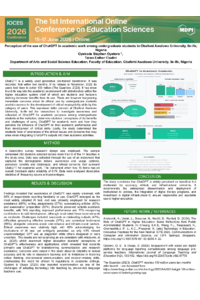
This study investigated undergraduate students’ awareness and utilization of ChatGPT for academic purposes among undergraduate students at Obafemi Awolowo University. It also determined their perceptions of the benefits and challenges of using ChatGPT for academic work; how the students perceive the influence of ChatGPT on their academic performance and their development of critical skills; and students’ level of awareness of the ethical issues and concerns that may arise when integrating ChatGPT's outputs into their academic activities.
A descriptive survey research design was employed. The sample comprised 380 students selected across more than 8 of the 14 faculties in the study area. Data was collected through the use of an instrument that captured the demographic details, awareness and usage patterns, perceived benefits and challenges, and ethical concerns tthat surround ChatGPT for academic work. Data were analysed using descriptive statistics.
Findings revealed that awareness of ChatGPT was nearly universal, with 93% of respondents reporting familiarity or use. ChatGPT emerged as the most widely adopted AI tool, and was primarily employed for research assistance (69%), writing assignments (57%), summarizing articles (42%), and examination preparation (39%). Students perceived notable academic benefits, with 74% reporting improved performance and 77% recognizing contributions to skill development, although most rated these improvements as moderate. Challenges included inaccurate or misleading outputs (47%), difficulties generating effective prompts (37%), and contextual irrelevance (56%), alongside concerns about over-reliance and infrastructural barriers. Ethical awareness was relatively high, with 66% acknowledging the implications of AI use, yet ambiguity persisted, as only 43% viewed unacknowledged GPT use as plagiarism while others disagreed or were uncertain.
The study concludes that ChatGPT is widely perceived as beneficial but moderated by accuracy, ethical, and infrastructural concerns. It recommends the widespread dissemination and deployment of institutional AI policies, the integration of digital literacy programs, and investment in digital infrastructure to ensure responsible and equitable use in higher education.
Keywords
ChatGPT for academic work
higher education
undergraduate education
AI policy
AI literacy
digital infrastructure
digital literacy
Poster
Perception of the use of ChatGPT in academic work (1).pdf
Is Self-Perceived Data Literacy Psychometrically Defensible? Evidence from Data Literacy Self-Perception Questionnaire Validation
Declared religious beliefs and attitudes toward science among the public in Chile