Event submissions
Published
This submission belongs to the session S3. Curriculum and Instruction of the event The 1st International Online Conference on Education Sciences
Published date
10 Jun, 2026
Academic Editor
'%3e%3cpath%20d='M12.6657%2010.9104C12.4185%2010.325%2012.0599%209.79327%2011.6097%209.34482C11.1609%208.89508%2010.6293%208.5365%2010.0442%208.28888C10.0389%208.28626%2010.0337%208.28495%2010.0285%208.28233C10.8446%207.69279%2011.3752%206.73249%2011.3752%205.64904C11.3752%203.8542%209.92103%202.39999%208.1262%202.39999C6.33136%202.39999%204.87715%203.8542%204.87715%205.64904C4.87715%206.73249%205.40774%207.69279%206.22393%208.28364C6.21869%208.28626%206.21345%208.28757%206.20821%208.29019C5.62129%208.5378%205.09463%208.89284%204.64265%209.34613C4.1929%209.79493%203.83432%2010.3266%203.58671%2010.9117C3.34345%2011.4845%203.21226%2012.0987%203.20023%2012.7209C3.19988%2012.7349%203.20233%2012.7488%203.20744%2012.7619C3.21255%2012.7749%203.22022%2012.7867%203.22998%2012.7968C3.23975%2012.8068%203.25142%2012.8147%203.26431%2012.8202C3.2772%2012.8256%203.29105%2012.8284%203.30504%2012.8284H4.09109C4.14874%2012.8284%204.19459%2012.7825%204.1959%2012.7262C4.2221%2011.7148%204.62823%2010.7676%205.34617%2010.0497C6.08899%209.30683%207.0755%208.89808%208.1262%208.89808C9.17689%208.89808%2010.1634%209.30683%2010.9062%2010.0497C11.6242%2010.7676%2012.0303%2011.7148%2012.0565%2012.7262C12.0578%2012.7838%2012.1037%2012.8284%2012.1613%2012.8284H12.9474C12.9613%2012.8284%2012.9752%2012.8256%2012.9881%2012.8202C13.001%2012.8147%2013.0126%2012.8068%2013.0224%2012.7968C13.0322%2012.7867%2013.0398%2012.7749%2013.0449%2012.7619C13.0501%2012.7488%2013.0525%2012.7349%2013.0522%2012.7209C13.0391%2012.0947%2012.9094%2011.4855%2012.6657%2010.9104ZM8.1262%207.9024C7.52486%207.9024%206.9589%207.6679%206.53312%207.24211C6.10733%206.81633%205.87283%206.25037%205.87283%205.64904C5.87283%205.0477%206.10733%204.48174%206.53312%204.05596C6.9589%203.63018%207.52486%203.39567%208.1262%203.39567C8.72753%203.39567%209.29349%203.63018%209.71927%204.05596C10.1451%204.48174%2010.3796%205.0477%2010.3796%205.64904C10.3796%206.25037%2010.1451%206.81633%209.71927%207.24211C9.29349%207.6679%208.72753%207.9024%208.1262%207.9024Z'%20fill='%235D1EE1'/%3e%3c/g%3e%3c/svg%3e) Honggang Liu
Honggang LiuCitation
Muhammad Nabeel Ghayur, Ayesha Ghayur, Pharmacology Curriculum Transformation from a Discipline-Based to a Systems-Based Model in an Osteopathic Medical School, in Proceedings of The 1st International Online Conference on Education Sciences, 15 June–17 June 2026, MDPI: Basel, Switzerland
Share
Email
Facebook
Twitter
LinkedIn
Pharmacology Curriculum Transformation from a Discipline-Based to a Systems-Based Model in an Osteopathic Medical School

Muhammad Nabeel Ghayur 1
'%3e%3cpath%20d='M12.6647%2010.9104C12.4176%2010.325%2012.0589%209.7933%2011.6088%209.34485C11.16%208.89511%2010.6283%208.53653%2010.0432%208.28891C10.038%208.28629%2010.0327%208.28498%2010.0275%208.28236C10.8437%207.69282%2011.3743%206.73252%2011.3743%205.64907C11.3743%203.85423%209.92005%202.40002%208.12522%202.40002C6.33038%202.40002%204.87618%203.85423%204.87618%205.64907C4.87618%206.73252%205.40677%207.69282%206.22296%208.28367C6.21772%208.28629%206.21248%208.2876%206.20724%208.29022C5.62031%208.53783%205.09365%208.89287%204.64167%209.34616C4.19192%209.79496%203.83334%2010.3266%203.58573%2010.9117C3.34247%2011.4846%203.21128%2012.0987%203.19925%2012.721C3.1989%2012.735%203.20135%2012.7489%203.20646%2012.7619C3.21157%2012.7749%203.21924%2012.7868%203.22901%2012.7968C3.23877%2012.8068%203.25045%2012.8148%203.26334%2012.8202C3.27623%2012.8256%203.29007%2012.8284%203.30406%2012.8284H4.09012C4.14776%2012.8284%204.19362%2012.7825%204.19493%2012.7262C4.22113%2011.7148%204.62726%2010.7676%205.34519%2010.0497C6.08802%209.30686%207.07452%208.89811%208.12522%208.89811C9.17592%208.89811%2010.1624%209.30686%2010.9052%2010.0497C11.6232%2010.7676%2012.0293%2011.7148%2012.0555%2012.7262C12.0568%2012.7839%2012.1027%2012.8284%2012.1603%2012.8284H12.9464C12.9604%2012.8284%2012.9742%2012.8256%2012.9871%2012.8202C13%2012.8148%2013.0117%2012.8068%2013.0214%2012.7968C13.0312%2012.7868%2013.0389%2012.7749%2013.044%2012.7619C13.0491%2012.7489%2013.0515%2012.735%2013.0512%2012.721C13.0381%2012.0947%2012.9084%2011.4856%2012.6647%2010.9104ZM8.12522%207.90243C7.52388%207.90243%206.95792%207.66793%206.53214%207.24215C6.10636%206.81636%205.87185%206.2504%205.87185%205.64907C5.87185%205.04773%206.10636%204.48177%206.53214%204.05599C6.95792%203.63021%207.52388%203.3957%208.12522%203.3957C8.72655%203.3957%209.29252%203.63021%209.7183%204.05599C10.1441%204.48177%2010.3786%205.04773%2010.3786%205.64907C10.3786%206.2504%2010.1441%206.81636%209.7183%207.24215C9.29252%207.66793%208.72655%207.90243%208.12522%207.90243Z'%20fill='%235D1EE1'/%3e%3c/g%3e%3c/svg%3e)
Ayesha Ghayur 1
1. Kentucky College of Osteopathic Medicine, University of Pikeville, Pikeville, 147 Sycamore Street, 41501, Kentucky, USA., USA
Abstract
Background:
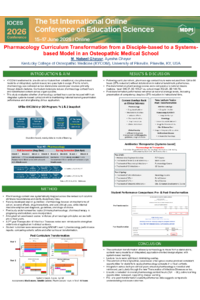
Recently, the University of Pikeville transformed its pre-clinical curriculum from a traditional, discipline-based model to an integrated, system-based, two-pass hybrid design. Prior to this reform, pharmacology was delivered as two stand-alone second-year courses, primarily through didactic lectures. The curriculum redesign reduced pharmacology contact hours and redistributed content across organ systems.
Objective:
This study evaluates whether pharmacology contact hours can be reduced within an integrated systems-based curriculum while maintaining national licensing examination performance and strengthening clinical application.
Methods:
Pharmacology content was systematically mapped across the revised curriculum to eliminate redundancies and clarify disciplinary roles. Faculty developed explicit guidelines: pharmacology focused on mechanisms of action, adverse effects, drug interactions, and core clinical uses, while internal medicine emphasized diagnosis, guidelines, and drugs of choice. Previously underrepresented topics (e.g., immunopharmacology and pharmacotherapy in pregnancy and lactation) were incorporated. A longitudinal case-based course reinforced pharmacologic principles across both pre-clinical years, and a second-year Therapeutics of Infectious Diseases series was introduced to strengthen antimicrobial application in clinical contexts. Student outcomes were assessed using NBOME Level 1 pharmacology performance reports, comparing cohorts before and after curricular transformation.
Results:
Following curricular reform, pharmacology contact hours were successfully reduced from 124 to 90 hours (a 27% reduction) without deterioration in national benchmark performance. Pre-transformation pharmacology scores were comparable to national means (national mean 549.07, SD 155.21 vs. school mean 502.25, SD 140.76). Post-transformation performance remained at national average levels, indicating the preservation of pharmacology competency despite a 27% reduction in instructional time.
Conclusions:
Strategic content mapping and longitudinal integration allow for a meaningful reduction in pharmacology contact hours while maintaining national examination performance. Embedding pharmacology within a two-pass, hybrid systems curriculum promotes efficiency and strengthens clinical application. Continued longitudinal assessment will further evaluate retention and clinical impact.
Keywords
Medical education
pharmacology
systems-based
curriculum transformation
Poster
Pharm Curr Transform-MNGhayur.pdf
Proximal Factors in Extracurricular Science Programs: Insights from Teachers’ Discourse
"Slacking" or "Empowering"? The Dual Impact of AI Programming Assistants on the Development of Undergraduate Students' Computational Thinking