Event submissions
Published
This submission belongs to the session S2. Nanotoxicology and Targeted Pharmacology of Nanomaterials of the event The 1st International Online Conference on Xenobiotics
Published date
17 Jun, 2026
Academic Editor
'%3e%3cpath%20d='M12.6657%2010.9104C12.4185%2010.325%2012.0599%209.79327%2011.6097%209.34482C11.1609%208.89508%2010.6293%208.5365%2010.0442%208.28888C10.0389%208.28626%2010.0337%208.28495%2010.0285%208.28233C10.8446%207.69279%2011.3752%206.73249%2011.3752%205.64904C11.3752%203.8542%209.92103%202.39999%208.1262%202.39999C6.33136%202.39999%204.87715%203.8542%204.87715%205.64904C4.87715%206.73249%205.40774%207.69279%206.22393%208.28364C6.21869%208.28626%206.21345%208.28757%206.20821%208.29019C5.62129%208.5378%205.09463%208.89284%204.64265%209.34613C4.1929%209.79493%203.83432%2010.3266%203.58671%2010.9117C3.34345%2011.4845%203.21226%2012.0987%203.20023%2012.7209C3.19988%2012.7349%203.20233%2012.7488%203.20744%2012.7619C3.21255%2012.7749%203.22022%2012.7867%203.22998%2012.7968C3.23975%2012.8068%203.25142%2012.8147%203.26431%2012.8202C3.2772%2012.8256%203.29105%2012.8284%203.30504%2012.8284H4.09109C4.14874%2012.8284%204.19459%2012.7825%204.1959%2012.7262C4.2221%2011.7148%204.62823%2010.7676%205.34617%2010.0497C6.08899%209.30683%207.0755%208.89808%208.1262%208.89808C9.17689%208.89808%2010.1634%209.30683%2010.9062%2010.0497C11.6242%2010.7676%2012.0303%2011.7148%2012.0565%2012.7262C12.0578%2012.7838%2012.1037%2012.8284%2012.1613%2012.8284H12.9474C12.9613%2012.8284%2012.9752%2012.8256%2012.9881%2012.8202C13.001%2012.8147%2013.0126%2012.8068%2013.0224%2012.7968C13.0322%2012.7867%2013.0398%2012.7749%2013.0449%2012.7619C13.0501%2012.7488%2013.0525%2012.7349%2013.0522%2012.7209C13.0391%2012.0947%2012.9094%2011.4855%2012.6657%2010.9104ZM8.1262%207.9024C7.52486%207.9024%206.9589%207.6679%206.53312%207.24211C6.10733%206.81633%205.87283%206.25037%205.87283%205.64904C5.87283%205.0477%206.10733%204.48174%206.53312%204.05596C6.9589%203.63018%207.52486%203.39567%208.1262%203.39567C8.72753%203.39567%209.29349%203.63018%209.71927%204.05596C10.1451%204.48174%2010.3796%205.0477%2010.3796%205.64904C10.3796%206.25037%2010.1451%206.81633%209.71927%207.24211C9.29349%207.6679%208.72753%207.9024%208.1262%207.9024Z'%20fill='%235D1EE1'/%3e%3c/g%3e%3c/svg%3e) Keith Brunt
Keith BruntCitation
Arisbel Cerpa-Naranjo, María Fuencisla Guilsanz-Muñoz, Javier Perez-Piñeiro, Maria S. Fernandez-Alfonso, Marta Sanz-Gómez, Elvira Bragado-García, Study of the cytotoxicity of pegylated expanded graphene oxide in human endothelial cells, in Proceedings of The 1st International Online Conference on Xenobiotics, 22 June–23 June 2026, MDPI: Basel, Switzerland
Share
Email
Facebook
Twitter
LinkedIn
Study of the cytotoxicity of pegylated expanded graphene oxide in human endothelial cells

Arisbel Cerpa-Naranjo 1
'%3e%3cpath%20d='M12.6647%2010.9104C12.4176%2010.325%2012.0589%209.7933%2011.6088%209.34485C11.16%208.89511%2010.6283%208.53653%2010.0432%208.28891C10.038%208.28629%2010.0327%208.28498%2010.0275%208.28236C10.8437%207.69282%2011.3743%206.73252%2011.3743%205.64907C11.3743%203.85423%209.92005%202.40002%208.12522%202.40002C6.33038%202.40002%204.87618%203.85423%204.87618%205.64907C4.87618%206.73252%205.40677%207.69282%206.22296%208.28367C6.21772%208.28629%206.21248%208.2876%206.20724%208.29022C5.62031%208.53783%205.09365%208.89287%204.64167%209.34616C4.19192%209.79496%203.83334%2010.3266%203.58573%2010.9117C3.34247%2011.4846%203.21128%2012.0987%203.19925%2012.721C3.1989%2012.735%203.20135%2012.7489%203.20646%2012.7619C3.21157%2012.7749%203.21924%2012.7868%203.22901%2012.7968C3.23877%2012.8068%203.25045%2012.8148%203.26334%2012.8202C3.27623%2012.8256%203.29007%2012.8284%203.30406%2012.8284H4.09012C4.14776%2012.8284%204.19362%2012.7825%204.19493%2012.7262C4.22113%2011.7148%204.62726%2010.7676%205.34519%2010.0497C6.08802%209.30686%207.07452%208.89811%208.12522%208.89811C9.17592%208.89811%2010.1624%209.30686%2010.9052%2010.0497C11.6232%2010.7676%2012.0293%2011.7148%2012.0555%2012.7262C12.0568%2012.7839%2012.1027%2012.8284%2012.1603%2012.8284H12.9464C12.9604%2012.8284%2012.9742%2012.8256%2012.9871%2012.8202C13%2012.8148%2013.0117%2012.8068%2013.0214%2012.7968C13.0312%2012.7868%2013.0389%2012.7749%2013.044%2012.7619C13.0491%2012.7489%2013.0515%2012.735%2013.0512%2012.721C13.0381%2012.0947%2012.9084%2011.4856%2012.6647%2010.9104ZM8.12522%207.90243C7.52388%207.90243%206.95792%207.66793%206.53214%207.24215C6.10636%206.81636%205.87185%206.2504%205.87185%205.64907C5.87185%205.04773%206.10636%204.48177%206.53214%204.05599C6.95792%203.63021%207.52388%203.3957%208.12522%203.3957C8.72655%203.3957%209.29252%203.63021%209.7183%204.05599C10.1441%204.48177%2010.3786%205.04773%2010.3786%205.64907C10.3786%206.2504%2010.1441%206.81636%209.7183%207.24215C9.29252%207.66793%208.72655%207.90243%208.12522%207.90243Z'%20fill='%235D1EE1'/%3e%3c/g%3e%3c/svg%3e)
María Fuencisla Guilsanz-Muñoz 2
Javier Perez-Piñeiro 2
Maria S. Fernandez-Alfonso 3
Marta Sanz-Gómez 3

Elvira Bragado-García 3
1. Department of Engineering. School of Architecture, Engineering, Science and Computing European University, Villaviciosa de Odón 28670, Madrid. Spain
2. Department of Sciences and Aerospatial, School of Architecture, Engineering, Science and Computing. European University, Villaviciosa de Odón 28670, Madrid, Spain
3. Pluridisciplinary Institute. Complutense University of Madrid. Madrid 28040. Spain
Abstract
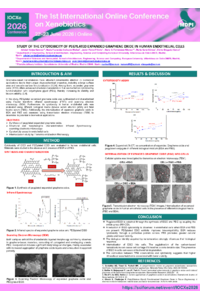
Carbon-based nanomaterials have attracted significant attention in biomedical research due to their unique properties and versatility. PEGylation has been widely used to improve graphene oxide stability and reduce toxicity in vitro, with PEG-GO showing low cytotoxicity in lymphoma cells and enhanced colloidal behavior in biological media. However, studies also indicate that PEGylated composites can interact with endothelial models under pathophysiological conditions, and surface modifications influence cellular uptake and internalization patterns.
In this study, pegylated expanded graphene oxide (EGO-PEG) was synthesized from expanded graphene oxide (EGO) to evaluate the impact of PEG functionalization on cytotoxicity in human endothelial cells. Structural and morphological characterization was performed using Infrared Spectroscopy (IR), Raman Spectroscopy (RS), Scanning Electron Microscopy (SEM), Transmission Electron Microscopy (TEM), and Atomic Force Microscopy (AFM), confirming successful PEG conjugation through amide (NH–CO) bond formation.
Cytotoxicity was assessed in EA.hy926 endothelial cells cultured in DMEM, BSA, and FBS using the MTT assay. EGO-PEG exhibited reduced cytotoxicity and higher cell viability compared to non-pegylated EGO. However, no significant decrease in toxicity was observed in protein-rich media (FBS or BSA). TEM micrographs revealed EGO internalization within cytoplasmic vacuoles, indicating effective cellular uptake. Cell viability was primarily influenced by nanoparticle size, shape, and concentration, and intracellular EGO accumulation may contribute to mitochondrial dysfunction.
These findings demonstrate that PEG functionalization enhances the cytocompatibility of expanded graphene oxide, supporting its potential in nanomedical applications.
Keywords
expended graphene oxide
endothelial cell
internalization
pegylated
Poster
STUDY OF THE CYTOTOXICITY OF PEGYLATED EXPANDED GRAPHENE OXIDE IN HUMAN ENDOTHELIAL CELLS- ARISBEL CERPA.pdf
Turmeric Phyto-NanoParticle (TPNP) enhances cellular bioavailability and anti-inflammatory effect of curcuminoids in human monocytes/macrophages
Marine-Derived Silver Nanoparticles for Aquaculture: A Systematic Evaluation of Synthesis–Performance Relationships and Nanotoxicological Implications