Event submissions
Published
This submission belongs to the session S3. Emerging Chemicals: Environment Risks and Health Effects of the event The 1st International Online Conference on Xenobiotics
Published date
17 Jun, 2026
Academic Editor
'%3e%3cpath%20d='M12.6657%2010.9104C12.4185%2010.325%2012.0599%209.79327%2011.6097%209.34482C11.1609%208.89508%2010.6293%208.5365%2010.0442%208.28888C10.0389%208.28626%2010.0337%208.28495%2010.0285%208.28233C10.8446%207.69279%2011.3752%206.73249%2011.3752%205.64904C11.3752%203.8542%209.92103%202.39999%208.1262%202.39999C6.33136%202.39999%204.87715%203.8542%204.87715%205.64904C4.87715%206.73249%205.40774%207.69279%206.22393%208.28364C6.21869%208.28626%206.21345%208.28757%206.20821%208.29019C5.62129%208.5378%205.09463%208.89284%204.64265%209.34613C4.1929%209.79493%203.83432%2010.3266%203.58671%2010.9117C3.34345%2011.4845%203.21226%2012.0987%203.20023%2012.7209C3.19988%2012.7349%203.20233%2012.7488%203.20744%2012.7619C3.21255%2012.7749%203.22022%2012.7867%203.22998%2012.7968C3.23975%2012.8068%203.25142%2012.8147%203.26431%2012.8202C3.2772%2012.8256%203.29105%2012.8284%203.30504%2012.8284H4.09109C4.14874%2012.8284%204.19459%2012.7825%204.1959%2012.7262C4.2221%2011.7148%204.62823%2010.7676%205.34617%2010.0497C6.08899%209.30683%207.0755%208.89808%208.1262%208.89808C9.17689%208.89808%2010.1634%209.30683%2010.9062%2010.0497C11.6242%2010.7676%2012.0303%2011.7148%2012.0565%2012.7262C12.0578%2012.7838%2012.1037%2012.8284%2012.1613%2012.8284H12.9474C12.9613%2012.8284%2012.9752%2012.8256%2012.9881%2012.8202C13.001%2012.8147%2013.0126%2012.8068%2013.0224%2012.7968C13.0322%2012.7867%2013.0398%2012.7749%2013.0449%2012.7619C13.0501%2012.7488%2013.0525%2012.7349%2013.0522%2012.7209C13.0391%2012.0947%2012.9094%2011.4855%2012.6657%2010.9104ZM8.1262%207.9024C7.52486%207.9024%206.9589%207.6679%206.53312%207.24211C6.10733%206.81633%205.87283%206.25037%205.87283%205.64904C5.87283%205.0477%206.10733%204.48174%206.53312%204.05596C6.9589%203.63018%207.52486%203.39567%208.1262%203.39567C8.72753%203.39567%209.29349%203.63018%209.71927%204.05596C10.1451%204.48174%2010.3796%205.0477%2010.3796%205.64904C10.3796%206.25037%2010.1451%206.81633%209.71927%207.24211C9.29349%207.6679%208.72753%207.9024%208.1262%207.9024Z'%20fill='%235D1EE1'/%3e%3c/g%3e%3c/svg%3e) Yang-Guang Gu
Yang-Guang GuCitation
Giada Caorsi, Cristina Cremonesi, Stefano Magni, Camilla Della Torre, Andrea Paolo Binelli, Multi-tier Assessment of ecotoxicity of a PEG-Based Pharmaceutical on Danio rerio Embryos: Are Additives the Missing Piece?, in Proceedings of The 1st International Online Conference on Xenobiotics, 22 June–23 June 2026, MDPI: Basel, Switzerland
Share
Email
Facebook
Twitter
LinkedIn
Multi-tier Assessment of ecotoxicity of a PEG-Based Pharmaceutical on Danio rerio Embryos: Are Additives the Missing Piece?
'%3e%3cpath%20d='M12.6647%2010.9104C12.4176%2010.325%2012.0589%209.7933%2011.6088%209.34485C11.16%208.89511%2010.6283%208.53653%2010.0432%208.28891C10.038%208.28629%2010.0327%208.28498%2010.0275%208.28236C10.8437%207.69282%2011.3743%206.73252%2011.3743%205.64907C11.3743%203.85423%209.92005%202.40002%208.12522%202.40002C6.33038%202.40002%204.87618%203.85423%204.87618%205.64907C4.87618%206.73252%205.40677%207.69282%206.22296%208.28367C6.21772%208.28629%206.21248%208.2876%206.20724%208.29022C5.62031%208.53783%205.09365%208.89287%204.64167%209.34616C4.19192%209.79496%203.83334%2010.3266%203.58573%2010.9117C3.34247%2011.4846%203.21128%2012.0987%203.19925%2012.721C3.1989%2012.735%203.20135%2012.7489%203.20646%2012.7619C3.21157%2012.7749%203.21924%2012.7868%203.22901%2012.7968C3.23877%2012.8068%203.25045%2012.8148%203.26334%2012.8202C3.27623%2012.8256%203.29007%2012.8284%203.30406%2012.8284H4.09012C4.14776%2012.8284%204.19362%2012.7825%204.19493%2012.7262C4.22113%2011.7148%204.62726%2010.7676%205.34519%2010.0497C6.08802%209.30686%207.07452%208.89811%208.12522%208.89811C9.17592%208.89811%2010.1624%209.30686%2010.9052%2010.0497C11.6232%2010.7676%2012.0293%2011.7148%2012.0555%2012.7262C12.0568%2012.7839%2012.1027%2012.8284%2012.1603%2012.8284H12.9464C12.9604%2012.8284%2012.9742%2012.8256%2012.9871%2012.8202C13%2012.8148%2013.0117%2012.8068%2013.0214%2012.7968C13.0312%2012.7868%2013.0389%2012.7749%2013.044%2012.7619C13.0491%2012.7489%2013.0515%2012.735%2013.0512%2012.721C13.0381%2012.0947%2012.9084%2011.4856%2012.6647%2010.9104ZM8.12522%207.90243C7.52388%207.90243%206.95792%207.66793%206.53214%207.24215C6.10636%206.81636%205.87185%206.2504%205.87185%205.64907C5.87185%205.04773%206.10636%204.48177%206.53214%204.05599C6.95792%203.63021%207.52388%203.3957%208.12522%203.3957C8.72655%203.3957%209.29252%203.63021%209.7183%204.05599C10.1441%204.48177%2010.3786%205.04773%2010.3786%205.64907C10.3786%206.2504%2010.1441%206.81636%209.7183%207.24215C9.29252%207.66793%208.72655%207.90243%208.12522%207.90243Z'%20fill='%235D1EE1'/%3e%3c/g%3e%3c/svg%3e)
Giada Caorsi 1
Cristina Cremonesi 1

Stefano Magni 1
Camilla Della Torre 1
Andrea Paolo Binelli 1
1. Department of Biosciences, University of Milan, Via Celoria 26, 20133 Milan , Italy, Italy
Abstract
Water-soluble polymers (WSPs) are extensively used across industrial, medical, and consumer applications. However, the lack of specific regulatory frameworks raises concerns about their continuous and uncontrolled release, especially into aquatic ecosystems, and the potential risks to organisms and human health. Notably, commercially available WSP-based products rarely consist of WSPs alone, but commonly include additives that may significantly influence their environmental behaviour and toxicity. Increasing evidence suggests that such additives may represent the main drivers of WSP-related (eco)toxicity. Among WSPs, polyethylene-glycol (PEG) is one of the most widely used, particularly in pharmaceutical formulations such as laxatives. These products typically contain high-molecular-weight PEG with the eventual presence of other additives. This study aims to investigate the potential effects of two formulations of the same commercially available PEG-basedlaxative: (i) pure PEG-4000 and (ii) PEG-4000 (5 g in 10 mL) dissolved in purified water and combined with two additives (potassium sorbate and citric acid). Danio rerio embryos were exposed to both formulations at an equivalent PEG concentration of 0.1 mg/L. A multitier approach was employed to assess effects across molecular, cellular, physiological, and organism levels, including proteomics analyses, oxidative stress and neurotoxicity biomarkers, cardiac activity, morphometric parameters, spontaneous coil-tailing activity, and swimming behaviour (distance moved, velocity, turn angle, thigmotaxis). At the cellular level, reactive oxygen species (ROS) production and ethoxyresorufin-O-deethylase (EROD) activity were significantly (p < 0.05) decreased only in embryos exposed to PEG+additives. Conversely, heart rate showed divergent trends, with a significant decrease in embryos exposed to PEG alone, but a significant increase in PEG+additives. Although the analysis of some endpoints is still ongoing, these findings suggest that additives in commercial PEG-based formulations may play a major role in modulating, and potentially driving, the overall toxicity of WSPs, highlighting the need to consider full product formulations in ecotoxicological risk assessment.
Keywords
WSPs
PEG
ecotoxicity: zebrafish
commercial products
Poster
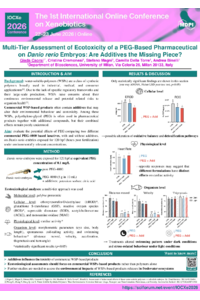
Caorsi_Poster Xenobiotics.pdf
Cytotoxic, genotoxic, and mutagenic effects of the mixture of dyes used in the formulation of black hair dye
Behavioral and reproductive consequences of Caenorhabditis elegans’ embryos after exposure to low doses of bisphenol A and its substitutes