Event submissions
Published
This submission belongs to the session S3. Emerging Chemicals: Environment Risks and Health Effects of the event The 1st International Online Conference on Xenobiotics
Published date
17 Jun, 2026
Academic Editor
'%3e%3cpath%20d='M12.6657%2010.9104C12.4185%2010.325%2012.0599%209.79327%2011.6097%209.34482C11.1609%208.89508%2010.6293%208.5365%2010.0442%208.28888C10.0389%208.28626%2010.0337%208.28495%2010.0285%208.28233C10.8446%207.69279%2011.3752%206.73249%2011.3752%205.64904C11.3752%203.8542%209.92103%202.39999%208.1262%202.39999C6.33136%202.39999%204.87715%203.8542%204.87715%205.64904C4.87715%206.73249%205.40774%207.69279%206.22393%208.28364C6.21869%208.28626%206.21345%208.28757%206.20821%208.29019C5.62129%208.5378%205.09463%208.89284%204.64265%209.34613C4.1929%209.79493%203.83432%2010.3266%203.58671%2010.9117C3.34345%2011.4845%203.21226%2012.0987%203.20023%2012.7209C3.19988%2012.7349%203.20233%2012.7488%203.20744%2012.7619C3.21255%2012.7749%203.22022%2012.7867%203.22998%2012.7968C3.23975%2012.8068%203.25142%2012.8147%203.26431%2012.8202C3.2772%2012.8256%203.29105%2012.8284%203.30504%2012.8284H4.09109C4.14874%2012.8284%204.19459%2012.7825%204.1959%2012.7262C4.2221%2011.7148%204.62823%2010.7676%205.34617%2010.0497C6.08899%209.30683%207.0755%208.89808%208.1262%208.89808C9.17689%208.89808%2010.1634%209.30683%2010.9062%2010.0497C11.6242%2010.7676%2012.0303%2011.7148%2012.0565%2012.7262C12.0578%2012.7838%2012.1037%2012.8284%2012.1613%2012.8284H12.9474C12.9613%2012.8284%2012.9752%2012.8256%2012.9881%2012.8202C13.001%2012.8147%2013.0126%2012.8068%2013.0224%2012.7968C13.0322%2012.7867%2013.0398%2012.7749%2013.0449%2012.7619C13.0501%2012.7488%2013.0525%2012.7349%2013.0522%2012.7209C13.0391%2012.0947%2012.9094%2011.4855%2012.6657%2010.9104ZM8.1262%207.9024C7.52486%207.9024%206.9589%207.6679%206.53312%207.24211C6.10733%206.81633%205.87283%206.25037%205.87283%205.64904C5.87283%205.0477%206.10733%204.48174%206.53312%204.05596C6.9589%203.63018%207.52486%203.39567%208.1262%203.39567C8.72753%203.39567%209.29349%203.63018%209.71927%204.05596C10.1451%204.48174%2010.3796%205.0477%2010.3796%205.64904C10.3796%206.25037%2010.1451%206.81633%209.71927%207.24211C9.29349%207.6679%208.72753%207.9024%208.1262%207.9024Z'%20fill='%235D1EE1'/%3e%3c/g%3e%3c/svg%3e) Stefano Magni
Stefano MagniCitation
Patrícia Hockicková, Alžbeta Kaiglová, Soňa Kucharíková, Behavioral and reproductive consequences of Caenorhabditis elegans’ embryos after exposure to low doses of bisphenol A and its substitutes, in Proceedings of The 1st International Online Conference on Xenobiotics, 22 June–23 June 2026, MDPI: Basel, Switzerland
Share
Email
Facebook
Twitter
LinkedIn
Behavioral and reproductive consequences of Caenorhabditis elegans’ embryos after exposure to low doses of bisphenol A and its substitutes
'%3e%3cpath%20d='M12.6647%2010.9104C12.4176%2010.325%2012.0589%209.7933%2011.6088%209.34485C11.16%208.89511%2010.6283%208.53653%2010.0432%208.28891C10.038%208.28629%2010.0327%208.28498%2010.0275%208.28236C10.8437%207.69282%2011.3743%206.73252%2011.3743%205.64907C11.3743%203.85423%209.92005%202.40002%208.12522%202.40002C6.33038%202.40002%204.87618%203.85423%204.87618%205.64907C4.87618%206.73252%205.40677%207.69282%206.22296%208.28367C6.21772%208.28629%206.21248%208.2876%206.20724%208.29022C5.62031%208.53783%205.09365%208.89287%204.64167%209.34616C4.19192%209.79496%203.83334%2010.3266%203.58573%2010.9117C3.34247%2011.4846%203.21128%2012.0987%203.19925%2012.721C3.1989%2012.735%203.20135%2012.7489%203.20646%2012.7619C3.21157%2012.7749%203.21924%2012.7868%203.22901%2012.7968C3.23877%2012.8068%203.25045%2012.8148%203.26334%2012.8202C3.27623%2012.8256%203.29007%2012.8284%203.30406%2012.8284H4.09012C4.14776%2012.8284%204.19362%2012.7825%204.19493%2012.7262C4.22113%2011.7148%204.62726%2010.7676%205.34519%2010.0497C6.08802%209.30686%207.07452%208.89811%208.12522%208.89811C9.17592%208.89811%2010.1624%209.30686%2010.9052%2010.0497C11.6232%2010.7676%2012.0293%2011.7148%2012.0555%2012.7262C12.0568%2012.7839%2012.1027%2012.8284%2012.1603%2012.8284H12.9464C12.9604%2012.8284%2012.9742%2012.8256%2012.9871%2012.8202C13%2012.8148%2013.0117%2012.8068%2013.0214%2012.7968C13.0312%2012.7868%2013.0389%2012.7749%2013.044%2012.7619C13.0491%2012.7489%2013.0515%2012.735%2013.0512%2012.721C13.0381%2012.0947%2012.9084%2011.4856%2012.6647%2010.9104ZM8.12522%207.90243C7.52388%207.90243%206.95792%207.66793%206.53214%207.24215C6.10636%206.81636%205.87185%206.2504%205.87185%205.64907C5.87185%205.04773%206.10636%204.48177%206.53214%204.05599C6.95792%203.63021%207.52388%203.3957%208.12522%203.3957C8.72655%203.3957%209.29252%203.63021%209.7183%204.05599C10.1441%204.48177%2010.3786%205.04773%2010.3786%205.64907C10.3786%206.2504%2010.1441%206.81636%209.7183%207.24215C9.29252%207.66793%208.72655%207.90243%208.12522%207.90243Z'%20fill='%235D1EE1'/%3e%3c/g%3e%3c/svg%3e)
Patrícia Hockicková 1
Alžbeta Kaiglová 1
Soňa Kucharíková 1
1. Department of Laboratory Medicine, Faculty of Health Care and Social Work, Trnava University in Trnava, Trnava 918 43, Slovakia, Slovakia
Abstract
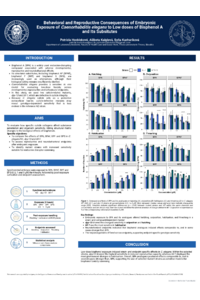
Introduction: Endocrine disruptors, such as bisphenols (e.g. BPA and its analogues), interfere with hormonal homeostasis and physiological processes. The objective of this study was to investigate the detrimental effects of BPA and selected analogues (BPAF, BPF, BPS) on the model organism Caenorhabditis elegans.
Methods: The effects of embryonic exposure to BPA, BPAF, BPF, and BPS were studied in a reference strain C. elegans N2 and two mutant strains, namely bli-1 and dpy-13. Embryos were exposed to 0,5; 1; and 5 µM of each compound for 4 hours. After exposure, hatching, oviposition, locomotor activity, and habituation to anterior touch were assessed to identify sensitive genotypes and evaluate their suitability for detecting subtle toxic effects.
Results: In WT, all tested bisphenols significantly reduced hatching already at 0,5 µM. C. elegans dpy-13 was the most sensitive for hatching, with the strongest effect observed at 5 µM of BPF, where median hatching decreased to 12,5%. During oviposition, dpy-13 showed relative resistance to BPA, but marked sensitivity to its analogues. BPAF significantly reduced egg laying from 0,5 µM, while BPF and BPS exhibited this effect at 1 µM. C. elegans bli-1 was the most sensitive in habituation, showing a dose-dependent increase in the number of anterior touches required after all bisphenols tested. In particular, at concentration of 0,5 µM BPS, the median reached 37,5 touches compared to 27 observed in WT.
Conclusions: Comparative analysis revealed that the adverse physiological impacts of BPA analogues were not only comparable to BPA but, in several cases, more potent. Findings using bli-1 and dpy-13 mutants demonstrate that specific cuticle architecture plays a key role in modulating the biological impact of these bisphenols. This study improves the risk assessment of BPA substitutes and identifies specific C. elegans mutants as sensitive tools for screening endocrine disruptors at environmental concentrations.
Keywords
Caenorhabditis elegans
endocrine disruptors
bisphenols
cuticle
cuticle mutants
Poster
IOXCE_2026_Poster_Hockickova.pdf
Multi-tier Assessment of ecotoxicity of a PEG-Based Pharmaceutical on Danio rerio Embryos: Are Additives the Missing Piece?
Perinatal and Direct Bisphenol A Exposure Shape Gut Microbiota and Behavior in a Sex-Specific Manner In mice