Event submissions
Published
This submission belongs to the session S3. Emerging Chemicals: Environment Risks and Health Effects of the event The 1st International Online Conference on Xenobiotics
Published date
17 Jun, 2026
Academic Editor
'%3e%3cpath%20d='M12.6657%2010.9104C12.4185%2010.325%2012.0599%209.79327%2011.6097%209.34482C11.1609%208.89508%2010.6293%208.5365%2010.0442%208.28888C10.0389%208.28626%2010.0337%208.28495%2010.0285%208.28233C10.8446%207.69279%2011.3752%206.73249%2011.3752%205.64904C11.3752%203.8542%209.92103%202.39999%208.1262%202.39999C6.33136%202.39999%204.87715%203.8542%204.87715%205.64904C4.87715%206.73249%205.40774%207.69279%206.22393%208.28364C6.21869%208.28626%206.21345%208.28757%206.20821%208.29019C5.62129%208.5378%205.09463%208.89284%204.64265%209.34613C4.1929%209.79493%203.83432%2010.3266%203.58671%2010.9117C3.34345%2011.4845%203.21226%2012.0987%203.20023%2012.7209C3.19988%2012.7349%203.20233%2012.7488%203.20744%2012.7619C3.21255%2012.7749%203.22022%2012.7867%203.22998%2012.7968C3.23975%2012.8068%203.25142%2012.8147%203.26431%2012.8202C3.2772%2012.8256%203.29105%2012.8284%203.30504%2012.8284H4.09109C4.14874%2012.8284%204.19459%2012.7825%204.1959%2012.7262C4.2221%2011.7148%204.62823%2010.7676%205.34617%2010.0497C6.08899%209.30683%207.0755%208.89808%208.1262%208.89808C9.17689%208.89808%2010.1634%209.30683%2010.9062%2010.0497C11.6242%2010.7676%2012.0303%2011.7148%2012.0565%2012.7262C12.0578%2012.7838%2012.1037%2012.8284%2012.1613%2012.8284H12.9474C12.9613%2012.8284%2012.9752%2012.8256%2012.9881%2012.8202C13.001%2012.8147%2013.0126%2012.8068%2013.0224%2012.7968C13.0322%2012.7867%2013.0398%2012.7749%2013.0449%2012.7619C13.0501%2012.7488%2013.0525%2012.7349%2013.0522%2012.7209C13.0391%2012.0947%2012.9094%2011.4855%2012.6657%2010.9104ZM8.1262%207.9024C7.52486%207.9024%206.9589%207.6679%206.53312%207.24211C6.10733%206.81633%205.87283%206.25037%205.87283%205.64904C5.87283%205.0477%206.10733%204.48174%206.53312%204.05596C6.9589%203.63018%207.52486%203.39567%208.1262%203.39567C8.72753%203.39567%209.29349%203.63018%209.71927%204.05596C10.1451%204.48174%2010.3796%205.0477%2010.3796%205.64904C10.3796%206.25037%2010.1451%206.81633%209.71927%207.24211C9.29349%207.6679%208.72753%207.9024%208.1262%207.9024Z'%20fill='%235D1EE1'/%3e%3c/g%3e%3c/svg%3e) Stefano Magni
Stefano MagniCitation
Ana López-Moreno, Alfonso Torres-Sánchez, Alicia Ruiz-Rodríguez, Margarita Aguilera, Perinatal and Direct Bisphenol A Exposure Shape Gut Microbiota and Behavior in a Sex-Specific Manner In mice, in Proceedings of The 1st International Online Conference on Xenobiotics, 22 June–23 June 2026, MDPI: Basel, Switzerland
Share
Email
Facebook
Twitter
LinkedIn
Perinatal and Direct Bisphenol A Exposure Shape Gut Microbiota and Behavior in a Sex-Specific Manner In mice

Ana López-Moreno 1
'%3e%3cpath%20d='M12.6647%2010.9104C12.4176%2010.325%2012.0589%209.7933%2011.6088%209.34485C11.16%208.89511%2010.6283%208.53653%2010.0432%208.28891C10.038%208.28629%2010.0327%208.28498%2010.0275%208.28236C10.8437%207.69282%2011.3743%206.73252%2011.3743%205.64907C11.3743%203.85423%209.92005%202.40002%208.12522%202.40002C6.33038%202.40002%204.87618%203.85423%204.87618%205.64907C4.87618%206.73252%205.40677%207.69282%206.22296%208.28367C6.21772%208.28629%206.21248%208.2876%206.20724%208.29022C5.62031%208.53783%205.09365%208.89287%204.64167%209.34616C4.19192%209.79496%203.83334%2010.3266%203.58573%2010.9117C3.34247%2011.4846%203.21128%2012.0987%203.19925%2012.721C3.1989%2012.735%203.20135%2012.7489%203.20646%2012.7619C3.21157%2012.7749%203.21924%2012.7868%203.22901%2012.7968C3.23877%2012.8068%203.25045%2012.8148%203.26334%2012.8202C3.27623%2012.8256%203.29007%2012.8284%203.30406%2012.8284H4.09012C4.14776%2012.8284%204.19362%2012.7825%204.19493%2012.7262C4.22113%2011.7148%204.62726%2010.7676%205.34519%2010.0497C6.08802%209.30686%207.07452%208.89811%208.12522%208.89811C9.17592%208.89811%2010.1624%209.30686%2010.9052%2010.0497C11.6232%2010.7676%2012.0293%2011.7148%2012.0555%2012.7262C12.0568%2012.7839%2012.1027%2012.8284%2012.1603%2012.8284H12.9464C12.9604%2012.8284%2012.9742%2012.8256%2012.9871%2012.8202C13%2012.8148%2013.0117%2012.8068%2013.0214%2012.7968C13.0312%2012.7868%2013.0389%2012.7749%2013.044%2012.7619C13.0491%2012.7489%2013.0515%2012.735%2013.0512%2012.721C13.0381%2012.0947%2012.9084%2011.4856%2012.6647%2010.9104ZM8.12522%207.90243C7.52388%207.90243%206.95792%207.66793%206.53214%207.24215C6.10636%206.81636%205.87185%206.2504%205.87185%205.64907C5.87185%205.04773%206.10636%204.48177%206.53214%204.05599C6.95792%203.63021%207.52388%203.3957%208.12522%203.3957C8.72655%203.3957%209.29252%203.63021%209.7183%204.05599C10.1441%204.48177%2010.3786%205.04773%2010.3786%205.64907C10.3786%206.2504%2010.1441%206.81636%209.7183%207.24215C9.29252%207.66793%208.72655%207.90243%208.12522%207.90243Z'%20fill='%235D1EE1'/%3e%3c/g%3e%3c/svg%3e)
Alfonso Torres-Sánchez 1
Alicia Ruiz-Rodríguez 1

Margarita Aguilera 1
1. Institute of Nutrition and Food Technology “José Mataix”; Center of Biomedical Research; University of Granada, Granada, Spain, Spain
Abstract
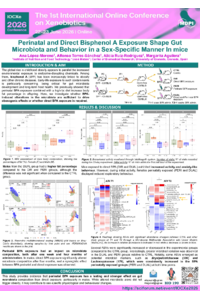
Bisphenol A (BPA) is an endocrine-disrupting chemical that is widely used in consumer products and is associated with obesity and chronic diseases. Early-life exposure to environmental contaminants is concerning because the perinatal period shapes gut microbiota and long-term host health. In previous work, we showed that perinatal BPA exposure combined with a high-fat diet increased body fat in offspring.
To investigate whether a microbiota altered by perinatal BPA exposure could drive obesogenic effects, or whether direct BPA exposure is required, forty germ-free mice (20 males and 20 females) were colonized at postnatal day 49 with gut microbiota from perinatally BPA-exposed or control mice. Mice were divided into four groups: CTRL (control microbiota, vehicle), DIR (control microbiota, direct BPA exposure), PERI (perinatal BPA microbiota, vehicle), and DUAL (perinatal BPA microbiota, direct BPA exposure). BPA or vehicle administration began three days after colonization and continued for four months. Body composition (EchoMRI/NMR), behavior (Intellicage), and gut microbiota composition (16S rRNA sequencing) were assessed.
Males in the DUAL group showed a higher fat percentage, although the differences were not significant. Mice exposed to direct BPA (DIR and DUAL) displayed increased activity and anxiety-like behavior. Beta diversity revealed persistent microbiota differences associated with perinatal BPA exposure after one week and four months. In males, direct BPA exposure significantly altered microbiota composition after four months and showed a synergistic effect with perinatal exposure. Specific ASVs were identified as potential microbial markers: Bifidobacterium_animalis and Alistipes were decreased in BPA-exposed groups, Erysipelotrichaceae and Lachnospiraceae increased in perinatal BPA groups, and Parabacteroides_goldsteinii and Bacteroides increased in direct BPA exposure groups.
In conclusion, perinatal BPA exposure has a lasting and stronger effect on gut microbiota composition than direct exposure, particularly in males. Altered microbiota alone did not trigger obesity but may have contributed to sex-specific physiological and behavioral changes.
Keywords
Bisphenol A
perinatal exposure
gut microbiota
obesogenic effects
germ-free mice
sex-specific effects
behavioral changes
Poster
Poster - Ana.pdf
Behavioral and reproductive consequences of Caenorhabditis elegans’ embryos after exposure to low doses of bisphenol A and its substitutes
In Silico Assessment of Interactions Between Pharmaceutical Contaminants and Human Metabolic Enzymes Using Molecular Docking