Event submissions
Published
This submission belongs to the session S3. Emerging Chemicals: Environment Risks and Health Effects of the event The 1st International Online Conference on Xenobiotics
Published date
17 Jun, 2026
Academic Editor
'%3e%3cpath%20d='M12.6657%2010.9104C12.4185%2010.325%2012.0599%209.79327%2011.6097%209.34482C11.1609%208.89508%2010.6293%208.5365%2010.0442%208.28888C10.0389%208.28626%2010.0337%208.28495%2010.0285%208.28233C10.8446%207.69279%2011.3752%206.73249%2011.3752%205.64904C11.3752%203.8542%209.92103%202.39999%208.1262%202.39999C6.33136%202.39999%204.87715%203.8542%204.87715%205.64904C4.87715%206.73249%205.40774%207.69279%206.22393%208.28364C6.21869%208.28626%206.21345%208.28757%206.20821%208.29019C5.62129%208.5378%205.09463%208.89284%204.64265%209.34613C4.1929%209.79493%203.83432%2010.3266%203.58671%2010.9117C3.34345%2011.4845%203.21226%2012.0987%203.20023%2012.7209C3.19988%2012.7349%203.20233%2012.7488%203.20744%2012.7619C3.21255%2012.7749%203.22022%2012.7867%203.22998%2012.7968C3.23975%2012.8068%203.25142%2012.8147%203.26431%2012.8202C3.2772%2012.8256%203.29105%2012.8284%203.30504%2012.8284H4.09109C4.14874%2012.8284%204.19459%2012.7825%204.1959%2012.7262C4.2221%2011.7148%204.62823%2010.7676%205.34617%2010.0497C6.08899%209.30683%207.0755%208.89808%208.1262%208.89808C9.17689%208.89808%2010.1634%209.30683%2010.9062%2010.0497C11.6242%2010.7676%2012.0303%2011.7148%2012.0565%2012.7262C12.0578%2012.7838%2012.1037%2012.8284%2012.1613%2012.8284H12.9474C12.9613%2012.8284%2012.9752%2012.8256%2012.9881%2012.8202C13.001%2012.8147%2013.0126%2012.8068%2013.0224%2012.7968C13.0322%2012.7867%2013.0398%2012.7749%2013.0449%2012.7619C13.0501%2012.7488%2013.0525%2012.7349%2013.0522%2012.7209C13.0391%2012.0947%2012.9094%2011.4855%2012.6657%2010.9104ZM8.1262%207.9024C7.52486%207.9024%206.9589%207.6679%206.53312%207.24211C6.10733%206.81633%205.87283%206.25037%205.87283%205.64904C5.87283%205.0477%206.10733%204.48174%206.53312%204.05596C6.9589%203.63018%207.52486%203.39567%208.1262%203.39567C8.72753%203.39567%209.29349%203.63018%209.71927%204.05596C10.1451%204.48174%2010.3796%205.0477%2010.3796%205.64904C10.3796%206.25037%2010.1451%206.81633%209.71927%207.24211C9.29349%207.6679%208.72753%207.9024%208.1262%207.9024Z'%20fill='%235D1EE1'/%3e%3c/g%3e%3c/svg%3e) Lin-Chi Wang
Lin-Chi WangCitation
Luka Kazensky, Ivana Banić, Ivana Vrhovac Madunić, Vedran Micek, Katarina Matković, Marko Gerić, Marija Jelena Lovrić Štefiček, Jasmina Rinkovec, Ivana Jakovljević, Vilena Kašuba, Mirta Milić, Mirjana Turkalj, Davorka Breljak, Gordana Pehnec, Bojana Žegura, Mario Lovrić, Jon Switters, Francesco Mureddu, Goran Gajski, From Homes to Cells: Assessing Genome Damage Induced by Indoor PAH Mixtures, in Proceedings of The 1st International Online Conference on Xenobiotics, 22 June–23 June 2026, MDPI: Basel, Switzerland
Share
Email
Facebook
Twitter
LinkedIn
From Homes to Cells: Assessing Genome Damage Induced by Indoor PAH Mixtures
'%3e%3cpath%20d='M12.6647%2010.9104C12.4176%2010.325%2012.0589%209.7933%2011.6088%209.34485C11.16%208.89511%2010.6283%208.53653%2010.0432%208.28891C10.038%208.28629%2010.0327%208.28498%2010.0275%208.28236C10.8437%207.69282%2011.3743%206.73252%2011.3743%205.64907C11.3743%203.85423%209.92005%202.40002%208.12522%202.40002C6.33038%202.40002%204.87618%203.85423%204.87618%205.64907C4.87618%206.73252%205.40677%207.69282%206.22296%208.28367C6.21772%208.28629%206.21248%208.2876%206.20724%208.29022C5.62031%208.53783%205.09365%208.89287%204.64167%209.34616C4.19192%209.79496%203.83334%2010.3266%203.58573%2010.9117C3.34247%2011.4846%203.21128%2012.0987%203.19925%2012.721C3.1989%2012.735%203.20135%2012.7489%203.20646%2012.7619C3.21157%2012.7749%203.21924%2012.7868%203.22901%2012.7968C3.23877%2012.8068%203.25045%2012.8148%203.26334%2012.8202C3.27623%2012.8256%203.29007%2012.8284%203.30406%2012.8284H4.09012C4.14776%2012.8284%204.19362%2012.7825%204.19493%2012.7262C4.22113%2011.7148%204.62726%2010.7676%205.34519%2010.0497C6.08802%209.30686%207.07452%208.89811%208.12522%208.89811C9.17592%208.89811%2010.1624%209.30686%2010.9052%2010.0497C11.6232%2010.7676%2012.0293%2011.7148%2012.0555%2012.7262C12.0568%2012.7839%2012.1027%2012.8284%2012.1603%2012.8284H12.9464C12.9604%2012.8284%2012.9742%2012.8256%2012.9871%2012.8202C13%2012.8148%2013.0117%2012.8068%2013.0214%2012.7968C13.0312%2012.7868%2013.0389%2012.7749%2013.044%2012.7619C13.0491%2012.7489%2013.0515%2012.735%2013.0512%2012.721C13.0381%2012.0947%2012.9084%2011.4856%2012.6647%2010.9104ZM8.12522%207.90243C7.52388%207.90243%206.95792%207.66793%206.53214%207.24215C6.10636%206.81636%205.87185%206.2504%205.87185%205.64907C5.87185%205.04773%206.10636%204.48177%206.53214%204.05599C6.95792%203.63021%207.52388%203.3957%208.12522%203.3957C8.72655%203.3957%209.29252%203.63021%209.7183%204.05599C10.1441%204.48177%2010.3786%205.04773%2010.3786%205.64907C10.3786%206.2504%2010.1441%206.81636%209.7183%207.24215C9.29252%207.66793%208.72655%207.90243%208.12522%207.90243Z'%20fill='%235D1EE1'/%3e%3c/g%3e%3c/svg%3e)
Luka Kazensky 1
Ivana Banić 2

Ivana Vrhovac Madunić 1
Vedran Micek 1
Katarina Matković 1
Marko Gerić 1
Marija Jelena Lovrić Štefiček 1
Jasmina Rinkovec 1
Ivana Jakovljević 1
Vilena Kašuba 1

Mirta Milić 1
Mirjana Turkalj 2
Davorka Breljak 1
Gordana Pehnec 1

Bojana Žegura 3

Mario Lovrić 4,5
Jon Switters 6
Francesco Mureddu 6

Goran Gajski 1
1. Institute for Medical Research and Occupational Health, Zagreb, Croatia, Croatia
2. Srebrnjak Children's Hospital, Zagreb, Croatia, Croatia
3. National Institute of Biology, Ljubljana, Slovenia, Slovenia
4. Institute for Anthropological Research, Zagreb, Croatia, Croatia
5. The Lisbon Council, Brussels, Belgium
6. The Lisbon Council, Brussels, Belgium, Belgium
Abstract
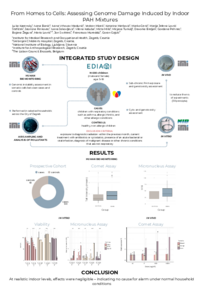
Indoor air pollution is an important public health concern, with polycyclic aromatic hydrocarbons (PAHs) among the key hazardous contaminants. This study evaluated the genotoxic potential of environmentally relevant PAH mixtures using an integrated approach combining human biomonitoring and in vitro and in vivo models. PAH mixtures were formulated based on concentrations measured in household indoor air and subsequently tested in mechanistic experimental systems. DNA damage was assessed using the comet and micronucleus assays in peripheral blood cells of human biomonitoring participants (children aged 5–18 years), divided into cases with diagnosed respiratory conditions and healthy controls), in vitro in human peripheral blood cells as well as lung (A549) and liver (HepG2) cell lines exposed to PAH mixtures, and in vivo in peripheral blood, lung, and liver cells of Wistar rats. Children with respiratory conditions exhibited significantly higher levels of genome damage compared with healthy controls. Experimental models further demonstrated concentration- and dose-dependent increases in DNA damage, with particularly pronounced effects in lymphocytes in vitro and liver cells in vivo. Overall, these findings provide new evidence linking indoor PAH exposure to genomic instability and highlight the value of integrated experimental and human biomonitoring approaches for improved indoor air risk assessment and protection of public health.
Supported by the Horizon Europe (#101057497 EDIAQI)
Keywords
indoor air pollution
cytotoxicity
genotoxicity
respiratory health
public health
Poster
IOCXe2026 – sciforum-177874.pdf
In Silico Assessment of Interactions Between Pharmaceutical Contaminants and Human Metabolic Enzymes Using Molecular Docking
Perceived BTEX Exposure and Occupational Safety Knowledge, Attitudes, and Practices among Petrol Station Attendants in Islamabad, Pakistan