Event submissions
Published
This submission belongs to the session S3. Emerging Chemicals: Environment Risks and Health Effects of the event The 1st International Online Conference on Xenobiotics
Published date
17 Jun, 2026
Academic Editor
'%3e%3cpath%20d='M12.6657%2010.9104C12.4185%2010.325%2012.0599%209.79327%2011.6097%209.34482C11.1609%208.89508%2010.6293%208.5365%2010.0442%208.28888C10.0389%208.28626%2010.0337%208.28495%2010.0285%208.28233C10.8446%207.69279%2011.3752%206.73249%2011.3752%205.64904C11.3752%203.8542%209.92103%202.39999%208.1262%202.39999C6.33136%202.39999%204.87715%203.8542%204.87715%205.64904C4.87715%206.73249%205.40774%207.69279%206.22393%208.28364C6.21869%208.28626%206.21345%208.28757%206.20821%208.29019C5.62129%208.5378%205.09463%208.89284%204.64265%209.34613C4.1929%209.79493%203.83432%2010.3266%203.58671%2010.9117C3.34345%2011.4845%203.21226%2012.0987%203.20023%2012.7209C3.19988%2012.7349%203.20233%2012.7488%203.20744%2012.7619C3.21255%2012.7749%203.22022%2012.7867%203.22998%2012.7968C3.23975%2012.8068%203.25142%2012.8147%203.26431%2012.8202C3.2772%2012.8256%203.29105%2012.8284%203.30504%2012.8284H4.09109C4.14874%2012.8284%204.19459%2012.7825%204.1959%2012.7262C4.2221%2011.7148%204.62823%2010.7676%205.34617%2010.0497C6.08899%209.30683%207.0755%208.89808%208.1262%208.89808C9.17689%208.89808%2010.1634%209.30683%2010.9062%2010.0497C11.6242%2010.7676%2012.0303%2011.7148%2012.0565%2012.7262C12.0578%2012.7838%2012.1037%2012.8284%2012.1613%2012.8284H12.9474C12.9613%2012.8284%2012.9752%2012.8256%2012.9881%2012.8202C13.001%2012.8147%2013.0126%2012.8068%2013.0224%2012.7968C13.0322%2012.7867%2013.0398%2012.7749%2013.0449%2012.7619C13.0501%2012.7488%2013.0525%2012.7349%2013.0522%2012.7209C13.0391%2012.0947%2012.9094%2011.4855%2012.6657%2010.9104ZM8.1262%207.9024C7.52486%207.9024%206.9589%207.6679%206.53312%207.24211C6.10733%206.81633%205.87283%206.25037%205.87283%205.64904C5.87283%205.0477%206.10733%204.48174%206.53312%204.05596C6.9589%203.63018%207.52486%203.39567%208.1262%203.39567C8.72753%203.39567%209.29349%203.63018%209.71927%204.05596C10.1451%204.48174%2010.3796%205.0477%2010.3796%205.64904C10.3796%206.25037%2010.1451%206.81633%209.71927%207.24211C9.29349%207.6679%208.72753%207.9024%208.1262%207.9024Z'%20fill='%235D1EE1'/%3e%3c/g%3e%3c/svg%3e) Lin-Chi Wang
Lin-Chi WangCitation
Gracia Luque, Marta Koziarska, Eva Peralta, Anna Kostka, Alicia Ruiz-Rodríguez, Agnieszka Gruszecka-Kosowska, Margarita Aguilera, Pilar Ortiz, Xenobiotics from Water to the Gut: Monitoring Environmental BPA and Assessing Its Gut Bacterial Tolerance for Health Risk and Biodetoxification, in Proceedings of The 1st International Online Conference on Xenobiotics, 22 June–23 June 2026, MDPI: Basel, Switzerland
Share
Email
Facebook
Twitter
LinkedIn
Xenobiotics from Water to the Gut: Monitoring Environmental BPA and Assessing Its Gut Bacterial Tolerance for Health Risk and Biodetoxification
'%3e%3cpath%20d='M12.6647%2010.9104C12.4176%2010.325%2012.0589%209.7933%2011.6088%209.34485C11.16%208.89511%2010.6283%208.53653%2010.0432%208.28891C10.038%208.28629%2010.0327%208.28498%2010.0275%208.28236C10.8437%207.69282%2011.3743%206.73252%2011.3743%205.64907C11.3743%203.85423%209.92005%202.40002%208.12522%202.40002C6.33038%202.40002%204.87618%203.85423%204.87618%205.64907C4.87618%206.73252%205.40677%207.69282%206.22296%208.28367C6.21772%208.28629%206.21248%208.2876%206.20724%208.29022C5.62031%208.53783%205.09365%208.89287%204.64167%209.34616C4.19192%209.79496%203.83334%2010.3266%203.58573%2010.9117C3.34247%2011.4846%203.21128%2012.0987%203.19925%2012.721C3.1989%2012.735%203.20135%2012.7489%203.20646%2012.7619C3.21157%2012.7749%203.21924%2012.7868%203.22901%2012.7968C3.23877%2012.8068%203.25045%2012.8148%203.26334%2012.8202C3.27623%2012.8256%203.29007%2012.8284%203.30406%2012.8284H4.09012C4.14776%2012.8284%204.19362%2012.7825%204.19493%2012.7262C4.22113%2011.7148%204.62726%2010.7676%205.34519%2010.0497C6.08802%209.30686%207.07452%208.89811%208.12522%208.89811C9.17592%208.89811%2010.1624%209.30686%2010.9052%2010.0497C11.6232%2010.7676%2012.0293%2011.7148%2012.0555%2012.7262C12.0568%2012.7839%2012.1027%2012.8284%2012.1603%2012.8284H12.9464C12.9604%2012.8284%2012.9742%2012.8256%2012.9871%2012.8202C13%2012.8148%2013.0117%2012.8068%2013.0214%2012.7968C13.0312%2012.7868%2013.0389%2012.7749%2013.044%2012.7619C13.0491%2012.7489%2013.0515%2012.735%2013.0512%2012.721C13.0381%2012.0947%2012.9084%2011.4856%2012.6647%2010.9104ZM8.12522%207.90243C7.52388%207.90243%206.95792%207.66793%206.53214%207.24215C6.10636%206.81636%205.87185%206.2504%205.87185%205.64907C5.87185%205.04773%206.10636%204.48177%206.53214%204.05599C6.95792%203.63021%207.52388%203.3957%208.12522%203.3957C8.72655%203.3957%209.29252%203.63021%209.7183%204.05599C10.1441%204.48177%2010.3786%205.04773%2010.3786%205.64907C10.3786%206.2504%2010.1441%206.81636%209.7183%207.24215C9.29252%207.66793%208.72655%207.90243%208.12522%207.90243Z'%20fill='%235D1EE1'/%3e%3c/g%3e%3c/svg%3e)
Gracia Luque 1
Marta Koziarska 2
Eva Peralta 3
Pilar Ortiz 4

Anna Kostka 2
Alicia Ruiz-Rodríguez 4

Agnieszka Gruszecka-Kosowska 2

Margarita Aguilera 4
1. Institute of Nutrition and Food Technology “Jose Mataix Verdú”, INYTA. Biomedical Research Center (CIBM), Health Sciences Technological Park, University of Granada, 18016, Granada, Spain, Spain
2. Department of Environmental Protection, Faculty of Geology, Geophysics, and Environmental Protection, AGH University of Krakow, Al. Mickiewicza 30, 30-059, Krakow, Poland, Poland
3. Biomedical Research Center (CIBM), Health Sciences Technological Park, University of Granada, 18016, Granada, Spain, Spain
4. Institute of Nutrition and Food Technology “Jose Mataix Verdú”, INYTA. Biomedical Research Center (CIBM), Health Sciences Technological Park, Department of Microbiology, University of Granada, 18016, Granada, Spain, Spain
Abstract
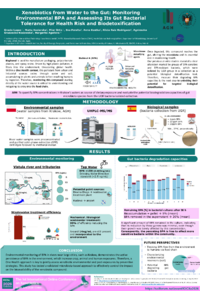
Bisphenol A (BPA) is a ubiquitous endocrine-disrupting compound present in numerous environmental compartments due to its extensive industrial use in plastics. Its widespread distribution enables infiltration into the anthropogenic water cycle and food contamination, facilitating bioaccumulation through the food chain and raising concerns about chronic low-dose human exposure via drinking water and dietary sources. Since ingestion represents a major exposure route, the gut microbiota constitute one of the first metabolic and biological barriers for this xenobiotic. Therefore, understanding gut bacterial bioreactions and responses to BPA is essential for a comprehensive risk assessment.
This study bridges environmental monitoring with microbiological assessment by knowledge transfer to analyse BPA concentrations in river and wastewater samples while evaluating the interaction capacities of key bacterial isolates from human gut microbiota. Several microbiota species were cultured and exposed in vitro to concentrations of BPA, simulating and encompassing environmental levels detected in water samples, as well as elevated experimental doses to establish tolerance thresholds. Microbial growth dynamics and degradation responses were monitored to determine dose-dependent profiles and identify the strains with better BPA biodegradation capacity.
Our findings revealed that selected bacterial strains from different genera exhibited differential tolerance profiles and metabolising capacities for BPA, representing promising taxa candidates for BPA detoxification strategies. This approach integrates environmental risk assessment with toxicomicrobiomics, emphasising the importance of incorporating microbiome-related mechanisms within the One Health framework for xenobiotic risk assessment and the development of microbiome-based solutions.
Keywords
bisphenols
environmental monitoring
gut microbiota
toxicomicrobiomics
biodegradation
Poster
GLA_Jox Poster.pdf
What neurological evidence has been reported on the long-term effects of human exposure to mixtures of environmental neurotoxicants?
Using the field lizard as a model to study the impact of glyphosate on soil-dwelling vertebrates