Event submissions
Published
This submission belongs to the session S1. Environmental Toxicity, Bioaccumulation and Remediation Strategies of the event The 1st International Online Conference on Xenobiotics
Published date
17 Jun, 2026
Academic Editor
'%3e%3cpath%20d='M12.6657%2010.9104C12.4185%2010.325%2012.0599%209.79327%2011.6097%209.34482C11.1609%208.89508%2010.6293%208.5365%2010.0442%208.28888C10.0389%208.28626%2010.0337%208.28495%2010.0285%208.28233C10.8446%207.69279%2011.3752%206.73249%2011.3752%205.64904C11.3752%203.8542%209.92103%202.39999%208.1262%202.39999C6.33136%202.39999%204.87715%203.8542%204.87715%205.64904C4.87715%206.73249%205.40774%207.69279%206.22393%208.28364C6.21869%208.28626%206.21345%208.28757%206.20821%208.29019C5.62129%208.5378%205.09463%208.89284%204.64265%209.34613C4.1929%209.79493%203.83432%2010.3266%203.58671%2010.9117C3.34345%2011.4845%203.21226%2012.0987%203.20023%2012.7209C3.19988%2012.7349%203.20233%2012.7488%203.20744%2012.7619C3.21255%2012.7749%203.22022%2012.7867%203.22998%2012.7968C3.23975%2012.8068%203.25142%2012.8147%203.26431%2012.8202C3.2772%2012.8256%203.29105%2012.8284%203.30504%2012.8284H4.09109C4.14874%2012.8284%204.19459%2012.7825%204.1959%2012.7262C4.2221%2011.7148%204.62823%2010.7676%205.34617%2010.0497C6.08899%209.30683%207.0755%208.89808%208.1262%208.89808C9.17689%208.89808%2010.1634%209.30683%2010.9062%2010.0497C11.6242%2010.7676%2012.0303%2011.7148%2012.0565%2012.7262C12.0578%2012.7838%2012.1037%2012.8284%2012.1613%2012.8284H12.9474C12.9613%2012.8284%2012.9752%2012.8256%2012.9881%2012.8202C13.001%2012.8147%2013.0126%2012.8068%2013.0224%2012.7968C13.0322%2012.7867%2013.0398%2012.7749%2013.0449%2012.7619C13.0501%2012.7488%2013.0525%2012.7349%2013.0522%2012.7209C13.0391%2012.0947%2012.9094%2011.4855%2012.6657%2010.9104ZM8.1262%207.9024C7.52486%207.9024%206.9589%207.6679%206.53312%207.24211C6.10733%206.81633%205.87283%206.25037%205.87283%205.64904C5.87283%205.0477%206.10733%204.48174%206.53312%204.05596C6.9589%203.63018%207.52486%203.39567%208.1262%203.39567C8.72753%203.39567%209.29349%203.63018%209.71927%204.05596C10.1451%204.48174%2010.3796%205.0477%2010.3796%205.64904C10.3796%206.25037%2010.1451%206.81633%209.71927%207.24211C9.29349%207.6679%208.72753%207.9024%208.1262%207.9024Z'%20fill='%235D1EE1'/%3e%3c/g%3e%3c/svg%3e) A. P. Pinto
A. P. PintoCitation
DUHA HAMMAD, Takahiko Miyazaki, Surface-Specific Retention and Biointeraction of Xenobiotic Airborne Particulate Matter on Adaxial and Abaxial Leaf Surfaces of Ruscus aculeatus, in Proceedings of The 1st International Online Conference on Xenobiotics, 22 June–23 June 2026, MDPI: Basel, Switzerland
Share
Email
Facebook
Twitter
LinkedIn
Surface-Specific Retention and Biointeraction of Xenobiotic Airborne Particulate Matter on Adaxial and Abaxial Leaf Surfaces of Ruscus aculeatus

DUHA HAMMAD 1

Takahiko Miyazaki 2
1. Department of Chemistry (WE DSCH), Faculty of Sciences and Bioengineering Sciences, Vrije Universiteit Brussel, 1050 Brussels, Belgium., Belgium
2. Department of Advanced Environmental Science and Engineering, Faculty of Engineering Sciences, Kyushu University, Fukuoka, Japan., Japan
Abstract
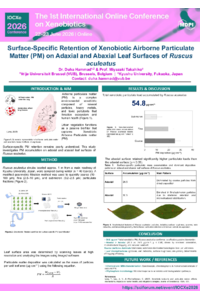
Airborne particulate matter (PM) represents a complex class of environmental xenobiotics composed of mineral particles, heavy metals, persistent organic compounds, and environmentally persistent free radicals that pose significant risks to ecosystems and human health. Vegetation functions as a biological interface where these xenobiotic particles are intercepted, retained, and potentially transformed through physicochemical interactions, surface adsorption, and biological processes occurring at the phyllosphere. Understanding surface-specific plant–xenobiotic interactions is therefore critical for predicting contaminant fate, residence time, and exposure mitigation in urban environments. This study evaluates the surface-specific retention of xenobiotic PM on the adaxial and abaxial leaf surfaces of Ruscus aculeatus, a low-stature urban shrub exposed to near-road emissions. Particulate deposition was quantified using a modified gravimetric filtration protocol separating coarse (10–100 μm), fine (2.5–10 μm), and ultrafine (0.2–2.5 μm) particle fractions. The species accumulated a total particulate load of 54.8 μg.cm⁻², with significantly higher retention on the abaxial surface (30.3 μg.cm⁻²) compared with the adaxial surface (24.5 μg.cm⁻²). Coarse particles dominated total mass accumulation, whereas fine particles exhibited enhanced stabilization on the sheltered abaxial surface. Microstructural leaf features, including grooves and vein networks, promoted mechanical trapping, reduced resuspension, and increased particle residence time, suggesting enhanced potential for biointerface interactions and transformation processes. These findings highlight the importance of leaf surface morphology in regulating plant–xenobiotic interactions, influencing environmental fate, and reducing near-ground exposure risks. The results support the strategic use of shrub vegetation as a complementary biological filter for mitigating airborne xenobiotic contamination in urban landscapes and provide a mechanistic basis for plant selection in nature-based air quality management strategies.
Keywords
Xenobiotics
airborne particulate matter
plant–pollutant interaction
environmental fate
phytoremediation
particle retention
leaf microstructure
urban contamination.
Oral Presentation
The 1st International Online Conference on Xenobiotics.pdf
Poster
Duha Hammad-poster.pdf
ENVIRONMENTAL RECTIFICATION THROUGH MICROBIAL
BIOREMEDIATION: PRINCIPLES AND STRATEGIES
BIOREMEDIATION: PRINCIPLES AND STRATEGIES
In silico ecotoxicological evaluation of hydroxylated progesterone biotransformation products generated by the marine-derived fungus Penicillium oxalicum CBMAI 1996