Event submissions
Published
This submission belongs to the session S1. Environmental Toxicity, Bioaccumulation and Remediation Strategies of the event The 1st International Online Conference on Xenobiotics
Published date
17 Jun, 2026
Academic Editor
'%3e%3cpath%20d='M12.6657%2010.9104C12.4185%2010.325%2012.0599%209.79327%2011.6097%209.34482C11.1609%208.89508%2010.6293%208.5365%2010.0442%208.28888C10.0389%208.28626%2010.0337%208.28495%2010.0285%208.28233C10.8446%207.69279%2011.3752%206.73249%2011.3752%205.64904C11.3752%203.8542%209.92103%202.39999%208.1262%202.39999C6.33136%202.39999%204.87715%203.8542%204.87715%205.64904C4.87715%206.73249%205.40774%207.69279%206.22393%208.28364C6.21869%208.28626%206.21345%208.28757%206.20821%208.29019C5.62129%208.5378%205.09463%208.89284%204.64265%209.34613C4.1929%209.79493%203.83432%2010.3266%203.58671%2010.9117C3.34345%2011.4845%203.21226%2012.0987%203.20023%2012.7209C3.19988%2012.7349%203.20233%2012.7488%203.20744%2012.7619C3.21255%2012.7749%203.22022%2012.7867%203.22998%2012.7968C3.23975%2012.8068%203.25142%2012.8147%203.26431%2012.8202C3.2772%2012.8256%203.29105%2012.8284%203.30504%2012.8284H4.09109C4.14874%2012.8284%204.19459%2012.7825%204.1959%2012.7262C4.2221%2011.7148%204.62823%2010.7676%205.34617%2010.0497C6.08899%209.30683%207.0755%208.89808%208.1262%208.89808C9.17689%208.89808%2010.1634%209.30683%2010.9062%2010.0497C11.6242%2010.7676%2012.0303%2011.7148%2012.0565%2012.7262C12.0578%2012.7838%2012.1037%2012.8284%2012.1613%2012.8284H12.9474C12.9613%2012.8284%2012.9752%2012.8256%2012.9881%2012.8202C13.001%2012.8147%2013.0126%2012.8068%2013.0224%2012.7968C13.0322%2012.7867%2013.0398%2012.7749%2013.0449%2012.7619C13.0501%2012.7488%2013.0525%2012.7349%2013.0522%2012.7209C13.0391%2012.0947%2012.9094%2011.4855%2012.6657%2010.9104ZM8.1262%207.9024C7.52486%207.9024%206.9589%207.6679%206.53312%207.24211C6.10733%206.81633%205.87283%206.25037%205.87283%205.64904C5.87283%205.0477%206.10733%204.48174%206.53312%204.05596C6.9589%203.63018%207.52486%203.39567%208.1262%203.39567C8.72753%203.39567%209.29349%203.63018%209.71927%204.05596C10.1451%204.48174%2010.3796%205.0477%2010.3796%205.64904C10.3796%206.25037%2010.1451%206.81633%209.71927%207.24211C9.29349%207.6679%208.72753%207.9024%208.1262%207.9024Z'%20fill='%235D1EE1'/%3e%3c/g%3e%3c/svg%3e) A. P. Pinto
A. P. PintoCitation
Ligia Vasconcelos, André Porto, In silico ecotoxicological evaluation of hydroxylated progesterone biotransformation products generated by the marine-derived fungus Penicillium oxalicum CBMAI 1996, in Proceedings of The 1st International Online Conference on Xenobiotics, 22 June–23 June 2026, MDPI: Basel, Switzerland
Share
Email
Facebook
Twitter
LinkedIn
In silico ecotoxicological evaluation of hydroxylated progesterone biotransformation products generated by the marine-derived fungus Penicillium oxalicum CBMAI 1996

Ligia Vasconcelos 1

André Porto 1
1. Department of Physical Chemistry, Chemistry Institute of São Carlos, University of São Paulo (USP), São Carlos 13563-120, Brazil, Brazil
Abstract
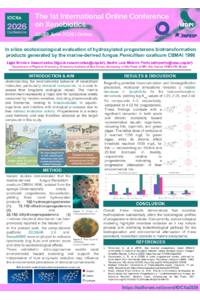
Understanding the environmental behavior of recalcitrant molecules, particularly steroidal compounds, is essential for assessing their long-term ecological impact. The marine environment represents a major sink for substances widely consumed by modern societies, including pharmaceuticals and hormones that tend to bioaccumulate in aquatic organisms and interfere with biological processes due to their intrinsic endocrine activity. Progesterone is a widely used hormone and was therefore selected as the target compound in this study.
Recent studies demonstrated that the marine-derived fungus Penicillium oxalicum CBMAI 1996, isolated from the sponge Chelonaplysilla erecta, promotes progesterone bio-oxidation, yielding three novel hydroxylated products—15β-hydroxyprogesterone (1), 7β,15β-dihydroxyprogesterone (2), and 2β,15β-dihydroxyprogesterone (3)—whose structural elucidation has been previously reported in the literature. In the present work, the computational platforms ECOSAR 2.0 and SwissADME were employed to estimate lipophilicity (log Kₒw) and predict acute and chronic ecotoxicological effects. These validated in silico approaches enable rapid environmental hazard screening and support the interpretation of how enzymatic oxidation may influence the environmental persistence of steroidal contaminants.
Simulations of the derivatives revealed a consistent decrease in molecular lipophilicity, with log Kₒw values of 3.20, 2.25, 2.44, and 4.02 for compounds 1–3 and progesterone, respectively, accompanied by reduced predicted ecotoxicity toward representative aquatic organisms, including fish, daphnids, and green algae. Acute fish toxicity values (LC₅₀, mg L⁻¹) were 121, 506, 164, and 25, whereas predicted chronic toxicity values (mg L⁻¹) were 82, 1030, 137, and 2.6. These findings indicate that microbial hydroxylation substantially alters the physicochemical and toxicological profiles of progesterone-derived products, suggesting a progressive attenuation of environmental risk.
Overall, the predicted reduction in hydrophobicity relative to the parent hormone indicates lower bioaccumulation potential, while ecotoxicological modeling highlights microbial oxidation as a relevant natural process contributing to the environmental attenuation and prospective degradation of persistent steroids in marine ecosystems.
Keywords
biotransformation
ecotoxicity simulations
lipophilicity
progesterone
fungi
Poster
Poster Xenobiotics.pptx.pdf
Surface-Specific Retention and Biointeraction of Xenobiotic Airborne Particulate Matter on Adaxial and Abaxial Leaf Surfaces of Ruscus aculeatus
Occurrence and Tissue-Specific Distribution of Arsenic and Other Potentially Toxic Elements in Retail Meats: Implications for Dietary Risk Assessment