Event submissions
Published
This submission belongs to the session S1. Environmental Toxicity, Bioaccumulation and Remediation Strategies of the event The 1st International Online Conference on Xenobiotics
Published date
17 Jun, 2026
Academic Editor
'%3e%3cpath%20d='M12.6657%2010.9104C12.4185%2010.325%2012.0599%209.79327%2011.6097%209.34482C11.1609%208.89508%2010.6293%208.5365%2010.0442%208.28888C10.0389%208.28626%2010.0337%208.28495%2010.0285%208.28233C10.8446%207.69279%2011.3752%206.73249%2011.3752%205.64904C11.3752%203.8542%209.92103%202.39999%208.1262%202.39999C6.33136%202.39999%204.87715%203.8542%204.87715%205.64904C4.87715%206.73249%205.40774%207.69279%206.22393%208.28364C6.21869%208.28626%206.21345%208.28757%206.20821%208.29019C5.62129%208.5378%205.09463%208.89284%204.64265%209.34613C4.1929%209.79493%203.83432%2010.3266%203.58671%2010.9117C3.34345%2011.4845%203.21226%2012.0987%203.20023%2012.7209C3.19988%2012.7349%203.20233%2012.7488%203.20744%2012.7619C3.21255%2012.7749%203.22022%2012.7867%203.22998%2012.7968C3.23975%2012.8068%203.25142%2012.8147%203.26431%2012.8202C3.2772%2012.8256%203.29105%2012.8284%203.30504%2012.8284H4.09109C4.14874%2012.8284%204.19459%2012.7825%204.1959%2012.7262C4.2221%2011.7148%204.62823%2010.7676%205.34617%2010.0497C6.08899%209.30683%207.0755%208.89808%208.1262%208.89808C9.17689%208.89808%2010.1634%209.30683%2010.9062%2010.0497C11.6242%2010.7676%2012.0303%2011.7148%2012.0565%2012.7262C12.0578%2012.7838%2012.1037%2012.8284%2012.1613%2012.8284H12.9474C12.9613%2012.8284%2012.9752%2012.8256%2012.9881%2012.8202C13.001%2012.8147%2013.0126%2012.8068%2013.0224%2012.7968C13.0322%2012.7867%2013.0398%2012.7749%2013.0449%2012.7619C13.0501%2012.7488%2013.0525%2012.7349%2013.0522%2012.7209C13.0391%2012.0947%2012.9094%2011.4855%2012.6657%2010.9104ZM8.1262%207.9024C7.52486%207.9024%206.9589%207.6679%206.53312%207.24211C6.10733%206.81633%205.87283%206.25037%205.87283%205.64904C5.87283%205.0477%206.10733%204.48174%206.53312%204.05596C6.9589%203.63018%207.52486%203.39567%208.1262%203.39567C8.72753%203.39567%209.29349%203.63018%209.71927%204.05596C10.1451%204.48174%2010.3796%205.0477%2010.3796%205.64904C10.3796%206.25037%2010.1451%206.81633%209.71927%207.24211C9.29349%207.6679%208.72753%207.9024%208.1262%207.9024Z'%20fill='%235D1EE1'/%3e%3c/g%3e%3c/svg%3e) Yang-Guang Gu
Yang-Guang GuCitation
Haida Mohammed, EZ-Zemrani Chihab-Eddine, Essadki Yasser, Mugani Richard, El Khalloufi Fatima, Oudra Brahim, Vasconcelos Vitor, Bouaïcha Noureddine, Bioprotective potential of lichen extract (Pseudevernia furfuracea) and its stimulating effect on the growth of radish (Raphanus sativus L.) and its tolerance to stress induced by cyanobacterial microcystins., in Proceedings of The 1st International Online Conference on Xenobiotics, 22 June–23 June 2026, MDPI: Basel, Switzerland
Share
Email
Facebook
Twitter
LinkedIn
Bioprotective potential of lichen extract (Pseudevernia furfuracea) and its stimulating effect on the growth of radish (Raphanus sativus L.) and its tolerance to stress induced by cyanobacterial microcystins.
'%3e%3cpath%20d='M12.6647%2010.9104C12.4176%2010.325%2012.0589%209.7933%2011.6088%209.34485C11.16%208.89511%2010.6283%208.53653%2010.0432%208.28891C10.038%208.28629%2010.0327%208.28498%2010.0275%208.28236C10.8437%207.69282%2011.3743%206.73252%2011.3743%205.64907C11.3743%203.85423%209.92005%202.40002%208.12522%202.40002C6.33038%202.40002%204.87618%203.85423%204.87618%205.64907C4.87618%206.73252%205.40677%207.69282%206.22296%208.28367C6.21772%208.28629%206.21248%208.2876%206.20724%208.29022C5.62031%208.53783%205.09365%208.89287%204.64167%209.34616C4.19192%209.79496%203.83334%2010.3266%203.58573%2010.9117C3.34247%2011.4846%203.21128%2012.0987%203.19925%2012.721C3.1989%2012.735%203.20135%2012.7489%203.20646%2012.7619C3.21157%2012.7749%203.21924%2012.7868%203.22901%2012.7968C3.23877%2012.8068%203.25045%2012.8148%203.26334%2012.8202C3.27623%2012.8256%203.29007%2012.8284%203.30406%2012.8284H4.09012C4.14776%2012.8284%204.19362%2012.7825%204.19493%2012.7262C4.22113%2011.7148%204.62726%2010.7676%205.34519%2010.0497C6.08802%209.30686%207.07452%208.89811%208.12522%208.89811C9.17592%208.89811%2010.1624%209.30686%2010.9052%2010.0497C11.6232%2010.7676%2012.0293%2011.7148%2012.0555%2012.7262C12.0568%2012.7839%2012.1027%2012.8284%2012.1603%2012.8284H12.9464C12.9604%2012.8284%2012.9742%2012.8256%2012.9871%2012.8202C13%2012.8148%2013.0117%2012.8068%2013.0214%2012.7968C13.0312%2012.7868%2013.0389%2012.7749%2013.044%2012.7619C13.0491%2012.7489%2013.0515%2012.735%2013.0512%2012.721C13.0381%2012.0947%2012.9084%2011.4856%2012.6647%2010.9104ZM8.12522%207.90243C7.52388%207.90243%206.95792%207.66793%206.53214%207.24215C6.10636%206.81636%205.87185%206.2504%205.87185%205.64907C5.87185%205.04773%206.10636%204.48177%206.53214%204.05599C6.95792%203.63021%207.52388%203.3957%208.12522%203.3957C8.72655%203.3957%209.29252%203.63021%209.7183%204.05599C10.1441%204.48177%2010.3786%205.04773%2010.3786%205.64907C10.3786%206.2504%2010.1441%206.81636%209.7183%207.24215C9.29252%207.66793%208.72655%207.90243%208.12522%207.90243Z'%20fill='%235D1EE1'/%3e%3c/g%3e%3c/svg%3e)
Haida Mohammed 1
EZ-Zemrani Chihab-Eddine 1
Essadki Yasser 1
Mugani Richard 2
El Khalloufi Fatima 3
Oudra Brahim 1

Vasconcelos Vitor 4

Bouaïcha Noureddine 5
1. Faculty of Sciences Semlalia of Marrakech, Water Sciences, Microbial Biotechnologies and Sustainability of Natural Resources laboratory (Aquabiotech), Cadi Ayyad University, UCA, Av. Prince My Abdellah, P.O. Box 2390 Marrakech,40000, Morocco, Morocco
2. Faculty of Sciences Semlalia of Marrakech, Water Sciences, Microbial Biotechnologies and Sustainability of Natural Resources laboratory (Aquabiotech), Cadi Ayyad University, UCA, Av. Prince My Abdellah, P.O. Box 2390 Marrakech,40000, Morocco, Burundi
3. Polydisciplinary Faculty of Khouribga, Natural Resources Engineering and Environmental Impacts Team, Multidisciplinary Research and In-novation Laboratory, Sultan Moulay Slimane University, Bd 2 Mars Khouribga, 25000, Beni Mellal, Morocco, Morocco
4. Interdisciplinary Centre of Marine and Environmental Research (CIIMAR/CIMAR), University of Porto, Terminal de Cruzeiros do Porto de Leixões, 4450-208 Matosinhos, Portugal, Portugal
5. Laboratoire Écologie, Société et Évolution, UMR 8079, Université Paris-Saclay, CNRS, AgroParisTech, 91190 Gif-sur-Yvette, France, France
Abstract
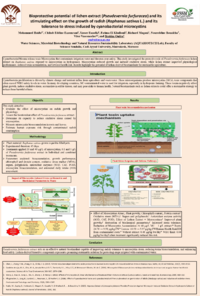
Climate change and anthropogenic pollution are leading to the eutrophication of aquatic ecosystems, creating favorable conditions for the proliferation of cyanobacteria. Some cyanobacteria species produce cyanotoxins, including microcystins (MCs), which can contaminate irrigation water and thus negatively affect crop productivity, and consequently food security and human health. To mitigate these impacts, lichen extract represents a promising source of bioactive compounds for sustainable agriculture. These extracts are known to stimulate plant growth, improve nutrient uptake, and increase tolerance to environmental stress. In this context, the potential of aqueous extract of Pseudovernia furfuracea was evaluated with regard to its effect on the growth and stress resilience of radish (Raphanus sativus L.) grown hydroponically and exposed to MCs. Two concentrations of MCs (10 and 40 µg/L) and a lichen extract (0.1 and 1 g/L) were applied individually or in combination for 45 days. Exposure to MCs alone inhibited growth, reduced chlorophyll and protein levels, and induced oxidative stress, as evidenced by elevated levels of malondialdehyde (MDA), polyphenols, and sugars, as well as increased activity of antioxidant enzymes such as superoxide dismutase (SOD), catalase (CAT), and peroxidase (POD). In contrast, the combined application of the lichen extract and MCs mitigated these adverse effects, restoring growth parameters, chlorophyll, protein, and sugar levels, while strengthening antioxidant defense systems. The results obtained highlight the effectiveness of P. furfuracea extract as a natural biostimulant capable of improving radish growth and its tolerance to MC-induced stress.
Keywords
Cyanobacteria
Microcystins
Biostimulant
Stress protection
Pseudovernia furfuracea
lichen extract
Raphanus sativus L.
hydroponic culture.
Poster
Poster-Haida.pdf
Occurrence and Tissue-Specific Distribution of Arsenic and Other Potentially Toxic Elements in Retail Meats: Implications for Dietary Risk Assessment
Assessment of the content of potentially hazardous elements in agricultural soils of several municipalities in the Province of Valencia (Spain)