Event submissions
Published
This submission belongs to the session S1. Environmental Toxicity, Bioaccumulation and Remediation Strategies of the event The 1st International Online Conference on Xenobiotics
Published date
17 Jun, 2026
Academic Editor
'%3e%3cpath%20d='M12.6657%2010.9104C12.4185%2010.325%2012.0599%209.79327%2011.6097%209.34482C11.1609%208.89508%2010.6293%208.5365%2010.0442%208.28888C10.0389%208.28626%2010.0337%208.28495%2010.0285%208.28233C10.8446%207.69279%2011.3752%206.73249%2011.3752%205.64904C11.3752%203.8542%209.92103%202.39999%208.1262%202.39999C6.33136%202.39999%204.87715%203.8542%204.87715%205.64904C4.87715%206.73249%205.40774%207.69279%206.22393%208.28364C6.21869%208.28626%206.21345%208.28757%206.20821%208.29019C5.62129%208.5378%205.09463%208.89284%204.64265%209.34613C4.1929%209.79493%203.83432%2010.3266%203.58671%2010.9117C3.34345%2011.4845%203.21226%2012.0987%203.20023%2012.7209C3.19988%2012.7349%203.20233%2012.7488%203.20744%2012.7619C3.21255%2012.7749%203.22022%2012.7867%203.22998%2012.7968C3.23975%2012.8068%203.25142%2012.8147%203.26431%2012.8202C3.2772%2012.8256%203.29105%2012.8284%203.30504%2012.8284H4.09109C4.14874%2012.8284%204.19459%2012.7825%204.1959%2012.7262C4.2221%2011.7148%204.62823%2010.7676%205.34617%2010.0497C6.08899%209.30683%207.0755%208.89808%208.1262%208.89808C9.17689%208.89808%2010.1634%209.30683%2010.9062%2010.0497C11.6242%2010.7676%2012.0303%2011.7148%2012.0565%2012.7262C12.0578%2012.7838%2012.1037%2012.8284%2012.1613%2012.8284H12.9474C12.9613%2012.8284%2012.9752%2012.8256%2012.9881%2012.8202C13.001%2012.8147%2013.0126%2012.8068%2013.0224%2012.7968C13.0322%2012.7867%2013.0398%2012.7749%2013.0449%2012.7619C13.0501%2012.7488%2013.0525%2012.7349%2013.0522%2012.7209C13.0391%2012.0947%2012.9094%2011.4855%2012.6657%2010.9104ZM8.1262%207.9024C7.52486%207.9024%206.9589%207.6679%206.53312%207.24211C6.10733%206.81633%205.87283%206.25037%205.87283%205.64904C5.87283%205.0477%206.10733%204.48174%206.53312%204.05596C6.9589%203.63018%207.52486%203.39567%208.1262%203.39567C8.72753%203.39567%209.29349%203.63018%209.71927%204.05596C10.1451%204.48174%2010.3796%205.0477%2010.3796%205.64904C10.3796%206.25037%2010.1451%206.81633%209.71927%207.24211C9.29349%207.6679%208.72753%207.9024%208.1262%207.9024Z'%20fill='%235D1EE1'/%3e%3c/g%3e%3c/svg%3e) A. P. Pinto
A. P. PintoCitation
Yasser Essadki, El Mehdi Darrag, Soukaina El Amrani Zerrifi, Mohamed Haida, Afaf Krimech, Rosario Martins, Alexandre Campos, Vitor Vasconcelos, Fatima El Khalloufi, Brahim Oudra, Noureddine Bouaïcha, In Vitro and In Silico Modulation of Microcystis aeruginosa and Chlorella sorokiniana Growth and Physiology by Volatile Extracts of the lichen Pseudevernia furfuracea, in Proceedings of The 1st International Online Conference on Xenobiotics, 22 June–23 June 2026, MDPI: Basel, Switzerland
Share
Email
Facebook
Twitter
LinkedIn
In Vitro and In Silico Modulation of Microcystis aeruginosa and Chlorella sorokiniana Growth and Physiology by Volatile Extracts of the lichen Pseudevernia furfuracea
'%3e%3cpath%20d='M12.6647%2010.9104C12.4176%2010.325%2012.0589%209.7933%2011.6088%209.34485C11.16%208.89511%2010.6283%208.53653%2010.0432%208.28891C10.038%208.28629%2010.0327%208.28498%2010.0275%208.28236C10.8437%207.69282%2011.3743%206.73252%2011.3743%205.64907C11.3743%203.85423%209.92005%202.40002%208.12522%202.40002C6.33038%202.40002%204.87618%203.85423%204.87618%205.64907C4.87618%206.73252%205.40677%207.69282%206.22296%208.28367C6.21772%208.28629%206.21248%208.2876%206.20724%208.29022C5.62031%208.53783%205.09365%208.89287%204.64167%209.34616C4.19192%209.79496%203.83334%2010.3266%203.58573%2010.9117C3.34247%2011.4846%203.21128%2012.0987%203.19925%2012.721C3.1989%2012.735%203.20135%2012.7489%203.20646%2012.7619C3.21157%2012.7749%203.21924%2012.7868%203.22901%2012.7968C3.23877%2012.8068%203.25045%2012.8148%203.26334%2012.8202C3.27623%2012.8256%203.29007%2012.8284%203.30406%2012.8284H4.09012C4.14776%2012.8284%204.19362%2012.7825%204.19493%2012.7262C4.22113%2011.7148%204.62726%2010.7676%205.34519%2010.0497C6.08802%209.30686%207.07452%208.89811%208.12522%208.89811C9.17592%208.89811%2010.1624%209.30686%2010.9052%2010.0497C11.6232%2010.7676%2012.0293%2011.7148%2012.0555%2012.7262C12.0568%2012.7839%2012.1027%2012.8284%2012.1603%2012.8284H12.9464C12.9604%2012.8284%2012.9742%2012.8256%2012.9871%2012.8202C13%2012.8148%2013.0117%2012.8068%2013.0214%2012.7968C13.0312%2012.7868%2013.0389%2012.7749%2013.044%2012.7619C13.0491%2012.7489%2013.0515%2012.735%2013.0512%2012.721C13.0381%2012.0947%2012.9084%2011.4856%2012.6647%2010.9104ZM8.12522%207.90243C7.52388%207.90243%206.95792%207.66793%206.53214%207.24215C6.10636%206.81636%205.87185%206.2504%205.87185%205.64907C5.87185%205.04773%206.10636%204.48177%206.53214%204.05599C6.95792%203.63021%207.52388%203.3957%208.12522%203.3957C8.72655%203.3957%209.29252%203.63021%209.7183%204.05599C10.1441%204.48177%2010.3786%205.04773%2010.3786%205.64907C10.3786%206.2504%2010.1441%206.81636%209.7183%207.24215C9.29252%207.66793%208.72655%207.90243%208.12522%207.90243Z'%20fill='%235D1EE1'/%3e%3c/g%3e%3c/svg%3e)
Yasser Essadki 1
El Mehdi Darrag 2
Soukaina El Amrani Zerrifi 3,4
Mohamed Haida 1
Afaf Krimech 1,5

Rosario Martins 6,7

Alexandre Campos 6

Vitor Vasconcelos 6,8
Fatima El Khalloufi 9
Brahim Oudra 1

Noureddine Bouaïcha 10
1. Cadi Ayyad University, UCA, Faculty of Sciences Semlalia of Marrakech, Water Sciences, Microbial Biotechnologies and Sustainability of Natural Resources laboratory (Aquabiotech), Av. Prince My Abdellah, P.O. Box 2390,40000 Marrakech, Morocco, Morocco
2. Laboratory of Applied Chemistry and Biomass, Faculty of Sciences Semlalia Marrakech, Cadi Ayyad University, Bd Prince Moulay Abdellah, Marrakech 40000, Morocco, Morocco
3. Higher Institute of Nurses Professions and Health Techniques, Dakhla, Morocco, Morocco
4. Cadi Ayyad University, UCA, Faculty of Sciences Semlalia of Marrakech, Water Sciences, Microbial Biotechnologies and Sustainability of Natural Resources laboratory (Aquabiotech), Av. Prince My Abdellah, P.O. Box 2390,40000 Marrakech, Morocco
5. National Center for Studies and Research on Water and Energy, Cadi Ayyad University, Avenue Abdelkrim Elkhatabi, P.O. Box: 511, Marrakech, Morocco
6. Interdisciplinary Centre of Marine and Environmental Research (CIIMAR/CIMAR), University of Porto, Terminal de Cruzeiros do Porto de Leixões, 4450-208 Matosinhos, Portugal, Portugal
7. Health and Environment Research Centre, School of Health, Polytechnic Institute of Porto (E2S/P.PORTO), R. Dr. António Bernardino de Almeida 400, 4200-072 Porto, Portugal
8. Department of Biology, Faculty of Sciences, University of Porto (FCUP), Rua Campo Alegre s/n, 4169-007 Porto, Portugal
9. Natural Resources Engineering and Environmental Impacts Team, Multidisciplinary Research and In-novation Laboratory, Polydisciplinary Faculty of Khouribga, Sultan Moulay Slimane University of Beni Mellal, Bd 2 Mars, Khouribga 25000, Morocco, Morocco
10. Laboratoire Écologie, Société et Évolution, UMR 8079, Université Paris-Saclay, CNRS, AgroParisTech, 91190 Gif-sur-Yvette, France, France
Abstract
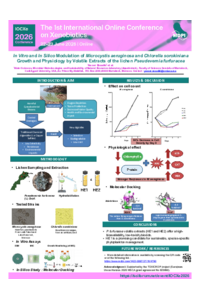
Natural compounds extracted from lichens represent a promising ecological alternative for controlling algal and cyanobacterial blooms in aquatic ecosystems. This study examines the anticyanobacterial and antimicroalgal potential of two volatile fractions (HE1 and HE2) extracted from the lichen Pseudevernia furfuracea (L.) Zopf., harvested from two Moroccan biotopes. Furthermore, the potential anticyanobacterial and antimicroalgal response mechanisms were investigated by analyzing the activity of antioxidant enzymes in the cyanobacterial species Microcystis aeruginosa and the green microalga Chlorella sorokiniana cells. In addition, a molecular docking analysis was performed to predict the experimental results, providing a mechanistic understanding of the main interactions of the identified compounds with cyanobacterial and microalgal targets. The results showed that both fractions (HE1 and HE2) inhibited the growth of M. aeruginosa and C. sorokiniana, with inhibition zone diameters of 12.6–13.7 and 20.7–20.9 mm, respectively. Minimum inhibitory concentrations (MICs) ranged from 375 to 750 µg/mL. In liquid culture, both HE1 and HE2 fractions reduced cell density by more than 98% after 8 days of exposure and decreased chlorophyll-a and protein levels by more than 80% compared to the controls. Furthermore, HE1 and HE2 induced distinct oxidative responses: M. aeruginosa exhibited early and significant increases in superoxide dismutase (SOD) and catalase (CAT) activities, as well as high malondialdehyde (MDA) levels, while C. sorokiniana showed slower and more moderate activation, indicating greater resistance to oxidative stress. Molecular docking analysis (-3.9 to -8.4 kcal mol⁻¹) identified abietatriene, δ-cadinene, guaiac acetate, atraric acid, and chloroatranol as the main bioactive compounds in the two volatile fractions (HE1 and HE2) extracted from the lichen P. furfuracea. In conclusion, the volatile extracts of P. furfuracea exert potent and species-specific inhibitory effects on cyanobacteria and microalgae through oxidative and metabolic interferences, confirming their potential as ecofriendly agents to limit cyanobacterial and algal proliferation.
Keywords
Pseudevernia furfuracea
Volatile organic compounds (VOCs)
Anti-cyanobacterial activity
Anti-microalgae
Oxidative stress
Algal proliferation
Molecular docking
Poster
Essadki_et_al.,2026.pdf
Ecotoxicological effects of the commercial fungicide NATIVO® on early development of crop plant species.
Addressing the Cyanobacterial Bloom Challenge: A Spatio-Temporal Sediment Analysis of Reservoirs and Artificial Lakes Across the SUDOE Region within the Framework of the Cyan’EAU Project