Event submissions
Published
This submission belongs to the session S1. Environmental Toxicity, Bioaccumulation and Remediation Strategies of the event The 1st International Online Conference on Xenobiotics
Published date
17 Jun, 2026
Academic Editor
'%3e%3cpath%20d='M12.6657%2010.9104C12.4185%2010.325%2012.0599%209.79327%2011.6097%209.34482C11.1609%208.89508%2010.6293%208.5365%2010.0442%208.28888C10.0389%208.28626%2010.0337%208.28495%2010.0285%208.28233C10.8446%207.69279%2011.3752%206.73249%2011.3752%205.64904C11.3752%203.8542%209.92103%202.39999%208.1262%202.39999C6.33136%202.39999%204.87715%203.8542%204.87715%205.64904C4.87715%206.73249%205.40774%207.69279%206.22393%208.28364C6.21869%208.28626%206.21345%208.28757%206.20821%208.29019C5.62129%208.5378%205.09463%208.89284%204.64265%209.34613C4.1929%209.79493%203.83432%2010.3266%203.58671%2010.9117C3.34345%2011.4845%203.21226%2012.0987%203.20023%2012.7209C3.19988%2012.7349%203.20233%2012.7488%203.20744%2012.7619C3.21255%2012.7749%203.22022%2012.7867%203.22998%2012.7968C3.23975%2012.8068%203.25142%2012.8147%203.26431%2012.8202C3.2772%2012.8256%203.29105%2012.8284%203.30504%2012.8284H4.09109C4.14874%2012.8284%204.19459%2012.7825%204.1959%2012.7262C4.2221%2011.7148%204.62823%2010.7676%205.34617%2010.0497C6.08899%209.30683%207.0755%208.89808%208.1262%208.89808C9.17689%208.89808%2010.1634%209.30683%2010.9062%2010.0497C11.6242%2010.7676%2012.0303%2011.7148%2012.0565%2012.7262C12.0578%2012.7838%2012.1037%2012.8284%2012.1613%2012.8284H12.9474C12.9613%2012.8284%2012.9752%2012.8256%2012.9881%2012.8202C13.001%2012.8147%2013.0126%2012.8068%2013.0224%2012.7968C13.0322%2012.7867%2013.0398%2012.7749%2013.0449%2012.7619C13.0501%2012.7488%2013.0525%2012.7349%2013.0522%2012.7209C13.0391%2012.0947%2012.9094%2011.4855%2012.6657%2010.9104ZM8.1262%207.9024C7.52486%207.9024%206.9589%207.6679%206.53312%207.24211C6.10733%206.81633%205.87283%206.25037%205.87283%205.64904C5.87283%205.0477%206.10733%204.48174%206.53312%204.05596C6.9589%203.63018%207.52486%203.39567%208.1262%203.39567C8.72753%203.39567%209.29349%203.63018%209.71927%204.05596C10.1451%204.48174%2010.3796%205.0477%2010.3796%205.64904C10.3796%206.25037%2010.1451%206.81633%209.71927%207.24211C9.29349%207.6679%208.72753%207.9024%208.1262%207.9024Z'%20fill='%235D1EE1'/%3e%3c/g%3e%3c/svg%3e) A. P. Pinto
A. P. PintoCitation
Antonio Peña-Fernández, Hazem Matar, Robert P. Chilcott, Borja Martínez-Alonso, Victor Guarnizo, Antonio Juberías, María de los Ángeles Peña, Guillermo Torrado, Norma S. Torres, PRELIMINARY EVALUATION OF NOVEL SURFACTANT-BASED DECONTAMINANTS FOR SKIN EXPOSURE TO PHORATE: A SIMULANT OF THE VX NERVE AGENT. , in Proceedings of The 1st International Online Conference on Xenobiotics, 22 June–23 June 2026, MDPI: Basel, Switzerland
Share
Email
Facebook
Twitter
LinkedIn
PRELIMINARY EVALUATION OF NOVEL SURFACTANT-BASED DECONTAMINANTS FOR SKIN EXPOSURE TO PHORATE: A SIMULANT OF THE VX NERVE AGENT.

Antonio Peña-Fernández 1
'%3e%3cpath%20d='M12.6647%2010.9104C12.4176%2010.325%2012.0589%209.7933%2011.6088%209.34485C11.16%208.89511%2010.6283%208.53653%2010.0432%208.28891C10.038%208.28629%2010.0327%208.28498%2010.0275%208.28236C10.8437%207.69282%2011.3743%206.73252%2011.3743%205.64907C11.3743%203.85423%209.92005%202.40002%208.12522%202.40002C6.33038%202.40002%204.87618%203.85423%204.87618%205.64907C4.87618%206.73252%205.40677%207.69282%206.22296%208.28367C6.21772%208.28629%206.21248%208.2876%206.20724%208.29022C5.62031%208.53783%205.09365%208.89287%204.64167%209.34616C4.19192%209.79496%203.83334%2010.3266%203.58573%2010.9117C3.34247%2011.4846%203.21128%2012.0987%203.19925%2012.721C3.1989%2012.735%203.20135%2012.7489%203.20646%2012.7619C3.21157%2012.7749%203.21924%2012.7868%203.22901%2012.7968C3.23877%2012.8068%203.25045%2012.8148%203.26334%2012.8202C3.27623%2012.8256%203.29007%2012.8284%203.30406%2012.8284H4.09012C4.14776%2012.8284%204.19362%2012.7825%204.19493%2012.7262C4.22113%2011.7148%204.62726%2010.7676%205.34519%2010.0497C6.08802%209.30686%207.07452%208.89811%208.12522%208.89811C9.17592%208.89811%2010.1624%209.30686%2010.9052%2010.0497C11.6232%2010.7676%2012.0293%2011.7148%2012.0555%2012.7262C12.0568%2012.7839%2012.1027%2012.8284%2012.1603%2012.8284H12.9464C12.9604%2012.8284%2012.9742%2012.8256%2012.9871%2012.8202C13%2012.8148%2013.0117%2012.8068%2013.0214%2012.7968C13.0312%2012.7868%2013.0389%2012.7749%2013.044%2012.7619C13.0491%2012.7489%2013.0515%2012.735%2013.0512%2012.721C13.0381%2012.0947%2012.9084%2011.4856%2012.6647%2010.9104ZM8.12522%207.90243C7.52388%207.90243%206.95792%207.66793%206.53214%207.24215C6.10636%206.81636%205.87185%206.2504%205.87185%205.64907C5.87185%205.04773%206.10636%204.48177%206.53214%204.05599C6.95792%203.63021%207.52388%203.3957%208.12522%203.3957C8.72655%203.3957%209.29252%203.63021%209.7183%204.05599C10.1441%204.48177%2010.3786%205.04773%2010.3786%205.64907C10.3786%206.2504%2010.1441%206.81636%209.7183%207.24215C9.29252%207.66793%208.72655%207.90243%208.12522%207.90243Z'%20fill='%235D1EE1'/%3e%3c/g%3e%3c/svg%3e)
Hazem Matar 2
Robert P. Chilcott 3
Borja Martínez-Alonso 4
Victor Guarnizo 4
Antonio Juberías 5

María de los Ángeles Peña 4
Norma S. Torres 4
Guillermo Torrado 4
1. Department of Surgery, Medical and Social Sciences, Faculty of Medicine and Health Sciences, University of Alcalá, Ctra. Madrid-Barcelona, Km. 33.600, 28871 Alcalá de Henares, Madrid, Spain., Spain
2. Ereuna Ltd., Porton Science Park, Bybrook road, Porton Down, SP4 0BF Wiltshire, UK, UK
3. Research Centre for Topical Drug Delivery and Toxicology, University of Hertfordshire, Hatfield AL10 9AB, UK, UK
4. Department of Biomedical Sciences, University of Alcalá, Madrid–Barcelona Road (A-2), Km 33.6, Alcalá de Henares, 28871 Madrid, Spain., Spain
5. Defence Military Pharmacy Centre (Centro Militar de Farmacia de la Defensa), Miraflores Road (M-609), Km 34, Colmenar Viejo, 28770 Madrid, Spain., Spain
Abstract
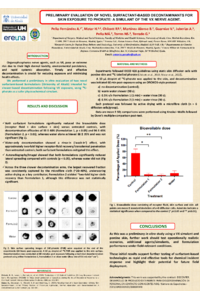
Effective skin decontamination is critical during mass-casualty incidents involving organophosphorus nerve agents, where dermal exposure and persistence can drive morbidity. We performed a preliminary in vitro evaluation of two novel surfactant-based formulations (University of Alcalá) intended for shower-based decontamination following VX exposure, using ¹⁴C-phorate as a safer physicochemical simulant. Experiments followed OECD Test Guideline 428 using static Franz-type diffusion cells with dermatomed porcine skin. A 10 µL droplet of ¹⁴C-phorate was applied to the skin, and decontamination was initiated 60 min post-exposure using an ORCHIDS-style protocol: (i) no decontamination (control); (ii) warm water shower (90 s); (iii) 0.5% v/v Formulation 1 (1 min) + water rinse (30 s); or (iv) 0.5% v/v Formulation 2 (1 min) + water rinse (30 s). Each protocol was followed by active drying with a microfibre cloth (n = 6 diffusion cells/group). Radioactivity was quantified by liquid scintillation counting in receptor fluid, donor chamber, skin surface, skin, shower effluent, and cloth; autoradiography with ImageJ was used to quantify lateral spreading. Non-parametric statistics used Kruskal–Wallis with Dunn’s multiple comparisons. Both surfactant formulations significantly reduced the bioavailable dose (receptor fluid + skin surface + skin) versus untreated controls, with decontamination efficacies of 93 ± 48% (Formulation 1, p < 0.05) and 96 ± 45% (Formulation 2, p < 0.05), whereas water alone achieved 88 ± 35% and was not significant. Water-only decontamination exhibited a rinse-in (“wash-in”) effect, with approximately doubled simulant penetration into skin versus untreated controls; both surfactant formulations negated this effect. Autoradiography/ImageJ showed that both formulations significantly reduced lateral spreading compared with controls (p < 0.05), whereas water did not. Across the three shower decontamination arms, the largest recovered fraction was consistently captured by the microfibre cloth (~20–40%), underscoring active drying as a key contributor; Formulation 2 yielded ~two-fold higher cloth recovery than Formulation 1, although this difference was not statistically significant. These initial results support further testing of surfactant-based technologies as rapid and effective tools for chemical incident response and highlight their potential for future field deployment.
Keywords
VX simulant
phorate
skin decontamination
surfactant formulation
wash-in effect
mass casualty decontamination.
Poster
MDPI 2026_Vx poster_APF.pdf
Addressing the Cyanobacterial Bloom Challenge: A Spatio-Temporal Sediment Analysis of Reservoirs and Artificial Lakes Across the SUDOE Region within the Framework of the Cyan’EAU Project
PATHOLOGICAL, BIOCHEMICAL AND IMMUNOLOGICAL STUDIES ON EXPERIMENTAL OCHRATOXIN A TOXICOSIS IN RABBITS