Event submissions
Published
This submission belongs to the session S1. Environmental Toxicity, Bioaccumulation and Remediation Strategies of the event The 1st International Online Conference on Xenobiotics
Published date
17 Jun, 2026
Academic Editor
'%3e%3cpath%20d='M12.6657%2010.9104C12.4185%2010.325%2012.0599%209.79327%2011.6097%209.34482C11.1609%208.89508%2010.6293%208.5365%2010.0442%208.28888C10.0389%208.28626%2010.0337%208.28495%2010.0285%208.28233C10.8446%207.69279%2011.3752%206.73249%2011.3752%205.64904C11.3752%203.8542%209.92103%202.39999%208.1262%202.39999C6.33136%202.39999%204.87715%203.8542%204.87715%205.64904C4.87715%206.73249%205.40774%207.69279%206.22393%208.28364C6.21869%208.28626%206.21345%208.28757%206.20821%208.29019C5.62129%208.5378%205.09463%208.89284%204.64265%209.34613C4.1929%209.79493%203.83432%2010.3266%203.58671%2010.9117C3.34345%2011.4845%203.21226%2012.0987%203.20023%2012.7209C3.19988%2012.7349%203.20233%2012.7488%203.20744%2012.7619C3.21255%2012.7749%203.22022%2012.7867%203.22998%2012.7968C3.23975%2012.8068%203.25142%2012.8147%203.26431%2012.8202C3.2772%2012.8256%203.29105%2012.8284%203.30504%2012.8284H4.09109C4.14874%2012.8284%204.19459%2012.7825%204.1959%2012.7262C4.2221%2011.7148%204.62823%2010.7676%205.34617%2010.0497C6.08899%209.30683%207.0755%208.89808%208.1262%208.89808C9.17689%208.89808%2010.1634%209.30683%2010.9062%2010.0497C11.6242%2010.7676%2012.0303%2011.7148%2012.0565%2012.7262C12.0578%2012.7838%2012.1037%2012.8284%2012.1613%2012.8284H12.9474C12.9613%2012.8284%2012.9752%2012.8256%2012.9881%2012.8202C13.001%2012.8147%2013.0126%2012.8068%2013.0224%2012.7968C13.0322%2012.7867%2013.0398%2012.7749%2013.0449%2012.7619C13.0501%2012.7488%2013.0525%2012.7349%2013.0522%2012.7209C13.0391%2012.0947%2012.9094%2011.4855%2012.6657%2010.9104ZM8.1262%207.9024C7.52486%207.9024%206.9589%207.6679%206.53312%207.24211C6.10733%206.81633%205.87283%206.25037%205.87283%205.64904C5.87283%205.0477%206.10733%204.48174%206.53312%204.05596C6.9589%203.63018%207.52486%203.39567%208.1262%203.39567C8.72753%203.39567%209.29349%203.63018%209.71927%204.05596C10.1451%204.48174%2010.3796%205.0477%2010.3796%205.64904C10.3796%206.25037%2010.1451%206.81633%209.71927%207.24211C9.29349%207.6679%208.72753%207.9024%208.1262%207.9024Z'%20fill='%235D1EE1'/%3e%3c/g%3e%3c/svg%3e) A. P. Pinto
A. P. PintoCitation
Marina Rubio Bellido, Belén Rodriguez Morillo, Alba Lara Moreno, Fernando Madrid Díaz, Jaime Villaverde Capellán, Enhanced biodegradation of phenylurea herbicides in polluted soils using a combined bioagmentation and biostimulation technology, in Proceedings of The 1st International Online Conference on Xenobiotics, 22 June–23 June 2026, MDPI: Basel, Switzerland
Share
Email
Facebook
Twitter
LinkedIn
Enhanced biodegradation of phenylurea herbicides in polluted soils using a combined bioagmentation and biostimulation technology
'%3e%3cpath%20d='M12.6647%2010.9104C12.4176%2010.325%2012.0589%209.7933%2011.6088%209.34485C11.16%208.89511%2010.6283%208.53653%2010.0432%208.28891C10.038%208.28629%2010.0327%208.28498%2010.0275%208.28236C10.8437%207.69282%2011.3743%206.73252%2011.3743%205.64907C11.3743%203.85423%209.92005%202.40002%208.12522%202.40002C6.33038%202.40002%204.87618%203.85423%204.87618%205.64907C4.87618%206.73252%205.40677%207.69282%206.22296%208.28367C6.21772%208.28629%206.21248%208.2876%206.20724%208.29022C5.62031%208.53783%205.09365%208.89287%204.64167%209.34616C4.19192%209.79496%203.83334%2010.3266%203.58573%2010.9117C3.34247%2011.4846%203.21128%2012.0987%203.19925%2012.721C3.1989%2012.735%203.20135%2012.7489%203.20646%2012.7619C3.21157%2012.7749%203.21924%2012.7868%203.22901%2012.7968C3.23877%2012.8068%203.25045%2012.8148%203.26334%2012.8202C3.27623%2012.8256%203.29007%2012.8284%203.30406%2012.8284H4.09012C4.14776%2012.8284%204.19362%2012.7825%204.19493%2012.7262C4.22113%2011.7148%204.62726%2010.7676%205.34519%2010.0497C6.08802%209.30686%207.07452%208.89811%208.12522%208.89811C9.17592%208.89811%2010.1624%209.30686%2010.9052%2010.0497C11.6232%2010.7676%2012.0293%2011.7148%2012.0555%2012.7262C12.0568%2012.7839%2012.1027%2012.8284%2012.1603%2012.8284H12.9464C12.9604%2012.8284%2012.9742%2012.8256%2012.9871%2012.8202C13%2012.8148%2013.0117%2012.8068%2013.0214%2012.7968C13.0312%2012.7868%2013.0389%2012.7749%2013.044%2012.7619C13.0491%2012.7489%2013.0515%2012.735%2013.0512%2012.721C13.0381%2012.0947%2012.9084%2011.4856%2012.6647%2010.9104ZM8.12522%207.90243C7.52388%207.90243%206.95792%207.66793%206.53214%207.24215C6.10636%206.81636%205.87185%206.2504%205.87185%205.64907C5.87185%205.04773%206.10636%204.48177%206.53214%204.05599C6.95792%203.63021%207.52388%203.3957%208.12522%203.3957C8.72655%203.3957%209.29252%203.63021%209.7183%204.05599C10.1441%204.48177%2010.3786%205.04773%2010.3786%205.64907C10.3786%206.2504%2010.1441%206.81636%209.7183%207.24215C9.29252%207.66793%208.72655%207.90243%208.12522%207.90243Z'%20fill='%235D1EE1'/%3e%3c/g%3e%3c/svg%3e)
Marina Rubio Bellido 1
Belén Rodriguez Morillo 1
Alba Lara Moreno 2
Fernando Madrid Díaz 1

Jaime Villaverde Capellán 1
1. Institute of Natural Resources and Agrobiology of Seville, Department of Agrochemistry, Environmental Microbiology and Soil Conservation, Spanish National Research Council (IRNAS-CSIC), 41012 Seville, Spain, Spain
2. Department of Microbiology and Parasitology, Faculty of Pharmacy, University of Seville, 41012 Seville, Spain, Spain
Abstract
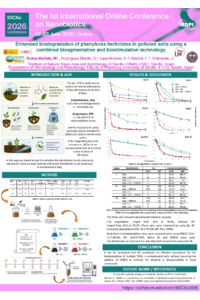
Pesticides are pollutants of significant environmental concern due to their widespread occurrence across diverse ecosystems. Among them, phenylurea herbicides (PUHs) are reported to be some of the most extensively used compounds in agriculture. To remediate soils contaminated with these organic pollutants, bioaugmentation and biostimulation have emerged as increasingly important green technologies over the past two decades. In addition, cyclodextrins (CDs) have been proposed as environmentally friendly alternatives to organic solvents or synthetic surfactants to improve solubilization, making these compounds more bioaccessible and enabling subsequent removal of hydrophobic contaminants from soils.
The aim of this study was to assess the natural attenuation of two PHUs, 3-(3-chloro-4-methylphenyl)-1,1-dimethylurea (chlorotoluron, CHL) and 1,1-dimethyl-3-(4-isopropylphenyl)urea (isoproturon, ISP), and the feasibility of using hydroxypropyl‑β‑cyclodextrin (HPβCD) or/and in combination with a PHU-degrading bacterial consortium (BC) in three real contaminated soils at an initial concentration of 10 mg kg-1. In this way, we intend to confirm whether the satisfactory results previously obtained in solution tests could be effectively transferred to soil conditions at contaminated sites.
The three soils showed natural bioremediation capacity: CHL degradation ranged from 29.6 to76.6%, whereas ISP ranged from 41.9 to 99.2%. These rates were improved by using the BC increasing degradation (CHL: 94.4-99.9%; ISP: 98.2-100%). In contrast, reductions in biodegradation rates were recorded when using HPβCD (CHL: 12.7-60.4%; ISP: 44.8-97.0%). When BC and HPβCD were used simultaneously, no improvement was observed compared to using only BC.
Based on these findings, it can be concluded that BC constitutes an effective consortium for the biodegradation of multiple PUHs in contaminated soils, without requiring the addition of HPβCD to enhance the solubility or bioaccessibility of these compounds in solution.
Keywords
Phenylurea herbicides
Hydroxypropyl-β-cyclodextrin
Bioaugmentation
Biodegradation
Bacterial consortium
Poster
Póster Marina Rubio Bellido.pdf
PATHOLOGICAL, BIOCHEMICAL AND IMMUNOLOGICAL STUDIES ON EXPERIMENTAL OCHRATOXIN A TOXICOSIS IN RABBITS
Innovative Integrated Platform Combining a Myco-Phytoremediation System with Portable Electrochemical Sensing for Sustainable Remediation of Heavy Metal-Contaminated Soils