Event submissions
Published
This submission belongs to the session S1. Environmental Toxicity, Bioaccumulation and Remediation Strategies of the event The 1st International Online Conference on Xenobiotics
Published date
17 Jun, 2026
Academic Editor
'%3e%3cpath%20d='M12.6657%2010.9104C12.4185%2010.325%2012.0599%209.79327%2011.6097%209.34482C11.1609%208.89508%2010.6293%208.5365%2010.0442%208.28888C10.0389%208.28626%2010.0337%208.28495%2010.0285%208.28233C10.8446%207.69279%2011.3752%206.73249%2011.3752%205.64904C11.3752%203.8542%209.92103%202.39999%208.1262%202.39999C6.33136%202.39999%204.87715%203.8542%204.87715%205.64904C4.87715%206.73249%205.40774%207.69279%206.22393%208.28364C6.21869%208.28626%206.21345%208.28757%206.20821%208.29019C5.62129%208.5378%205.09463%208.89284%204.64265%209.34613C4.1929%209.79493%203.83432%2010.3266%203.58671%2010.9117C3.34345%2011.4845%203.21226%2012.0987%203.20023%2012.7209C3.19988%2012.7349%203.20233%2012.7488%203.20744%2012.7619C3.21255%2012.7749%203.22022%2012.7867%203.22998%2012.7968C3.23975%2012.8068%203.25142%2012.8147%203.26431%2012.8202C3.2772%2012.8256%203.29105%2012.8284%203.30504%2012.8284H4.09109C4.14874%2012.8284%204.19459%2012.7825%204.1959%2012.7262C4.2221%2011.7148%204.62823%2010.7676%205.34617%2010.0497C6.08899%209.30683%207.0755%208.89808%208.1262%208.89808C9.17689%208.89808%2010.1634%209.30683%2010.9062%2010.0497C11.6242%2010.7676%2012.0303%2011.7148%2012.0565%2012.7262C12.0578%2012.7838%2012.1037%2012.8284%2012.1613%2012.8284H12.9474C12.9613%2012.8284%2012.9752%2012.8256%2012.9881%2012.8202C13.001%2012.8147%2013.0126%2012.8068%2013.0224%2012.7968C13.0322%2012.7867%2013.0398%2012.7749%2013.0449%2012.7619C13.0501%2012.7488%2013.0525%2012.7349%2013.0522%2012.7209C13.0391%2012.0947%2012.9094%2011.4855%2012.6657%2010.9104ZM8.1262%207.9024C7.52486%207.9024%206.9589%207.6679%206.53312%207.24211C6.10733%206.81633%205.87283%206.25037%205.87283%205.64904C5.87283%205.0477%206.10733%204.48174%206.53312%204.05596C6.9589%203.63018%207.52486%203.39567%208.1262%203.39567C8.72753%203.39567%209.29349%203.63018%209.71927%204.05596C10.1451%204.48174%2010.3796%205.0477%2010.3796%205.64904C10.3796%206.25037%2010.1451%206.81633%209.71927%207.24211C9.29349%207.6679%208.72753%207.9024%208.1262%207.9024Z'%20fill='%235D1EE1'/%3e%3c/g%3e%3c/svg%3e) Stefano Magni
Stefano MagniCitation
A. P. Pinto, Ana V. Dordio, Alfredo J. P. Carvalho, Hugo Carrão, Evaluation of Bacillus pumilus for Pharmaceutical Removal from Contaminated Water, in Proceedings of The 1st International Online Conference on Xenobiotics, 22 June–23 June 2026, MDPI: Basel, Switzerland
Share
Email
Facebook
Twitter
LinkedIn
Evaluation of Bacillus pumilus for Pharmaceutical Removal from Contaminated Water

Ana V. Dordio 1,2

Alfredo J. P. Carvalho 1,2
'%3e%3cpath%20d='M12.6647%2010.9104C12.4176%2010.325%2012.0589%209.7933%2011.6088%209.34485C11.16%208.89511%2010.6283%208.53653%2010.0432%208.28891C10.038%208.28629%2010.0327%208.28498%2010.0275%208.28236C10.8437%207.69282%2011.3743%206.73252%2011.3743%205.64907C11.3743%203.85423%209.92005%202.40002%208.12522%202.40002C6.33038%202.40002%204.87618%203.85423%204.87618%205.64907C4.87618%206.73252%205.40677%207.69282%206.22296%208.28367C6.21772%208.28629%206.21248%208.2876%206.20724%208.29022C5.62031%208.53783%205.09365%208.89287%204.64167%209.34616C4.19192%209.79496%203.83334%2010.3266%203.58573%2010.9117C3.34247%2011.4846%203.21128%2012.0987%203.19925%2012.721C3.1989%2012.735%203.20135%2012.7489%203.20646%2012.7619C3.21157%2012.7749%203.21924%2012.7868%203.22901%2012.7968C3.23877%2012.8068%203.25045%2012.8148%203.26334%2012.8202C3.27623%2012.8256%203.29007%2012.8284%203.30406%2012.8284H4.09012C4.14776%2012.8284%204.19362%2012.7825%204.19493%2012.7262C4.22113%2011.7148%204.62726%2010.7676%205.34519%2010.0497C6.08802%209.30686%207.07452%208.89811%208.12522%208.89811C9.17592%208.89811%2010.1624%209.30686%2010.9052%2010.0497C11.6232%2010.7676%2012.0293%2011.7148%2012.0555%2012.7262C12.0568%2012.7839%2012.1027%2012.8284%2012.1603%2012.8284H12.9464C12.9604%2012.8284%2012.9742%2012.8256%2012.9871%2012.8202C13%2012.8148%2013.0117%2012.8068%2013.0214%2012.7968C13.0312%2012.7868%2013.0389%2012.7749%2013.044%2012.7619C13.0491%2012.7489%2013.0515%2012.735%2013.0512%2012.721C13.0381%2012.0947%2012.9084%2011.4856%2012.6647%2010.9104ZM8.12522%207.90243C7.52388%207.90243%206.95792%207.66793%206.53214%207.24215C6.10636%206.81636%205.87185%206.2504%205.87185%205.64907C5.87185%205.04773%206.10636%204.48177%206.53214%204.05599C6.95792%203.63021%207.52388%203.3957%208.12522%203.3957C8.72655%203.3957%209.29252%203.63021%209.7183%204.05599C10.1441%204.48177%2010.3786%205.04773%2010.3786%205.64907C10.3786%206.2504%2010.1441%206.81636%209.7183%207.24215C9.29252%207.66793%208.72655%207.90243%208.12522%207.90243Z'%20fill='%235D1EE1'/%3e%3c/g%3e%3c/svg%3e)
Hugo Carrão 3

A. P. Pinto 2,4
1. MARE - Marine and Environmental Sciences Centre, School of Sciences and Technology, University of Évora, Évora, Portugal, Portugal
2. Chemistry and Biochemistry Department, School of Sciences and Technology, Évora University, Rua Romão Ramalho nº59, 7000-671 Évora, Portugal
3. Chemistry and Biochemistry Department, School of Sciences and Technology, Évora University, Rua Romão Ramalho nº59, 7000-671 Évora, Portugal, Portugal
4. Mediterranean Institute for Agriculture, Environment and Development, MED & Global Change and Sustainability Institute, CHANGE, Institute for Advanced Studies and Research, Évora University, Pólo da Mitra, Ap. 94, 7006-554 Évora, Portugal, Portugal
Abstract
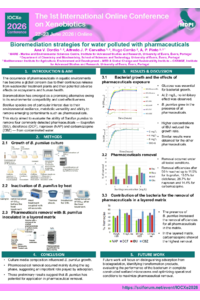
Pharmaceuticals in aquatic environments are a global concern, driving the search for sustainable removal technologies. Bioremediation is promising due to its environmental compatibility and low cost. Bacillus species are attractive candidates because of their metabolic versatility, resilience, and ability to remove emerging contaminants. However, improving removal efficiency remains essential for wastewater treatment.
This preliminary study evaluates the potential of Bacillus pumilus to remove ibuprofen, carbamazepine, diclofenac, and naproxen from contaminated water, supporting future optimization studies of this bacterial system.
The bacterium was cultivated in modified Marchlewicz et al. (2016) medium at 30 °C and 200 rpm, starting at an OD600 of ~0.03. Batch assays were performed with and without glucose (1 g L⁻¹) in 200 mL cultures containing individual pharmaceuticals (2–8 mg L⁻¹) or a mixture of the four compounds (2 mg L⁻¹ each) for 50 h. Growth was monitored by OD600 and residual pharmaceutical concentrations were quantified by HPLC–UV/Vis.
Controls with heat-inactivated cells and without glucose were included to assess adsorption onto bacterial biomass.
Culture medium composition affected growth, with glucose as an essential carbon and energy source. B. pumilus grew with all pharmaceuticals, although inhibition increased with concentration, and was strongest for ibuprofen (8 mg L⁻¹).
Pharmaceutical removal occurred under all conditions, reaching 50 h efficiencies of 6.8–11.5% (ibuprofen), 23–27% (naproxen), 10–15.5% (diclofenac), and 6.9–14.4% (carbamazepine). Removal was highest during the first 6 h of incubation. In fact, 25–88% of total removal occurred during the lag phase (2 h), when cell proliferation was minimal, indicating that adsorption onto bacterial biomass is the predominant initial mechanism, followed by slower removal during subsequent growth phases.
In summary, Bacillus pumilus removed the tested pharmaceuticals, with adsorption playing a major role in the initial phase. Although efficiencies were moderate, the results highlight its potential for pharmaceutical removal and support further optimization for wastewater treatment applications.
Marchlewicz A. et al., 2016. Water Air Soil Pollut. 227(6).
Keywords
Bioremediation
Bacillus pumilus
Emerging pharmaceutical contaminants
Adsorption
Wastewater treatment
Poster
APPinto-Bioremediation strategies for water polluted with pharmaceuticals.pdf
Environmental Fate and Bioaccumulation of Antibiotic Xenobiotics in Aquatic Ecosystems: Ecotoxicological Risks and Bioremediation Approaches
The Pyruvate–Glyoxalate Pathway as a Toxicity Assessment Tool of Xenobiotics: Lessons from Prebiotic Chemistry.