Event submissions
Published
This submission belongs to the session S1. Environmental Toxicity, Bioaccumulation and Remediation Strategies of the event The 1st International Online Conference on Xenobiotics
Published date
17 Jun, 2026
Academic Editor
'%3e%3cpath%20d='M12.6657%2010.9104C12.4185%2010.325%2012.0599%209.79327%2011.6097%209.34482C11.1609%208.89508%2010.6293%208.5365%2010.0442%208.28888C10.0389%208.28626%2010.0337%208.28495%2010.0285%208.28233C10.8446%207.69279%2011.3752%206.73249%2011.3752%205.64904C11.3752%203.8542%209.92103%202.39999%208.1262%202.39999C6.33136%202.39999%204.87715%203.8542%204.87715%205.64904C4.87715%206.73249%205.40774%207.69279%206.22393%208.28364C6.21869%208.28626%206.21345%208.28757%206.20821%208.29019C5.62129%208.5378%205.09463%208.89284%204.64265%209.34613C4.1929%209.79493%203.83432%2010.3266%203.58671%2010.9117C3.34345%2011.4845%203.21226%2012.0987%203.20023%2012.7209C3.19988%2012.7349%203.20233%2012.7488%203.20744%2012.7619C3.21255%2012.7749%203.22022%2012.7867%203.22998%2012.7968C3.23975%2012.8068%203.25142%2012.8147%203.26431%2012.8202C3.2772%2012.8256%203.29105%2012.8284%203.30504%2012.8284H4.09109C4.14874%2012.8284%204.19459%2012.7825%204.1959%2012.7262C4.2221%2011.7148%204.62823%2010.7676%205.34617%2010.0497C6.08899%209.30683%207.0755%208.89808%208.1262%208.89808C9.17689%208.89808%2010.1634%209.30683%2010.9062%2010.0497C11.6242%2010.7676%2012.0303%2011.7148%2012.0565%2012.7262C12.0578%2012.7838%2012.1037%2012.8284%2012.1613%2012.8284H12.9474C12.9613%2012.8284%2012.9752%2012.8256%2012.9881%2012.8202C13.001%2012.8147%2013.0126%2012.8068%2013.0224%2012.7968C13.0322%2012.7867%2013.0398%2012.7749%2013.0449%2012.7619C13.0501%2012.7488%2013.0525%2012.7349%2013.0522%2012.7209C13.0391%2012.0947%2012.9094%2011.4855%2012.6657%2010.9104ZM8.1262%207.9024C7.52486%207.9024%206.9589%207.6679%206.53312%207.24211C6.10733%206.81633%205.87283%206.25037%205.87283%205.64904C5.87283%205.0477%206.10733%204.48174%206.53312%204.05596C6.9589%203.63018%207.52486%203.39567%208.1262%203.39567C8.72753%203.39567%209.29349%203.63018%209.71927%204.05596C10.1451%204.48174%2010.3796%205.0477%2010.3796%205.64904C10.3796%206.25037%2010.1451%206.81633%209.71927%207.24211C9.29349%207.6679%208.72753%207.9024%208.1262%207.9024Z'%20fill='%235D1EE1'/%3e%3c/g%3e%3c/svg%3e) A. P. Pinto
A. P. PintoCitation
Hanen CHAABANI, Hiba Hamdi, Moncef Mokni, Yosra Guedri, Imen Ayed Boussema, Salwa Abid-Essefi, Molecular insights into the renal and hepatic toxicity of the fungicide Trifloxystrobin, in Proceedings of The 1st International Online Conference on Xenobiotics, 22 June–23 June 2026, MDPI: Basel, Switzerland
Share
Email
Facebook
Twitter
LinkedIn
Molecular insights into the renal and hepatic toxicity of the fungicide Trifloxystrobin
'%3e%3cpath%20d='M12.6647%2010.9104C12.4176%2010.325%2012.0589%209.7933%2011.6088%209.34485C11.16%208.89511%2010.6283%208.53653%2010.0432%208.28891C10.038%208.28629%2010.0327%208.28498%2010.0275%208.28236C10.8437%207.69282%2011.3743%206.73252%2011.3743%205.64907C11.3743%203.85423%209.92005%202.40002%208.12522%202.40002C6.33038%202.40002%204.87618%203.85423%204.87618%205.64907C4.87618%206.73252%205.40677%207.69282%206.22296%208.28367C6.21772%208.28629%206.21248%208.2876%206.20724%208.29022C5.62031%208.53783%205.09365%208.89287%204.64167%209.34616C4.19192%209.79496%203.83334%2010.3266%203.58573%2010.9117C3.34247%2011.4846%203.21128%2012.0987%203.19925%2012.721C3.1989%2012.735%203.20135%2012.7489%203.20646%2012.7619C3.21157%2012.7749%203.21924%2012.7868%203.22901%2012.7968C3.23877%2012.8068%203.25045%2012.8148%203.26334%2012.8202C3.27623%2012.8256%203.29007%2012.8284%203.30406%2012.8284H4.09012C4.14776%2012.8284%204.19362%2012.7825%204.19493%2012.7262C4.22113%2011.7148%204.62726%2010.7676%205.34519%2010.0497C6.08802%209.30686%207.07452%208.89811%208.12522%208.89811C9.17592%208.89811%2010.1624%209.30686%2010.9052%2010.0497C11.6232%2010.7676%2012.0293%2011.7148%2012.0555%2012.7262C12.0568%2012.7839%2012.1027%2012.8284%2012.1603%2012.8284H12.9464C12.9604%2012.8284%2012.9742%2012.8256%2012.9871%2012.8202C13%2012.8148%2013.0117%2012.8068%2013.0214%2012.7968C13.0312%2012.7868%2013.0389%2012.7749%2013.044%2012.7619C13.0491%2012.7489%2013.0515%2012.735%2013.0512%2012.721C13.0381%2012.0947%2012.9084%2011.4856%2012.6647%2010.9104ZM8.12522%207.90243C7.52388%207.90243%206.95792%207.66793%206.53214%207.24215C6.10636%206.81636%205.87185%206.2504%205.87185%205.64907C5.87185%205.04773%206.10636%204.48177%206.53214%204.05599C6.95792%203.63021%207.52388%203.3957%208.12522%203.3957C8.72655%203.3957%209.29252%203.63021%209.7183%204.05599C10.1441%204.48177%2010.3786%205.04773%2010.3786%205.64907C10.3786%206.2504%2010.1441%206.81636%209.7183%207.24215C9.29252%207.66793%208.72655%207.90243%208.12522%207.90243Z'%20fill='%235D1EE1'/%3e%3c/g%3e%3c/svg%3e)
Hanen CHAABANI 1
Hiba Hamdi 1
Moncef Mokni 2
Yosra Guedri 3
Imen Ayed Boussema 1,4
Salwa Abid-Essefi 1
1. Laboratory of Research on Biologically Compatible Compounds, LR01SE17, University of Monastir, Faculty of Dental Medicine, 5019, Monastir, Tunisia, Tunisia
2. Department of Anatomic Pathology and Histology, Hospital of Hached, Sousse, Tunisia, Tunisia
3. Department of Nephrology, Dialysis, and Transplant, University Hospital of Sahloul, Sousse, Tunisia, Tunisia
4. Faculty of Sciences of Gafsa, University of Gafsa, Gafsa, Tunisia
Abstract
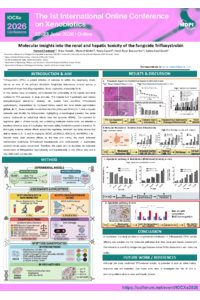
Introduction: Although the European Food Safety Authority (EFSA) previously identified potential Trifloxystrobin (TFX)-induced nephrotoxicity and hepatotoxicity, the underlying molecular mechanisms remain poorly understood. This study investigated TFX-induced toxicity using in vitro (HEK-293T and Hep-G2) and in vivo (Wistar rats) models.
Methods: Rats received oral TFX for 28 days, while cells were treated for 24 hours. Assessments included histopathology, serum biochemistry, and acetylcholinesterase (AChE) activity. Oxidative stress (ROS, MDA, SOD, CAT, GPx, GST) and genotoxicity (Comet assay, γH2AX) were evaluated. Apoptosis was quantified in vitro via Rhodamine-123 (Rh-123), Acridine Orange/Ethidium Bromide (AO/EB), and Caspase-3 activity and in vivo through p53, Bax, and Bcl-2 immunohistochemistry expression.
Results: TFX caused significant renal tubular dilatation and hepatocellular necrosis, supported by IC50 values of 40 µM (HEK-293T) and 50 µM (Hep-G2). TFX inhibited AChE activity and elevated serum biomarkers (CREA, BUN, ALT, AST) in a dose-dependent manner. Mechanistically, TFX triggered robust oxidative stress and DNA double-strand breaks. In vitro results demonstrated that TFX induces apoptotic cell death in a concentration- and caspase-dependent manner, characterized by loss of mitochondrial membrane potential (Rh-123), morphological changes (AO/EB) and increased Caspase-3 activation. Notably, NAC pretreatment significantly attenuated TFX-induced apoptosis, confirming that oxidative stress is the primary driver of cell death. These findings were corroborated in vivo by the upregulation of p53 and a pro-apoptotic shift in the Bax/Bcl-2 ratio in renal and hepatic tissues.
Conclusion: TFX-induced nephrotoxicity and hepatotoxicity are primarily driven by oxidative stress, DNA damage, and toxic AChE inhibition. The transition from cellular injury to organ dysfunction is mediated by a caspase-dependent apoptotic pathway. These results provide a comprehensive molecular framework for the systemic toxicities previously reported by regulatory authorities.
Keywords
Trifloxystrobin
oxidative stress
kidney
liver
toxicity
apoptosis
Poster
Poster IOCXE 2026.pdf
Mechanistic Insights into Early-Life Cadmium-Induced Cognitive Dysfunction in Adult Rats and the Therapeutic Role of Zinc
EFFECT OF MORINDA LUCIDA LEAF POWDER AS A NATURAL FEED ADDITIVES IN ANIMALS FOR MITIGATING ANTIBIOTIC RESIDUES IN THE ENVIRONMENT: A SYSTEMATIC REVIEW