Event submissions
Published
This submission belongs to the session S1. Environmental Toxicity, Bioaccumulation and Remediation Strategies of the event The 1st International Online Conference on Xenobiotics
Published date
17 Jun, 2026
Academic Editor
'%3e%3cpath%20d='M12.6657%2010.9104C12.4185%2010.325%2012.0599%209.79327%2011.6097%209.34482C11.1609%208.89508%2010.6293%208.5365%2010.0442%208.28888C10.0389%208.28626%2010.0337%208.28495%2010.0285%208.28233C10.8446%207.69279%2011.3752%206.73249%2011.3752%205.64904C11.3752%203.8542%209.92103%202.39999%208.1262%202.39999C6.33136%202.39999%204.87715%203.8542%204.87715%205.64904C4.87715%206.73249%205.40774%207.69279%206.22393%208.28364C6.21869%208.28626%206.21345%208.28757%206.20821%208.29019C5.62129%208.5378%205.09463%208.89284%204.64265%209.34613C4.1929%209.79493%203.83432%2010.3266%203.58671%2010.9117C3.34345%2011.4845%203.21226%2012.0987%203.20023%2012.7209C3.19988%2012.7349%203.20233%2012.7488%203.20744%2012.7619C3.21255%2012.7749%203.22022%2012.7867%203.22998%2012.7968C3.23975%2012.8068%203.25142%2012.8147%203.26431%2012.8202C3.2772%2012.8256%203.29105%2012.8284%203.30504%2012.8284H4.09109C4.14874%2012.8284%204.19459%2012.7825%204.1959%2012.7262C4.2221%2011.7148%204.62823%2010.7676%205.34617%2010.0497C6.08899%209.30683%207.0755%208.89808%208.1262%208.89808C9.17689%208.89808%2010.1634%209.30683%2010.9062%2010.0497C11.6242%2010.7676%2012.0303%2011.7148%2012.0565%2012.7262C12.0578%2012.7838%2012.1037%2012.8284%2012.1613%2012.8284H12.9474C12.9613%2012.8284%2012.9752%2012.8256%2012.9881%2012.8202C13.001%2012.8147%2013.0126%2012.8068%2013.0224%2012.7968C13.0322%2012.7867%2013.0398%2012.7749%2013.0449%2012.7619C13.0501%2012.7488%2013.0525%2012.7349%2013.0522%2012.7209C13.0391%2012.0947%2012.9094%2011.4855%2012.6657%2010.9104ZM8.1262%207.9024C7.52486%207.9024%206.9589%207.6679%206.53312%207.24211C6.10733%206.81633%205.87283%206.25037%205.87283%205.64904C5.87283%205.0477%206.10733%204.48174%206.53312%204.05596C6.9589%203.63018%207.52486%203.39567%208.1262%203.39567C8.72753%203.39567%209.29349%203.63018%209.71927%204.05596C10.1451%204.48174%2010.3796%205.0477%2010.3796%205.64904C10.3796%206.25037%2010.1451%206.81633%209.71927%207.24211C9.29349%207.6679%208.72753%207.9024%208.1262%207.9024Z'%20fill='%235D1EE1'/%3e%3c/g%3e%3c/svg%3e) Stefano Magni
Stefano MagniCitation
Alejandro Alejos-Campo, Eva Fernández-Gómez, Luis Roca-Pérez, Oscar Andreu-Sánchez, Rafael Boluda, XENOBIOTICS PERSISTENCE IN MEDITERRANEAN SOIL: EFFECTS OF COMPOST APPLICATION ON THEIR DISSIPATION, in Proceedings of The 1st International Online Conference on Xenobiotics, 22 June–23 June 2026, MDPI: Basel, Switzerland
Share
Email
Facebook
Twitter
LinkedIn
XENOBIOTICS PERSISTENCE IN MEDITERRANEAN SOIL: EFFECTS OF COMPOST APPLICATION ON THEIR DISSIPATION
'%3e%3cpath%20d='M12.6647%2010.9104C12.4176%2010.325%2012.0589%209.7933%2011.6088%209.34485C11.16%208.89511%2010.6283%208.53653%2010.0432%208.28891C10.038%208.28629%2010.0327%208.28498%2010.0275%208.28236C10.8437%207.69282%2011.3743%206.73252%2011.3743%205.64907C11.3743%203.85423%209.92005%202.40002%208.12522%202.40002C6.33038%202.40002%204.87618%203.85423%204.87618%205.64907C4.87618%206.73252%205.40677%207.69282%206.22296%208.28367C6.21772%208.28629%206.21248%208.2876%206.20724%208.29022C5.62031%208.53783%205.09365%208.89287%204.64167%209.34616C4.19192%209.79496%203.83334%2010.3266%203.58573%2010.9117C3.34247%2011.4846%203.21128%2012.0987%203.19925%2012.721C3.1989%2012.735%203.20135%2012.7489%203.20646%2012.7619C3.21157%2012.7749%203.21924%2012.7868%203.22901%2012.7968C3.23877%2012.8068%203.25045%2012.8148%203.26334%2012.8202C3.27623%2012.8256%203.29007%2012.8284%203.30406%2012.8284H4.09012C4.14776%2012.8284%204.19362%2012.7825%204.19493%2012.7262C4.22113%2011.7148%204.62726%2010.7676%205.34519%2010.0497C6.08802%209.30686%207.07452%208.89811%208.12522%208.89811C9.17592%208.89811%2010.1624%209.30686%2010.9052%2010.0497C11.6232%2010.7676%2012.0293%2011.7148%2012.0555%2012.7262C12.0568%2012.7839%2012.1027%2012.8284%2012.1603%2012.8284H12.9464C12.9604%2012.8284%2012.9742%2012.8256%2012.9871%2012.8202C13%2012.8148%2013.0117%2012.8068%2013.0214%2012.7968C13.0312%2012.7868%2013.0389%2012.7749%2013.044%2012.7619C13.0491%2012.7489%2013.0515%2012.735%2013.0512%2012.721C13.0381%2012.0947%2012.9084%2011.4856%2012.6647%2010.9104ZM8.12522%207.90243C7.52388%207.90243%206.95792%207.66793%206.53214%207.24215C6.10636%206.81636%205.87185%206.2504%205.87185%205.64907C5.87185%205.04773%206.10636%204.48177%206.53214%204.05599C6.95792%203.63021%207.52388%203.3957%208.12522%203.3957C8.72655%203.3957%209.29252%203.63021%209.7183%204.05599C10.1441%204.48177%2010.3786%205.04773%2010.3786%205.64907C10.3786%206.2504%2010.1441%206.81636%209.7183%207.24215C9.29252%207.66793%208.72655%207.90243%208.12522%207.90243Z'%20fill='%235D1EE1'/%3e%3c/g%3e%3c/svg%3e)
Alejandro Alejos-Campo 1
Eva Fernández-Gómez 1
Luis Roca-Pérez 1
Oscar Andreu-Sánchez 1
Rafael Boluda 1
1. Department of Plant Biology, Faculty of Pharmacy, Universitat de València, Avinguda Vicent Andrés Estellés, 22, 46100 Burjassot, Valencia, Spain, Spain
Abstract
The presence of organic contaminants in agroecosystems poses a significant risk to ecosystem health and food safety. These xenobiotics enter soils through sewage sludge application, reclaimed wastewater irrigation, and livestock manure, where they disrupt soil microbial diversity and functionality and impair key edaphic processes such as nutrient cycling and organic matter decomposition. Their persistence enables accumulation in plant tissues and biomagnification across trophic levels, posing risks to ecosystem health and food safety. A persistence study evaluated the behaviour of two pesticides (trifloxystrobin and pendimethalin) and two pharmaceutical products (mebendazole and venlafaxine) in a Mediterranean Alfisol soil type, as well as the effect of adding biowaste compost on their dissipation. A microcosm assay monitored their concentrations over 21 days. Determination of these compounds in the soil matrix was performed using QuEChERSER liquid-phase extraction method followed by UHPLC-MS/MS quantification. Trifloxystrobin showed rapid degradation in soil, while mebendazole exhibited high persistence in unamended soil and venlafaxine showed very high persistence in both soils. Pendimethalin dissipation was intermediate. Compost significantly accelerated the degradation of pendimethalin and mebendazole and also promoted venlafaxine degradation. These results reinforce the need to control xenobiotic contamination in intensive agricultural systems. In the Valencian Community, uptake and accumulation of organic contaminants in plant tissues has been observed, threatening food safety through bioaccumulation and biomagnification. The validation of soil bioremediation strategies using quality organic amendments like compost, together with robust analytical methods (QuEChERSER-UHPLC-MS/MS), is key to generating information that supports specific regulations and healthy soils to mitigate the ecotoxicological effects of these contaminants.
Keywords
persistence
agricultural soil
dissipation
pharmaceutical
pesticides
biocompost
Poster
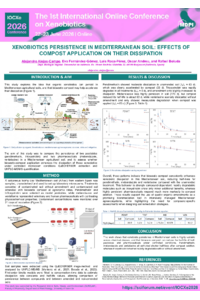
Poster.pdf
Chitosan–Niobium Nanocomposites Reduce Ciprofloxacin and Silver Nanoparticle Impacts in Freshwater Ecosystems
Use of Balanophyllia europaea as a biological model for monitoring the Mediterranean coralligenous biocenosis: the SIMBIOSI project