Event submissions
Published
This submission belongs to the session S1. Environmental Toxicity, Bioaccumulation and Remediation Strategies of the event The 1st International Online Conference on Xenobiotics
Published date
17 Jun, 2026
Academic Editor
'%3e%3cpath%20d='M12.6657%2010.9104C12.4185%2010.325%2012.0599%209.79327%2011.6097%209.34482C11.1609%208.89508%2010.6293%208.5365%2010.0442%208.28888C10.0389%208.28626%2010.0337%208.28495%2010.0285%208.28233C10.8446%207.69279%2011.3752%206.73249%2011.3752%205.64904C11.3752%203.8542%209.92103%202.39999%208.1262%202.39999C6.33136%202.39999%204.87715%203.8542%204.87715%205.64904C4.87715%206.73249%205.40774%207.69279%206.22393%208.28364C6.21869%208.28626%206.21345%208.28757%206.20821%208.29019C5.62129%208.5378%205.09463%208.89284%204.64265%209.34613C4.1929%209.79493%203.83432%2010.3266%203.58671%2010.9117C3.34345%2011.4845%203.21226%2012.0987%203.20023%2012.7209C3.19988%2012.7349%203.20233%2012.7488%203.20744%2012.7619C3.21255%2012.7749%203.22022%2012.7867%203.22998%2012.7968C3.23975%2012.8068%203.25142%2012.8147%203.26431%2012.8202C3.2772%2012.8256%203.29105%2012.8284%203.30504%2012.8284H4.09109C4.14874%2012.8284%204.19459%2012.7825%204.1959%2012.7262C4.2221%2011.7148%204.62823%2010.7676%205.34617%2010.0497C6.08899%209.30683%207.0755%208.89808%208.1262%208.89808C9.17689%208.89808%2010.1634%209.30683%2010.9062%2010.0497C11.6242%2010.7676%2012.0303%2011.7148%2012.0565%2012.7262C12.0578%2012.7838%2012.1037%2012.8284%2012.1613%2012.8284H12.9474C12.9613%2012.8284%2012.9752%2012.8256%2012.9881%2012.8202C13.001%2012.8147%2013.0126%2012.8068%2013.0224%2012.7968C13.0322%2012.7867%2013.0398%2012.7749%2013.0449%2012.7619C13.0501%2012.7488%2013.0525%2012.7349%2013.0522%2012.7209C13.0391%2012.0947%2012.9094%2011.4855%2012.6657%2010.9104ZM8.1262%207.9024C7.52486%207.9024%206.9589%207.6679%206.53312%207.24211C6.10733%206.81633%205.87283%206.25037%205.87283%205.64904C5.87283%205.0477%206.10733%204.48174%206.53312%204.05596C6.9589%203.63018%207.52486%203.39567%208.1262%203.39567C8.72753%203.39567%209.29349%203.63018%209.71927%204.05596C10.1451%204.48174%2010.3796%205.0477%2010.3796%205.64904C10.3796%206.25037%2010.1451%206.81633%209.71927%207.24211C9.29349%207.6679%208.72753%207.9024%208.1262%207.9024Z'%20fill='%235D1EE1'/%3e%3c/g%3e%3c/svg%3e) Yang-Guang Gu
Yang-Guang GuCitation
asma mnassri, Imen Ayed-Boussema, Le-Hoa Mai, Thi-Van-Ha Nguyen, Karima Rjiba, Sophie Brouard, Salwa ABID-ESSEFI, Cyproconazole, a triazole fungicide, drives human immune dysfunction by impairing regulatory B cell activity and inducing T cell senescence, in Proceedings of The 1st International Online Conference on Xenobiotics, 22 June–23 June 2026, MDPI: Basel, Switzerland
Share
Email
Facebook
Twitter
LinkedIn
Cyproconazole, a triazole fungicide, drives human immune dysfunction by impairing regulatory B cell activity and inducing T cell senescence
'%3e%3cpath%20d='M12.6647%2010.9104C12.4176%2010.325%2012.0589%209.7933%2011.6088%209.34485C11.16%208.89511%2010.6283%208.53653%2010.0432%208.28891C10.038%208.28629%2010.0327%208.28498%2010.0275%208.28236C10.8437%207.69282%2011.3743%206.73252%2011.3743%205.64907C11.3743%203.85423%209.92005%202.40002%208.12522%202.40002C6.33038%202.40002%204.87618%203.85423%204.87618%205.64907C4.87618%206.73252%205.40677%207.69282%206.22296%208.28367C6.21772%208.28629%206.21248%208.2876%206.20724%208.29022C5.62031%208.53783%205.09365%208.89287%204.64167%209.34616C4.19192%209.79496%203.83334%2010.3266%203.58573%2010.9117C3.34247%2011.4846%203.21128%2012.0987%203.19925%2012.721C3.1989%2012.735%203.20135%2012.7489%203.20646%2012.7619C3.21157%2012.7749%203.21924%2012.7868%203.22901%2012.7968C3.23877%2012.8068%203.25045%2012.8148%203.26334%2012.8202C3.27623%2012.8256%203.29007%2012.8284%203.30406%2012.8284H4.09012C4.14776%2012.8284%204.19362%2012.7825%204.19493%2012.7262C4.22113%2011.7148%204.62726%2010.7676%205.34519%2010.0497C6.08802%209.30686%207.07452%208.89811%208.12522%208.89811C9.17592%208.89811%2010.1624%209.30686%2010.9052%2010.0497C11.6232%2010.7676%2012.0293%2011.7148%2012.0555%2012.7262C12.0568%2012.7839%2012.1027%2012.8284%2012.1603%2012.8284H12.9464C12.9604%2012.8284%2012.9742%2012.8256%2012.9871%2012.8202C13%2012.8148%2013.0117%2012.8068%2013.0214%2012.7968C13.0312%2012.7868%2013.0389%2012.7749%2013.044%2012.7619C13.0491%2012.7489%2013.0515%2012.735%2013.0512%2012.721C13.0381%2012.0947%2012.9084%2011.4856%2012.6647%2010.9104ZM8.12522%207.90243C7.52388%207.90243%206.95792%207.66793%206.53214%207.24215C6.10636%206.81636%205.87185%206.2504%205.87185%205.64907C5.87185%205.04773%206.10636%204.48177%206.53214%204.05599C6.95792%203.63021%207.52388%203.3957%208.12522%203.3957C8.72655%203.3957%209.29252%203.63021%209.7183%204.05599C10.1441%204.48177%2010.3786%205.04773%2010.3786%205.64907C10.3786%206.2504%2010.1441%206.81636%209.7183%207.24215C9.29252%207.66793%208.72655%207.90243%208.12522%207.90243Z'%20fill='%235D1EE1'/%3e%3c/g%3e%3c/svg%3e)
asma mnassri 1
Imen Ayed-Boussema 1
Le-Hoa Mai 2
Thi-Van-Ha Nguyen 2
Karima Rjiba 1

Sophie Brouard 2
Salwa ABID-ESSEFI 1
1. Laboratory for Research on Biologically Compatible Compounds, Faculty of Dental Medicine, University of Monastir, Monastir, Tunisia., Tunisia
2. Center for Research in Transplantation and Translational Immunology UMR 1064, Nantes University, INSERM, Nantes, France., France
Abstract
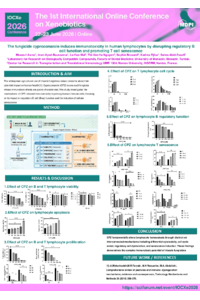
Background. Triazole fungicides, including cyproconazole (CPZ), are among the most widely applied agricultural chemicals globally. While their endocrine-disrupting properties are recognized, their impact on human lymphocyte homeostasis, particularly on immunoregulatory and senescence-associated mechanisms, remains poorly characterized.
Objective. This study investigated the cellular and molecular mechanisms by which CPZ induces immunotoxicity in primary human immune cells, with a focus on regulatory B cell (Breg) function and T lymphocyte senescence.
Methods. Primary peripheral blood mononuclear cells (PBMCs) and purified B and T lymphocyte subsets isolated from healthy donors were exposed to CPZ (30–200 µM, 24–72 h). Cell viability, proliferation, and cell cycle distribution were assessed by flow cytometry. Breg immunosuppressive capacity was evaluated in lymphocyte co-culture assays. T cell senescence was characterized by quantification of surface markers (CD57, CD28, CD27, PD-1) and SASP-associated cytokine secretion was assessed by ELISA. Data were analyzed using one-way ANOVA with Tukey's post hoc test.
Results. CPZ concentration- and time-dependently impaired B cell homeostasis and abrogated Breg-mediated immunosuppression, resulting in a shift toward a pro-inflammatory cytokine milieu. Concurrently, CPZ drove T lymphocytes toward a senescent phenotype, characterized by G0/G1 cell cycle arrest, apoptosis resistance, downregulation of co-stimulatory molecules (CD28, CD27), and acquisition of a Senescence-Associated Secretory Phenotype (SASP) with elevated pro-inflammatory cytokine release (p<0.05).
Conclusion: CPZ disrupts human immune regulation through two converging mechanisms: dismantling Breg-mediated immunological tolerance and accelerating T cell-driven chronic inflammation. These findings provide a mechanistic basis for reconsidering the immunotoxicological risk profile of triazole fungicides and support revised regulatory safety thresholds for occupational and environmental exposures.
Keywords
Cyproconazole
Immunotoxicity
Regulatory B cells (Bregs)
T-cell senescence
SASP
Inflammaging
Human lymphocytes.
Poster
Poster.pdf
Phytotoxicity of 2,4-Dinitrotoluene on Growth and Metabolism of Oryza sativa
Toxicity of chemicals, binary and triple mixtures on daphnids: Molecular responses to understand pollution