Event submissions
Published
This submission belongs to the session S1. Environmental Toxicity, Bioaccumulation and Remediation Strategies of the event The 1st International Online Conference on Xenobiotics
Published date
17 Jun, 2026
Academic Editor
'%3e%3cpath%20d='M12.6657%2010.9104C12.4185%2010.325%2012.0599%209.79327%2011.6097%209.34482C11.1609%208.89508%2010.6293%208.5365%2010.0442%208.28888C10.0389%208.28626%2010.0337%208.28495%2010.0285%208.28233C10.8446%207.69279%2011.3752%206.73249%2011.3752%205.64904C11.3752%203.8542%209.92103%202.39999%208.1262%202.39999C6.33136%202.39999%204.87715%203.8542%204.87715%205.64904C4.87715%206.73249%205.40774%207.69279%206.22393%208.28364C6.21869%208.28626%206.21345%208.28757%206.20821%208.29019C5.62129%208.5378%205.09463%208.89284%204.64265%209.34613C4.1929%209.79493%203.83432%2010.3266%203.58671%2010.9117C3.34345%2011.4845%203.21226%2012.0987%203.20023%2012.7209C3.19988%2012.7349%203.20233%2012.7488%203.20744%2012.7619C3.21255%2012.7749%203.22022%2012.7867%203.22998%2012.7968C3.23975%2012.8068%203.25142%2012.8147%203.26431%2012.8202C3.2772%2012.8256%203.29105%2012.8284%203.30504%2012.8284H4.09109C4.14874%2012.8284%204.19459%2012.7825%204.1959%2012.7262C4.2221%2011.7148%204.62823%2010.7676%205.34617%2010.0497C6.08899%209.30683%207.0755%208.89808%208.1262%208.89808C9.17689%208.89808%2010.1634%209.30683%2010.9062%2010.0497C11.6242%2010.7676%2012.0303%2011.7148%2012.0565%2012.7262C12.0578%2012.7838%2012.1037%2012.8284%2012.1613%2012.8284H12.9474C12.9613%2012.8284%2012.9752%2012.8256%2012.9881%2012.8202C13.001%2012.8147%2013.0126%2012.8068%2013.0224%2012.7968C13.0322%2012.7867%2013.0398%2012.7749%2013.0449%2012.7619C13.0501%2012.7488%2013.0525%2012.7349%2013.0522%2012.7209C13.0391%2012.0947%2012.9094%2011.4855%2012.6657%2010.9104ZM8.1262%207.9024C7.52486%207.9024%206.9589%207.6679%206.53312%207.24211C6.10733%206.81633%205.87283%206.25037%205.87283%205.64904C5.87283%205.0477%206.10733%204.48174%206.53312%204.05596C6.9589%203.63018%207.52486%203.39567%208.1262%203.39567C8.72753%203.39567%209.29349%203.63018%209.71927%204.05596C10.1451%204.48174%2010.3796%205.0477%2010.3796%205.64904C10.3796%206.25037%2010.1451%206.81633%209.71927%207.24211C9.29349%207.6679%208.72753%207.9024%208.1262%207.9024Z'%20fill='%235D1EE1'/%3e%3c/g%3e%3c/svg%3e) A. P. Pinto
A. P. PintoCitation
Ioana Catalina Gifu, Raluca Ianchis ꭞ, Lucian Gabriel Zamfir, Silviu Preda, Cristina Firincă, Iuliana Răut, Mariana Constantin, Mihaela Doni, Ana Maria Gurban, Innovative Polysaccharide-Derived Hydrogels for Sustainable Decontamination of Antibiotic-Polluted Matrices, in Proceedings of The 1st International Online Conference on Xenobiotics, 22 June–23 June 2026, MDPI: Basel, Switzerland
Share
Email
Facebook
Twitter
LinkedIn
Innovative Polysaccharide-Derived Hydrogels for Sustainable Decontamination of Antibiotic-Polluted Matrices

Ioana Catalina Gifu 1
'%3e%3cpath%20d='M12.6647%2010.9104C12.4176%2010.325%2012.0589%209.7933%2011.6088%209.34485C11.16%208.89511%2010.6283%208.53653%2010.0432%208.28891C10.038%208.28629%2010.0327%208.28498%2010.0275%208.28236C10.8437%207.69282%2011.3743%206.73252%2011.3743%205.64907C11.3743%203.85423%209.92005%202.40002%208.12522%202.40002C6.33038%202.40002%204.87618%203.85423%204.87618%205.64907C4.87618%206.73252%205.40677%207.69282%206.22296%208.28367C6.21772%208.28629%206.21248%208.2876%206.20724%208.29022C5.62031%208.53783%205.09365%208.89287%204.64167%209.34616C4.19192%209.79496%203.83334%2010.3266%203.58573%2010.9117C3.34247%2011.4846%203.21128%2012.0987%203.19925%2012.721C3.1989%2012.735%203.20135%2012.7489%203.20646%2012.7619C3.21157%2012.7749%203.21924%2012.7868%203.22901%2012.7968C3.23877%2012.8068%203.25045%2012.8148%203.26334%2012.8202C3.27623%2012.8256%203.29007%2012.8284%203.30406%2012.8284H4.09012C4.14776%2012.8284%204.19362%2012.7825%204.19493%2012.7262C4.22113%2011.7148%204.62726%2010.7676%205.34519%2010.0497C6.08802%209.30686%207.07452%208.89811%208.12522%208.89811C9.17592%208.89811%2010.1624%209.30686%2010.9052%2010.0497C11.6232%2010.7676%2012.0293%2011.7148%2012.0555%2012.7262C12.0568%2012.7839%2012.1027%2012.8284%2012.1603%2012.8284H12.9464C12.9604%2012.8284%2012.9742%2012.8256%2012.9871%2012.8202C13%2012.8148%2013.0117%2012.8068%2013.0214%2012.7968C13.0312%2012.7868%2013.0389%2012.7749%2013.044%2012.7619C13.0491%2012.7489%2013.0515%2012.735%2013.0512%2012.721C13.0381%2012.0947%2012.9084%2011.4856%2012.6647%2010.9104ZM8.12522%207.90243C7.52388%207.90243%206.95792%207.66793%206.53214%207.24215C6.10636%206.81636%205.87185%206.2504%205.87185%205.64907C5.87185%205.04773%206.10636%204.48177%206.53214%204.05599C6.95792%203.63021%207.52388%203.3957%208.12522%203.3957C8.72655%203.3957%209.29252%203.63021%209.7183%204.05599C10.1441%204.48177%2010.3786%205.04773%2010.3786%205.64907C10.3786%206.2504%2010.1441%206.81636%209.7183%207.24215C9.29252%207.66793%208.72655%207.90243%208.12522%207.90243Z'%20fill='%235D1EE1'/%3e%3c/g%3e%3c/svg%3e)
Raluca Ianchis ꭞ 1
Lucian Gabriel Zamfir 1
Silviu Preda 2
Cristina Firincă 1
Iuliana Răut 1
Mariana Constantin 1

Mihaela Doni 1
Ana Maria Gurban 3
1. INCDCP- ICECHIM, Department of Biotechnology, – Bucharest, 202 Spl. Independentei, 0600021, Romania, Romania
2. Institute of Physical Chemistry ‘‘Ilie Murgulescu’’, Romanian Academy, 202 Spl. Independentei 202, 0600021 Bucharest, Romania, Romania
3. National R&D Institute for Chemistry and Petrochemistry ICECHIM – Bucharest, Spl. Independentei 202, 6th district, 0600021, Romania, Romania
Abstract
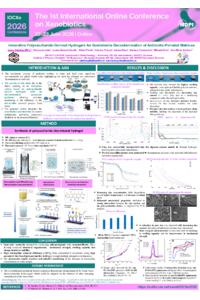
The continuous increase in antibiotic residues in water and food poses significant environmental and public health risks, highlighting the need for efficient and sustainable decontamination methods. The novelty of this study lies in the direct coupling of an adsorption system based on polysaccharide hybrid hydrogels with an electrochemical aptasensor platform, allowing real-time monitoring of the efficiency of the tetracycline removal process from water. The proposed system integrates remediation and detection in a novel architecture, providing continuous feedback on process efficiency [https://doi.org/10.3390/pharmaceutics15020373].
Salecan–Clay–Biopolymer hydrogels act as an active matrix for the capture and removal of tetracycline from aqueous media based on electrostatic interactions and hydrogen bonds, while the aptasensor, functionalized with tetracycline-specific aptamers, ensures selective and sensitive detection of residual concentrations. Carboxylate groups of the biopolymer and hydroxyl groups of Salecan synergistically enhance adsorption, while the aromatic rings of tetracycline can participate in π–π interactions. The incorporation of inorganic nanofillers further improves performance by increasing surface area, active site density, and enhancing binding interactions https://doi.org/10.1016/j.molliq.2025.127383.
Physicochemical characterization showed that these innovative hydrogels exhibit adsorption capacities of 100 to 500 mg/g for tetracycline, depending on the crosslinking degree and functionalization, with removal efficiencies of 90% under optimal pH and dosage conditions. Adsorption kinetics follow a pseudo-second-order model, indicating chemisorption dominance. The hydrogels also demonstrate good regeneration, maintaining high efficiency over multiple cycles, supporting their sustainability for water treatment.
The tetracycline-specific electrochemical aptasensor was placed directly in the treated aqueous environment, enabling continuous, selective, and sensitive monitoring of residual tetracycline. This allowed dynamic assessment of the decontamination process and demonstrated high efficiency in real-time evaluation.
Through this approach, an in situ antibiotic decontamination and monitoring system is obtained, which combines efficient remediation with selective real-time detection, opening up prospects for smart water treatment systems and in situ monitoring of emerging contaminants.
Keywords
decontamination
polysaccharide-based hybrid hydrogels
removal of antibiotics
aptasensors
Poster
Poster Xenobiotic ICG_FINAL_12.06.pdf
Toxicity of chemicals, binary and triple mixtures on daphnids: Molecular responses to understand pollution
Bioremediation Potential of Heavy Metal and Pesticide-Tolerant Poacea Endophytes from an Open Pit Mining Area in Benguet, Philippines