Event submissions
Published
This submission belongs to the session S4. (Micro)plastic Pollution in Environment and Human of the event The 1st International Online Conference on Xenobiotics
Published date
17 Jun, 2026
Academic Editor
'%3e%3cpath%20d='M12.6657%2010.9104C12.4185%2010.325%2012.0599%209.79327%2011.6097%209.34482C11.1609%208.89508%2010.6293%208.5365%2010.0442%208.28888C10.0389%208.28626%2010.0337%208.28495%2010.0285%208.28233C10.8446%207.69279%2011.3752%206.73249%2011.3752%205.64904C11.3752%203.8542%209.92103%202.39999%208.1262%202.39999C6.33136%202.39999%204.87715%203.8542%204.87715%205.64904C4.87715%206.73249%205.40774%207.69279%206.22393%208.28364C6.21869%208.28626%206.21345%208.28757%206.20821%208.29019C5.62129%208.5378%205.09463%208.89284%204.64265%209.34613C4.1929%209.79493%203.83432%2010.3266%203.58671%2010.9117C3.34345%2011.4845%203.21226%2012.0987%203.20023%2012.7209C3.19988%2012.7349%203.20233%2012.7488%203.20744%2012.7619C3.21255%2012.7749%203.22022%2012.7867%203.22998%2012.7968C3.23975%2012.8068%203.25142%2012.8147%203.26431%2012.8202C3.2772%2012.8256%203.29105%2012.8284%203.30504%2012.8284H4.09109C4.14874%2012.8284%204.19459%2012.7825%204.1959%2012.7262C4.2221%2011.7148%204.62823%2010.7676%205.34617%2010.0497C6.08899%209.30683%207.0755%208.89808%208.1262%208.89808C9.17689%208.89808%2010.1634%209.30683%2010.9062%2010.0497C11.6242%2010.7676%2012.0303%2011.7148%2012.0565%2012.7262C12.0578%2012.7838%2012.1037%2012.8284%2012.1613%2012.8284H12.9474C12.9613%2012.8284%2012.9752%2012.8256%2012.9881%2012.8202C13.001%2012.8147%2013.0126%2012.8068%2013.0224%2012.7968C13.0322%2012.7867%2013.0398%2012.7749%2013.0449%2012.7619C13.0501%2012.7488%2013.0525%2012.7349%2013.0522%2012.7209C13.0391%2012.0947%2012.9094%2011.4855%2012.6657%2010.9104ZM8.1262%207.9024C7.52486%207.9024%206.9589%207.6679%206.53312%207.24211C6.10733%206.81633%205.87283%206.25037%205.87283%205.64904C5.87283%205.0477%206.10733%204.48174%206.53312%204.05596C6.9589%203.63018%207.52486%203.39567%208.1262%203.39567C8.72753%203.39567%209.29349%203.63018%209.71927%204.05596C10.1451%204.48174%2010.3796%205.0477%2010.3796%205.64904C10.3796%206.25037%2010.1451%206.81633%209.71927%207.24211C9.29349%207.6679%208.72753%207.9024%208.1262%207.9024Z'%20fill='%235D1EE1'/%3e%3c/g%3e%3c/svg%3e) A. P. Pinto
A. P. PintoCitation
Catarina Guimarães, Sara C. Antunes, Luis R. Vieira, Isabel Iglesias, Isabel Sousa-Pinto, Gary F. Kett, João Martins, Sandra Nogueira, Linking Human Activities to Microplastic Pollution: Evidence from Marina da Afurada, in Proceedings of The 1st International Online Conference on Xenobiotics, 22 June–23 June 2026, MDPI: Basel, Switzerland
Share
Email
Facebook
Twitter
LinkedIn
Linking Human Activities to Microplastic Pollution: Evidence from Marina da Afurada
'%3e%3cpath%20d='M12.6647%2010.9104C12.4176%2010.325%2012.0589%209.7933%2011.6088%209.34485C11.16%208.89511%2010.6283%208.53653%2010.0432%208.28891C10.038%208.28629%2010.0327%208.28498%2010.0275%208.28236C10.8437%207.69282%2011.3743%206.73252%2011.3743%205.64907C11.3743%203.85423%209.92005%202.40002%208.12522%202.40002C6.33038%202.40002%204.87618%203.85423%204.87618%205.64907C4.87618%206.73252%205.40677%207.69282%206.22296%208.28367C6.21772%208.28629%206.21248%208.2876%206.20724%208.29022C5.62031%208.53783%205.09365%208.89287%204.64167%209.34616C4.19192%209.79496%203.83334%2010.3266%203.58573%2010.9117C3.34247%2011.4846%203.21128%2012.0987%203.19925%2012.721C3.1989%2012.735%203.20135%2012.7489%203.20646%2012.7619C3.21157%2012.7749%203.21924%2012.7868%203.22901%2012.7968C3.23877%2012.8068%203.25045%2012.8148%203.26334%2012.8202C3.27623%2012.8256%203.29007%2012.8284%203.30406%2012.8284H4.09012C4.14776%2012.8284%204.19362%2012.7825%204.19493%2012.7262C4.22113%2011.7148%204.62726%2010.7676%205.34519%2010.0497C6.08802%209.30686%207.07452%208.89811%208.12522%208.89811C9.17592%208.89811%2010.1624%209.30686%2010.9052%2010.0497C11.6232%2010.7676%2012.0293%2011.7148%2012.0555%2012.7262C12.0568%2012.7839%2012.1027%2012.8284%2012.1603%2012.8284H12.9464C12.9604%2012.8284%2012.9742%2012.8256%2012.9871%2012.8202C13%2012.8148%2013.0117%2012.8068%2013.0214%2012.7968C13.0312%2012.7868%2013.0389%2012.7749%2013.044%2012.7619C13.0491%2012.7489%2013.0515%2012.735%2013.0512%2012.721C13.0381%2012.0947%2012.9084%2011.4856%2012.6647%2010.9104ZM8.12522%207.90243C7.52388%207.90243%206.95792%207.66793%206.53214%207.24215C6.10636%206.81636%205.87185%206.2504%205.87185%205.64907C5.87185%205.04773%206.10636%204.48177%206.53214%204.05599C6.95792%203.63021%207.52388%203.3957%208.12522%203.3957C8.72655%203.3957%209.29252%203.63021%209.7183%204.05599C10.1441%204.48177%2010.3786%205.04773%2010.3786%205.64907C10.3786%206.2504%2010.1441%206.81636%209.7183%207.24215C9.29252%207.66793%208.72655%207.90243%208.12522%207.90243Z'%20fill='%235D1EE1'/%3e%3c/g%3e%3c/svg%3e)
Catarina Guimarães 1
João Martins 1

Luis R. Vieira 2,3
Isabel Iglesias 2
Sandra Nogueira 1,4
Gary F. Kett 1,4
Isabel Sousa-Pinto 1,4

Sara C. Antunes 1,4
1. Department of Biology, Faculty of Sciences of the University of Porto, Porto, Portugal, Portugal
2. CIIMAR - Interdisciplinary Centre of Marine and Environmental Research, Matosinhos, Portugal, Portugal
3. Department of Biology, Faculty of Sciences of the University of Porto, Porto, Portugal
4. CIIMAR - Interdisciplinary Centre of Marine and Environmental Research, Matosinhos, Portugal
Abstract
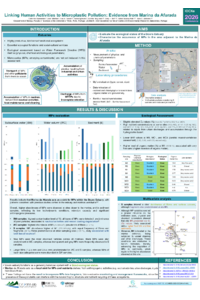
Estuaries are subject to intense anthropogenic pressures, particularly in areas with marinas and intensive nautical activities. These transitional ecosystems are increasingly affected by microplastic (MP) pollution, even though MPs are not yet included in the Water Framework Directive. This study aimed to evaluate the ecological status of the Douro Estuary and characterize the occurrence of MPs in the area adjacent to the Marina da Afurada. The ecological status was assessed using physico-chemical parameters, chlorophyll a concentrations and benthic community composition. Sediment grain size and organic matter (OM) content were also analyzed. Additionally, MPs collected from the water column, subsurface, and sediments were quantified and characterized by morphology. The results revealed a gradient of improving water quality from upstream to downstream locations. Areas near the marina recorded the lowest dissolved oxygen value (82.7%); high concentrations of NO3+NO2 and NH4 (1.247 mg/L and 0.40 mg/L, respectively); and high OM content (15.6%). These patterns reflect high residence times for the water masses and strong urban influence. The benthic community was dominated by tolerant species, with AMBI and BAT indices indicating ecological conditions between “moderate” and “good”. MP abundance was higher in sediments, particularly in very fine-grained, organic-rich areas directly influenced by the marina, where fibres accounted for 82% of MPs. Fibres were also predominant in water column samples (75%), whereas paint particles were most abundant in subsurface samples (49%), suggesting a link to local nautical activities. Multivariate analyses revealed a significant correlation between OM, grain size, and MP abundance, highlighting the influence of hydrodynamic conditions in MP retention. Thus, this study demonstrates that although the Douro estuary functions as a generally balanced system, the Marina da Afurada acts as a local sink for MPs and nutrients derived from anthropogenic activities. These findings reinforce the need to incorporate MPs into future estuarine monitoring and management frameworks.
Keywords
Microplastics
Estuaries
Marinas
Benthic indices (AMBI/BAT)
Water Framework Directive
Poster
poster JOX_Catarina_vF.pdf
Beyond monitorization: ecological evaluation of the Douro estuary and its microplastic distribution
Micro- and Nanoplastics in Food Products and Drinking Water: Risk Assessment, Analytical Methods, and Regulatory Framework Development