Event submissions
Published
This submission belongs to the session S4. (Micro)plastic Pollution in Environment and Human of the event The 1st International Online Conference on Xenobiotics
Published date
17 Jun, 2026
Academic Editor
'%3e%3cpath%20d='M12.6657%2010.9104C12.4185%2010.325%2012.0599%209.79327%2011.6097%209.34482C11.1609%208.89508%2010.6293%208.5365%2010.0442%208.28888C10.0389%208.28626%2010.0337%208.28495%2010.0285%208.28233C10.8446%207.69279%2011.3752%206.73249%2011.3752%205.64904C11.3752%203.8542%209.92103%202.39999%208.1262%202.39999C6.33136%202.39999%204.87715%203.8542%204.87715%205.64904C4.87715%206.73249%205.40774%207.69279%206.22393%208.28364C6.21869%208.28626%206.21345%208.28757%206.20821%208.29019C5.62129%208.5378%205.09463%208.89284%204.64265%209.34613C4.1929%209.79493%203.83432%2010.3266%203.58671%2010.9117C3.34345%2011.4845%203.21226%2012.0987%203.20023%2012.7209C3.19988%2012.7349%203.20233%2012.7488%203.20744%2012.7619C3.21255%2012.7749%203.22022%2012.7867%203.22998%2012.7968C3.23975%2012.8068%203.25142%2012.8147%203.26431%2012.8202C3.2772%2012.8256%203.29105%2012.8284%203.30504%2012.8284H4.09109C4.14874%2012.8284%204.19459%2012.7825%204.1959%2012.7262C4.2221%2011.7148%204.62823%2010.7676%205.34617%2010.0497C6.08899%209.30683%207.0755%208.89808%208.1262%208.89808C9.17689%208.89808%2010.1634%209.30683%2010.9062%2010.0497C11.6242%2010.7676%2012.0303%2011.7148%2012.0565%2012.7262C12.0578%2012.7838%2012.1037%2012.8284%2012.1613%2012.8284H12.9474C12.9613%2012.8284%2012.9752%2012.8256%2012.9881%2012.8202C13.001%2012.8147%2013.0126%2012.8068%2013.0224%2012.7968C13.0322%2012.7867%2013.0398%2012.7749%2013.0449%2012.7619C13.0501%2012.7488%2013.0525%2012.7349%2013.0522%2012.7209C13.0391%2012.0947%2012.9094%2011.4855%2012.6657%2010.9104ZM8.1262%207.9024C7.52486%207.9024%206.9589%207.6679%206.53312%207.24211C6.10733%206.81633%205.87283%206.25037%205.87283%205.64904C5.87283%205.0477%206.10733%204.48174%206.53312%204.05596C6.9589%203.63018%207.52486%203.39567%208.1262%203.39567C8.72753%203.39567%209.29349%203.63018%209.71927%204.05596C10.1451%204.48174%2010.3796%205.0477%2010.3796%205.64904C10.3796%206.25037%2010.1451%206.81633%209.71927%207.24211C9.29349%207.6679%208.72753%207.9024%208.1262%207.9024Z'%20fill='%235D1EE1'/%3e%3c/g%3e%3c/svg%3e) Tiziana Cappello
Tiziana CappelloCitation
Mattia Alessi, Stefano Magni, Andrea Binelli, Cristina Cremonesi, Silvia Giorgia Signorini, Giada Caorsi, Giovanni De Bernardi, Sara Castiglioni, Noelia Salgueiro-Gonzalez, Camilla Della Torre, Plastic contamination in different streams of Lake Orta (Northern Italy), in Proceedings of The 1st International Online Conference on Xenobiotics, 22 June–23 June 2026, MDPI: Basel, Switzerland
Share
Email
Facebook
Twitter
LinkedIn
Plastic contamination in different streams of Lake Orta (Northern Italy)
'%3e%3cpath%20d='M12.6647%2010.9104C12.4176%2010.325%2012.0589%209.7933%2011.6088%209.34485C11.16%208.89511%2010.6283%208.53653%2010.0432%208.28891C10.038%208.28629%2010.0327%208.28498%2010.0275%208.28236C10.8437%207.69282%2011.3743%206.73252%2011.3743%205.64907C11.3743%203.85423%209.92005%202.40002%208.12522%202.40002C6.33038%202.40002%204.87618%203.85423%204.87618%205.64907C4.87618%206.73252%205.40677%207.69282%206.22296%208.28367C6.21772%208.28629%206.21248%208.2876%206.20724%208.29022C5.62031%208.53783%205.09365%208.89287%204.64167%209.34616C4.19192%209.79496%203.83334%2010.3266%203.58573%2010.9117C3.34247%2011.4846%203.21128%2012.0987%203.19925%2012.721C3.1989%2012.735%203.20135%2012.7489%203.20646%2012.7619C3.21157%2012.7749%203.21924%2012.7868%203.22901%2012.7968C3.23877%2012.8068%203.25045%2012.8148%203.26334%2012.8202C3.27623%2012.8256%203.29007%2012.8284%203.30406%2012.8284H4.09012C4.14776%2012.8284%204.19362%2012.7825%204.19493%2012.7262C4.22113%2011.7148%204.62726%2010.7676%205.34519%2010.0497C6.08802%209.30686%207.07452%208.89811%208.12522%208.89811C9.17592%208.89811%2010.1624%209.30686%2010.9052%2010.0497C11.6232%2010.7676%2012.0293%2011.7148%2012.0555%2012.7262C12.0568%2012.7839%2012.1027%2012.8284%2012.1603%2012.8284H12.9464C12.9604%2012.8284%2012.9742%2012.8256%2012.9871%2012.8202C13%2012.8148%2013.0117%2012.8068%2013.0214%2012.7968C13.0312%2012.7868%2013.0389%2012.7749%2013.044%2012.7619C13.0491%2012.7489%2013.0515%2012.735%2013.0512%2012.721C13.0381%2012.0947%2012.9084%2011.4856%2012.6647%2010.9104ZM8.12522%207.90243C7.52388%207.90243%206.95792%207.66793%206.53214%207.24215C6.10636%206.81636%205.87185%206.2504%205.87185%205.64907C5.87185%205.04773%206.10636%204.48177%206.53214%204.05599C6.95792%203.63021%207.52388%203.3957%208.12522%203.3957C8.72655%203.3957%209.29252%203.63021%209.7183%204.05599C10.1441%204.48177%2010.3786%205.04773%2010.3786%205.64907C10.3786%206.2504%2010.1441%206.81636%209.7183%207.24215C9.29252%207.66793%208.72655%207.90243%208.12522%207.90243Z'%20fill='%235D1EE1'/%3e%3c/g%3e%3c/svg%3e)
Mattia Alessi 1

Stefano Magni 1
Andrea Binelli 1
Cristina Cremonesi 1
Silvia Giorgia Signorini 1
Giada Caorsi 1
Giovanni De Bernardi 2

Sara Castiglioni 3
Noelia Salgueiro-Gonzalez 3
Camilla Della Torre 1
1. Department of Biosciences, University of Milan, Milan, Italy, Italy
2. Ecomuseo del Lago d’Orta e del Mottarone, Pettenasco, Italy, Italy
3. Department of Environmental Health Science, Istituto di Ricerche Farmacologiche Mario Negri - IRCCS, Milan, Italy, Italy
Abstract
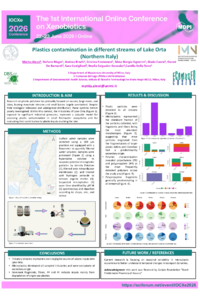
Despite the growing evidence of plastic contamination in marine ecosystems, freshwater environments, particularly small tributaries, remain comparatively understudied. Inflowing streams may represent important pathways for plastic transport into lacustrine systems, acting as point sources that may influence contamination patterns at the basin scale. This study assessed the presence of plastics in the water of six tributaries of Lake Orta (Northern Italy): Fiumetta, Pescone, Qualba, Plesina, Lagna, and Pellino. Sampling was conducted in November 2025 at the inlet of each tributary of Lake Orta using 100 µm plankton nets equipped with a flowmeter. Collected particles were subsequently analysed and characterised in terms of shape, size, colour and polymer composition using micro–Fourier Transform Infrared spectroscopy (µFT-IR). A total of 91 suspected particles were analysed, of which 31 were confirmed as plastics. Microplastics (< 1mm) represented the dominant fraction of the detected debris, accounting for 94 % of the confirmed plastic. Fragments were the most frequent particle type (48%) and were mainly composed of polypropylene. Among the investigated tributaries, plastic concentrations were lowest in the Pescone stream (0.04 plastics m⁻³), while the highest values were detected in the Lagna tributary (0.25 plastics m⁻³). Polypropylene (58%) and polyethylene (26%) were the most frequently identified polymers. Variability in particle abundance and typology suggests the influence of site-specific factors, potentially related to urban settlements and industrial activities within the respective catchment. Further analyses are ongoing to monitor the seasonal fluctuation of plastic pollution in the selected streams.
Acknowledgments: This study was financed by the Cariplo Foundation.
Keywords
Plastics pollution
Lake
Streams
µFT-IR
Poster
Alessi_Mattia.pdf
Fungal-Assisted Biodegradation of Bioplastics: A Comparative Analytical Study
Synergistic Testicular Toxicity Induced by Arsenic and Microplastics and Its Attenuation by Imperatorin in Wistar Rats