Event submissions
Published
This submission belongs to the session S4. (Micro)plastic Pollution in Environment and Human of the event The 1st International Online Conference on Xenobiotics
Published date
17 Jun, 2026
Academic Editor
'%3e%3cpath%20d='M12.6657%2010.9104C12.4185%2010.325%2012.0599%209.79327%2011.6097%209.34482C11.1609%208.89508%2010.6293%208.5365%2010.0442%208.28888C10.0389%208.28626%2010.0337%208.28495%2010.0285%208.28233C10.8446%207.69279%2011.3752%206.73249%2011.3752%205.64904C11.3752%203.8542%209.92103%202.39999%208.1262%202.39999C6.33136%202.39999%204.87715%203.8542%204.87715%205.64904C4.87715%206.73249%205.40774%207.69279%206.22393%208.28364C6.21869%208.28626%206.21345%208.28757%206.20821%208.29019C5.62129%208.5378%205.09463%208.89284%204.64265%209.34613C4.1929%209.79493%203.83432%2010.3266%203.58671%2010.9117C3.34345%2011.4845%203.21226%2012.0987%203.20023%2012.7209C3.19988%2012.7349%203.20233%2012.7488%203.20744%2012.7619C3.21255%2012.7749%203.22022%2012.7867%203.22998%2012.7968C3.23975%2012.8068%203.25142%2012.8147%203.26431%2012.8202C3.2772%2012.8256%203.29105%2012.8284%203.30504%2012.8284H4.09109C4.14874%2012.8284%204.19459%2012.7825%204.1959%2012.7262C4.2221%2011.7148%204.62823%2010.7676%205.34617%2010.0497C6.08899%209.30683%207.0755%208.89808%208.1262%208.89808C9.17689%208.89808%2010.1634%209.30683%2010.9062%2010.0497C11.6242%2010.7676%2012.0303%2011.7148%2012.0565%2012.7262C12.0578%2012.7838%2012.1037%2012.8284%2012.1613%2012.8284H12.9474C12.9613%2012.8284%2012.9752%2012.8256%2012.9881%2012.8202C13.001%2012.8147%2013.0126%2012.8068%2013.0224%2012.7968C13.0322%2012.7867%2013.0398%2012.7749%2013.0449%2012.7619C13.0501%2012.7488%2013.0525%2012.7349%2013.0522%2012.7209C13.0391%2012.0947%2012.9094%2011.4855%2012.6657%2010.9104ZM8.1262%207.9024C7.52486%207.9024%206.9589%207.6679%206.53312%207.24211C6.10733%206.81633%205.87283%206.25037%205.87283%205.64904C5.87283%205.0477%206.10733%204.48174%206.53312%204.05596C6.9589%203.63018%207.52486%203.39567%208.1262%203.39567C8.72753%203.39567%209.29349%203.63018%209.71927%204.05596C10.1451%204.48174%2010.3796%205.0477%2010.3796%205.64904C10.3796%206.25037%2010.1451%206.81633%209.71927%207.24211C9.29349%207.6679%208.72753%207.9024%208.1262%207.9024Z'%20fill='%235D1EE1'/%3e%3c/g%3e%3c/svg%3e) A. P. Pinto
A. P. PintoCitation
Oxana Spinu, Igor Povar, Natalia Bolocan, Thermodynamic Insights into (Micro)plastic Pollution in the Environment: Interfacial Processes, Chemical Synergism, and Ecological Implications, in Proceedings of The 1st International Online Conference on Xenobiotics, 22 June–23 June 2026, MDPI: Basel, Switzerland
Share
Email
Facebook
Twitter
LinkedIn
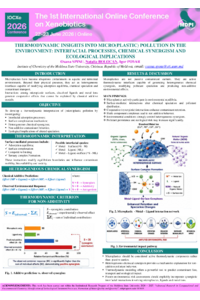
Thermodynamic Insights into (Micro)plastic Pollution in the Environment: Interfacial Processes, Chemical Synergism, and Ecological Implications

Oxana Spinu 1
'%3e%3cpath%20d='M12.6647%2010.9104C12.4176%2010.325%2012.0589%209.7933%2011.6088%209.34485C11.16%208.89511%2010.6283%208.53653%2010.0432%208.28891C10.038%208.28629%2010.0327%208.28498%2010.0275%208.28236C10.8437%207.69282%2011.3743%206.73252%2011.3743%205.64907C11.3743%203.85423%209.92005%202.40002%208.12522%202.40002C6.33038%202.40002%204.87618%203.85423%204.87618%205.64907C4.87618%206.73252%205.40677%207.69282%206.22296%208.28367C6.21772%208.28629%206.21248%208.2876%206.20724%208.29022C5.62031%208.53783%205.09365%208.89287%204.64167%209.34616C4.19192%209.79496%203.83334%2010.3266%203.58573%2010.9117C3.34247%2011.4846%203.21128%2012.0987%203.19925%2012.721C3.1989%2012.735%203.20135%2012.7489%203.20646%2012.7619C3.21157%2012.7749%203.21924%2012.7868%203.22901%2012.7968C3.23877%2012.8068%203.25045%2012.8148%203.26334%2012.8202C3.27623%2012.8256%203.29007%2012.8284%203.30406%2012.8284H4.09012C4.14776%2012.8284%204.19362%2012.7825%204.19493%2012.7262C4.22113%2011.7148%204.62726%2010.7676%205.34519%2010.0497C6.08802%209.30686%207.07452%208.89811%208.12522%208.89811C9.17592%208.89811%2010.1624%209.30686%2010.9052%2010.0497C11.6232%2010.7676%2012.0293%2011.7148%2012.0555%2012.7262C12.0568%2012.7839%2012.1027%2012.8284%2012.1603%2012.8284H12.9464C12.9604%2012.8284%2012.9742%2012.8256%2012.9871%2012.8202C13%2012.8148%2013.0117%2012.8068%2013.0214%2012.7968C13.0312%2012.7868%2013.0389%2012.7749%2013.044%2012.7619C13.0491%2012.7489%2013.0515%2012.735%2013.0512%2012.721C13.0381%2012.0947%2012.9084%2011.4856%2012.6647%2010.9104ZM8.12522%207.90243C7.52388%207.90243%206.95792%207.66793%206.53214%207.24215C6.10636%206.81636%205.87185%206.2504%205.87185%205.64907C5.87185%205.04773%206.10636%204.48177%206.53214%204.05599C6.95792%203.63021%207.52388%203.3957%208.12522%203.3957C8.72655%203.3957%209.29252%203.63021%209.7183%204.05599C10.1441%204.48177%2010.3786%205.04773%2010.3786%205.64907C10.3786%206.2504%2010.1441%206.81636%209.7183%207.24215C9.29252%207.66793%208.72655%207.90243%208.12522%207.90243Z'%20fill='%235D1EE1'/%3e%3c/g%3e%3c/svg%3e)
Natalia Bolocan 1
Igor Povar 1
1. Institute of Chemistry, Moldova State University, Chișinău, Moldova, Moldova
Abstract
Introduction:
(Micro)plastic pollution has emerged as a critical environmental issue due to its persistence, widespread distribution, and complex interactions with natural systems. Beyond physical accumulation, microplastics act as active chemical interfaces that influence the transport, transformation, and bioavailability of contaminants, including heavy metals and organic xenobiotics.
Methods:
This study applies a thermodynamic and physicochemical framework to analyze the role of microplastics as heterogeneous substrates in aquatic environments. Interfacial interactions were evaluated using adsorption equilibria, surface complexation modeling, and speciation analysis. Particular emphasis was placed on cooperative (synergistic) effects between microplastics, dissolved organic matter, and coexisting ionic species under varying pH and ionic strength conditions.
Results:
The results demonstrate that microplastics significantly modify chemical speciation and pollutant distribution through surface-mediated processes. Synergistic interactions between polymer surfaces and ligands enhance the binding capacity for metal ions, shifting equilibrium boundaries and promoting localized accumulation. These effects are strongly dependent on environmental parameters, particularly pH and ionic composition, which govern both surface charge and ligand availability. Furthermore, microplastics facilitate the formation of multi-component complexes, leading to non-additive behavior in pollutant partitioning. This heterogeneous synergism amplifies the environmental persistence and potential toxicity of associated contaminants.
Conclusions:
Microplastics should be considered not only as passive carriers but as active thermodynamic participants in environmental systems. Their ability to induce synergistic interfacial effects necessitates a revised framework for predicting contaminant fate and transport. Integrating thermodynamic modeling with environmental monitoring can improve risk assessment and support the development of targeted mitigation strategies for complex pollution scenarios involving microplastics and xenobiotics.
Acknowledgements
This work has been carried out within the Institutional Research Program of the State University of Moldova for the period 2024-2027, subprogram “Advanced Research in Computational and Environmental Chemistry, Identification of Technological Treatment Processes, Formation of Water Quality and Quantity”, code 010603.
Keywords
(Micro)plastic pollution / Thermodynamic modeling / Cooperative (synergistic) effects / Environmental monitoring
Poster
sciforum-179163-The 1st International Online Conference on Xenobiotics.pdf
Limited Uptake and Effects of End-of-life Tire particles in the gut of the Pavement Ant, Tetramorium immigrans: A First Assessment
Flocculation as a Control Strategy for Plastic Removal in Wastewater Treatment Plants