Event submissions
Published
This submission belongs to the session S4. (Micro)plastic Pollution in Environment and Human of the event The 1st International Online Conference on Xenobiotics
Published date
17 Jun, 2026
Academic Editor
'%3e%3cpath%20d='M12.6657%2010.9104C12.4185%2010.325%2012.0599%209.79327%2011.6097%209.34482C11.1609%208.89508%2010.6293%208.5365%2010.0442%208.28888C10.0389%208.28626%2010.0337%208.28495%2010.0285%208.28233C10.8446%207.69279%2011.3752%206.73249%2011.3752%205.64904C11.3752%203.8542%209.92103%202.39999%208.1262%202.39999C6.33136%202.39999%204.87715%203.8542%204.87715%205.64904C4.87715%206.73249%205.40774%207.69279%206.22393%208.28364C6.21869%208.28626%206.21345%208.28757%206.20821%208.29019C5.62129%208.5378%205.09463%208.89284%204.64265%209.34613C4.1929%209.79493%203.83432%2010.3266%203.58671%2010.9117C3.34345%2011.4845%203.21226%2012.0987%203.20023%2012.7209C3.19988%2012.7349%203.20233%2012.7488%203.20744%2012.7619C3.21255%2012.7749%203.22022%2012.7867%203.22998%2012.7968C3.23975%2012.8068%203.25142%2012.8147%203.26431%2012.8202C3.2772%2012.8256%203.29105%2012.8284%203.30504%2012.8284H4.09109C4.14874%2012.8284%204.19459%2012.7825%204.1959%2012.7262C4.2221%2011.7148%204.62823%2010.7676%205.34617%2010.0497C6.08899%209.30683%207.0755%208.89808%208.1262%208.89808C9.17689%208.89808%2010.1634%209.30683%2010.9062%2010.0497C11.6242%2010.7676%2012.0303%2011.7148%2012.0565%2012.7262C12.0578%2012.7838%2012.1037%2012.8284%2012.1613%2012.8284H12.9474C12.9613%2012.8284%2012.9752%2012.8256%2012.9881%2012.8202C13.001%2012.8147%2013.0126%2012.8068%2013.0224%2012.7968C13.0322%2012.7867%2013.0398%2012.7749%2013.0449%2012.7619C13.0501%2012.7488%2013.0525%2012.7349%2013.0522%2012.7209C13.0391%2012.0947%2012.9094%2011.4855%2012.6657%2010.9104ZM8.1262%207.9024C7.52486%207.9024%206.9589%207.6679%206.53312%207.24211C6.10733%206.81633%205.87283%206.25037%205.87283%205.64904C5.87283%205.0477%206.10733%204.48174%206.53312%204.05596C6.9589%203.63018%207.52486%203.39567%208.1262%203.39567C8.72753%203.39567%209.29349%203.63018%209.71927%204.05596C10.1451%204.48174%2010.3796%205.0477%2010.3796%205.64904C10.3796%206.25037%2010.1451%206.81633%209.71927%207.24211C9.29349%207.6679%208.72753%207.9024%208.1262%207.9024Z'%20fill='%235D1EE1'/%3e%3c/g%3e%3c/svg%3e) A. P. Pinto
A. P. PintoCitation
Sara Santos, Janeide Padilha, Ronaldo Sousa, Arunava Pradhan, Amílcar Teixeira, Juliana Souza-Kasprzyk, Wiktoria Zawrzykraj, Przemysław Niedzielski, Contaminant Mixtures and Warming: Bioaccumulation and Organismal Stress in an Invaded Freshwater Trophic Chain, in Proceedings of The 1st International Online Conference on Xenobiotics, 22 June–23 June 2026, MDPI: Basel, Switzerland
Share
Email
Facebook
Twitter
LinkedIn
Contaminant Mixtures and Warming: Bioaccumulation and Organismal Stress in an Invaded Freshwater Trophic Chain
'%3e%3cpath%20d='M12.6647%2010.9104C12.4176%2010.325%2012.0589%209.7933%2011.6088%209.34485C11.16%208.89511%2010.6283%208.53653%2010.0432%208.28891C10.038%208.28629%2010.0327%208.28498%2010.0275%208.28236C10.8437%207.69282%2011.3743%206.73252%2011.3743%205.64907C11.3743%203.85423%209.92005%202.40002%208.12522%202.40002C6.33038%202.40002%204.87618%203.85423%204.87618%205.64907C4.87618%206.73252%205.40677%207.69282%206.22296%208.28367C6.21772%208.28629%206.21248%208.2876%206.20724%208.29022C5.62031%208.53783%205.09365%208.89287%204.64167%209.34616C4.19192%209.79496%203.83334%2010.3266%203.58573%2010.9117C3.34247%2011.4846%203.21128%2012.0987%203.19925%2012.721C3.1989%2012.735%203.20135%2012.7489%203.20646%2012.7619C3.21157%2012.7749%203.21924%2012.7868%203.22901%2012.7968C3.23877%2012.8068%203.25045%2012.8148%203.26334%2012.8202C3.27623%2012.8256%203.29007%2012.8284%203.30406%2012.8284H4.09012C4.14776%2012.8284%204.19362%2012.7825%204.19493%2012.7262C4.22113%2011.7148%204.62726%2010.7676%205.34519%2010.0497C6.08802%209.30686%207.07452%208.89811%208.12522%208.89811C9.17592%208.89811%2010.1624%209.30686%2010.9052%2010.0497C11.6232%2010.7676%2012.0293%2011.7148%2012.0555%2012.7262C12.0568%2012.7839%2012.1027%2012.8284%2012.1603%2012.8284H12.9464C12.9604%2012.8284%2012.9742%2012.8256%2012.9871%2012.8202C13%2012.8148%2013.0117%2012.8068%2013.0214%2012.7968C13.0312%2012.7868%2013.0389%2012.7749%2013.044%2012.7619C13.0491%2012.7489%2013.0515%2012.735%2013.0512%2012.721C13.0381%2012.0947%2012.9084%2011.4856%2012.6647%2010.9104ZM8.12522%207.90243C7.52388%207.90243%206.95792%207.66793%206.53214%207.24215C6.10636%206.81636%205.87185%206.2504%205.87185%205.64907C5.87185%205.04773%206.10636%204.48177%206.53214%204.05599C6.95792%203.63021%207.52388%203.3957%208.12522%203.3957C8.72655%203.3957%209.29252%203.63021%209.7183%204.05599C10.1441%204.48177%2010.3786%205.04773%2010.3786%205.64907C10.3786%206.2504%2010.1441%206.81636%209.7183%207.24215C9.29252%207.66793%208.72655%207.90243%208.12522%207.90243Z'%20fill='%235D1EE1'/%3e%3c/g%3e%3c/svg%3e)
Sara Santos 1
Janeide Padilha 1
Ronaldo Sousa 1
Arunava Pradhan 1
Amílcar Teixeira 2
Juliana Souza-Kasprzyk 3
Wiktoria Zawrzykraj 3

Przemysław Niedzielski 3
1. Center of Molecular and Environmental Biology, Department of Biology, University of Minho, Campus Gualtar, 4710-057 Braga, Portugal
2. Mountain Research Centre (CIMO), Associated Laboratory for Sustainability and Technology in Inland Regions (LA SusTEC), Polytechnic Institute of Bragança, Santa Apolónia Campus, 5300-253 Bragança, Portugal
3. Department of Analytical Chemistry, Faculty of Chemistry, Adam Mickiewicz University in Poznań, 8 Uniwersytetu Poznańskiego Street, 61-614 Poznań, Poland
Abstract
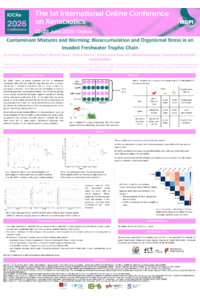
The global increase in plastic production, driven by its affordability and resilience, has resulted in extensive environmental pollution, with microplastics (MPs) now permeating even the most isolated and pristine habitats. Within freshwater ecosystems, these particles, alongside other emerging pollutants such as toxic silver nanoparticles (AgNPs), are consumed by organisms, causing adverse health effects and potentially moving through food chains. This situation is exacerbated by climate change, which can modify contaminant behavior, and by biological invasions that disrupt ecosystem structure, potentially magnifying pollutant impacts. Critically, all these pressures may interact, and their possible combined effects represent a significant but largely unexplored risk to ecosystem health. This study employed a mesocosm-based multi-stressor design with four treatments (control, MPs, AgNPs, mixture), featuring an algal community, Physa acuta snails, and the signal crayfish (Pacifastacus leniusculus), to investigate the interactive effects of MPs and AgNPs under varying temperatures (18 and 24 ºC) and exposure durations (24 and 48 hours). To assess oxidative stress we analysed two antioxidant enzymes, catalase and glutathione S-transferases, and acetylcholinesterase to investigate neurotoxicity. Findings revealed contaminant accumulation across all trophic levels. Microplastic distribution showed no consistent tissue-specific patterns nor clear responses to temperature or exposure duration, whereas AgNPs exhibited structured tissue accumulation. Correlations between the two contaminants were weak and limited to specific groups, indicating that their simultaneous presence does not guarantee co-accumulation. Enzymatic biomarkers varied primarily by tissue, with limited treatment-related effects, suggesting that the experimental concentrations and durations may not have elicited classic stress responses. Future studies should incorporate more complex food webs and environmentally realistic contaminant levels to better mimic natural systems. Employing a broader suite of stress biomarkers would also help clarify immune responses across species and trophic positions. Additionally, implementing monitoring programs for these and other contaminants is essential for tracking their prevalence and detecting emerging trends.
Keywords
microplastics
contaminant mixtures
freshwater food webs
oxidative stress
multi-stressor effects
Poster
Sara_Santos_Poster.pdf
Microplastic Bioaccumulation and its Trophic Implications in Corbicula fluminea
Differential Disruption of Morphogenesis and Biomineralization in Mussel Larvae Exposed to Environmental Microplastics and Diuron