Event submissions
Published
This submission belongs to the session S4. (Micro)plastic Pollution in Environment and Human of the event The 1st International Online Conference on Xenobiotics
Published date
17 Jun, 2026
Academic Editor
'%3e%3cpath%20d='M12.6657%2010.9104C12.4185%2010.325%2012.0599%209.79327%2011.6097%209.34482C11.1609%208.89508%2010.6293%208.5365%2010.0442%208.28888C10.0389%208.28626%2010.0337%208.28495%2010.0285%208.28233C10.8446%207.69279%2011.3752%206.73249%2011.3752%205.64904C11.3752%203.8542%209.92103%202.39999%208.1262%202.39999C6.33136%202.39999%204.87715%203.8542%204.87715%205.64904C4.87715%206.73249%205.40774%207.69279%206.22393%208.28364C6.21869%208.28626%206.21345%208.28757%206.20821%208.29019C5.62129%208.5378%205.09463%208.89284%204.64265%209.34613C4.1929%209.79493%203.83432%2010.3266%203.58671%2010.9117C3.34345%2011.4845%203.21226%2012.0987%203.20023%2012.7209C3.19988%2012.7349%203.20233%2012.7488%203.20744%2012.7619C3.21255%2012.7749%203.22022%2012.7867%203.22998%2012.7968C3.23975%2012.8068%203.25142%2012.8147%203.26431%2012.8202C3.2772%2012.8256%203.29105%2012.8284%203.30504%2012.8284H4.09109C4.14874%2012.8284%204.19459%2012.7825%204.1959%2012.7262C4.2221%2011.7148%204.62823%2010.7676%205.34617%2010.0497C6.08899%209.30683%207.0755%208.89808%208.1262%208.89808C9.17689%208.89808%2010.1634%209.30683%2010.9062%2010.0497C11.6242%2010.7676%2012.0303%2011.7148%2012.0565%2012.7262C12.0578%2012.7838%2012.1037%2012.8284%2012.1613%2012.8284H12.9474C12.9613%2012.8284%2012.9752%2012.8256%2012.9881%2012.8202C13.001%2012.8147%2013.0126%2012.8068%2013.0224%2012.7968C13.0322%2012.7867%2013.0398%2012.7749%2013.0449%2012.7619C13.0501%2012.7488%2013.0525%2012.7349%2013.0522%2012.7209C13.0391%2012.0947%2012.9094%2011.4855%2012.6657%2010.9104ZM8.1262%207.9024C7.52486%207.9024%206.9589%207.6679%206.53312%207.24211C6.10733%206.81633%205.87283%206.25037%205.87283%205.64904C5.87283%205.0477%206.10733%204.48174%206.53312%204.05596C6.9589%203.63018%207.52486%203.39567%208.1262%203.39567C8.72753%203.39567%209.29349%203.63018%209.71927%204.05596C10.1451%204.48174%2010.3796%205.0477%2010.3796%205.64904C10.3796%206.25037%2010.1451%206.81633%209.71927%207.24211C9.29349%207.6679%208.72753%207.9024%208.1262%207.9024Z'%20fill='%235D1EE1'/%3e%3c/g%3e%3c/svg%3e) A. P. Pinto
A. P. PintoCitation
María Arroyo, Nidia Pérez, Victoria Romero, Eva Peralta, Alicia Ruiz-Rodríguez, Margarita Aguilera, Gut plastizyme: Systematic Review to identify gut microbiota enzymesproposed as plastic degradation resources, in Proceedings of The 1st International Online Conference on Xenobiotics, 22 June–23 June 2026, MDPI: Basel, Switzerland
Share
Email
Facebook
Twitter
LinkedIn
Gut plastizyme: Systematic Review to identify gut microbiota enzymesproposed as plastic degradation resources
'%3e%3cpath%20d='M12.6647%2010.9104C12.4176%2010.325%2012.0589%209.7933%2011.6088%209.34485C11.16%208.89511%2010.6283%208.53653%2010.0432%208.28891C10.038%208.28629%2010.0327%208.28498%2010.0275%208.28236C10.8437%207.69282%2011.3743%206.73252%2011.3743%205.64907C11.3743%203.85423%209.92005%202.40002%208.12522%202.40002C6.33038%202.40002%204.87618%203.85423%204.87618%205.64907C4.87618%206.73252%205.40677%207.69282%206.22296%208.28367C6.21772%208.28629%206.21248%208.2876%206.20724%208.29022C5.62031%208.53783%205.09365%208.89287%204.64167%209.34616C4.19192%209.79496%203.83334%2010.3266%203.58573%2010.9117C3.34247%2011.4846%203.21128%2012.0987%203.19925%2012.721C3.1989%2012.735%203.20135%2012.7489%203.20646%2012.7619C3.21157%2012.7749%203.21924%2012.7868%203.22901%2012.7968C3.23877%2012.8068%203.25045%2012.8148%203.26334%2012.8202C3.27623%2012.8256%203.29007%2012.8284%203.30406%2012.8284H4.09012C4.14776%2012.8284%204.19362%2012.7825%204.19493%2012.7262C4.22113%2011.7148%204.62726%2010.7676%205.34519%2010.0497C6.08802%209.30686%207.07452%208.89811%208.12522%208.89811C9.17592%208.89811%2010.1624%209.30686%2010.9052%2010.0497C11.6232%2010.7676%2012.0293%2011.7148%2012.0555%2012.7262C12.0568%2012.7839%2012.1027%2012.8284%2012.1603%2012.8284H12.9464C12.9604%2012.8284%2012.9742%2012.8256%2012.9871%2012.8202C13%2012.8148%2013.0117%2012.8068%2013.0214%2012.7968C13.0312%2012.7868%2013.0389%2012.7749%2013.044%2012.7619C13.0491%2012.7489%2013.0515%2012.735%2013.0512%2012.721C13.0381%2012.0947%2012.9084%2011.4856%2012.6647%2010.9104ZM8.12522%207.90243C7.52388%207.90243%206.95792%207.66793%206.53214%207.24215C6.10636%206.81636%205.87185%206.2504%205.87185%205.64907C5.87185%205.04773%206.10636%204.48177%206.53214%204.05599C6.95792%203.63021%207.52388%203.3957%208.12522%203.3957C8.72655%203.3957%209.29252%203.63021%209.7183%204.05599C10.1441%204.48177%2010.3786%205.04773%2010.3786%205.64907C10.3786%206.2504%2010.1441%206.81636%209.7183%207.24215C9.29252%207.66793%208.72655%207.90243%208.12522%207.90243Z'%20fill='%235D1EE1'/%3e%3c/g%3e%3c/svg%3e)
María Arroyo 1
Nidia Pérez 1
Victoria Romero 1,2
Eva Peralta 1
Alicia Ruiz-Rodríguez 1,2

Margarita Aguilera 1,2
1. Department of Microbiology. Faculty of Pharmacy. University of Granada, 18071, Granada, Spain, Spain
2. Institute of Nutrition and Food Technology “Jose Mataix Verdú”, INYTA. Biomedical Research Center (CIBM), Health Sciences Technological Park, University of Granada, 18016, Granada, Spain
Abstract
Rapid industrialization and anthropogenic activities have led to the widespread occurrence of emerging contaminants, such as plasticizers and microplastics. These pollutants are a global concern due to their persistence and ability to interfere with endocrine systems, potentially causing adverse ecological and health effects. This systematic review identifies plastic degradation enzyme capacities within the gut microbiome taxa, previously described for environmental microorganisms. A search term was conducted using the following keywords: “Biodegradation”, “Microbial degradation”, “xenobiotic metabolism”, “microbial degradation pathways”, “enzymes”, “laccase”, “monooxygenase”, “dioxygenase”, “dehydrogenase”, “Bisphenol A” (BPA), “Xenobiotics”, and “Endocrine disruptor”. Records were screened against inclusion criteria based on keywords detected in the titles and abstracts of original articles and experimental studies on the specific microbial degradation of BPA, in which specific enzymes, genes, or metabolic pathways were described. The analysis and presentation of the data obtained from the systematic review search were organized in accordance with the PRISMA 2020 flow diagram for a new systematic review. A summary of the microorganisms with BPA-degrading enzymes identified in in vitro studies was compiled, highlighting genera such as Lactobacillus, Enterococcus, Bacillus and Pseudomonas. Their key enzymatic mechanisms primarily involve the action of laccases, peroxidases, or cytochrome P450, which transform BPA into intermediates such as hydroquinone, 4-hidroxybenzoic acid, or 4-hidroxyacetophenone. It has been also described the homology of the first environmental plastizyme with the specific enzymatic repertoire (laccases, dioxygenases, and hydratases) of species taxonomically closest to the intestinal microbiota isolates, as determined by bioinformatic and molecular analyses of complete genomes (whole-genome sequencing, WGS). To extrapolate these results, a pilot complementary bioinformatic approach will be carried out with a reconstructed MAG (Metagenome-assambled Genome) from gut microbiota from a children cohort with a known level of BPA exposure to validate and describe the presence of “gut plastizyme” and specific “gut BPAzyme”.
Keywords
Bisphenol A (BPA)
Xenobiotics
Biodegradation
Gut microbiota
Enzymes
Plastizyme
Poster
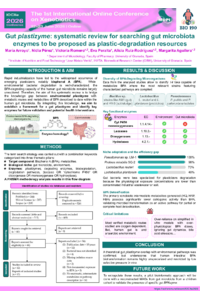
Poster Review Gut Plastizyme.pptx.pdf
Differential Disruption of Morphogenesis and Biomineralization in Mussel Larvae Exposed to Environmental Microplastics and Diuron
Impact of Prenatal Polystyrene Microplastic Exposure on Neurodevelopment and Hippocampal Neurogenesis