Event submissions
Published
This submission belongs to the session S2. Actuarial Science of the event The 1st International Online Conference on Risks
Published date
01 Jul, 2026
Academic Editor
'%3e%3cpath%20d='M12.6657%2010.9104C12.4185%2010.325%2012.0599%209.79327%2011.6097%209.34482C11.1609%208.89508%2010.6293%208.5365%2010.0442%208.28888C10.0389%208.28626%2010.0337%208.28495%2010.0285%208.28233C10.8446%207.69279%2011.3752%206.73249%2011.3752%205.64904C11.3752%203.8542%209.92103%202.39999%208.1262%202.39999C6.33136%202.39999%204.87715%203.8542%204.87715%205.64904C4.87715%206.73249%205.40774%207.69279%206.22393%208.28364C6.21869%208.28626%206.21345%208.28757%206.20821%208.29019C5.62129%208.5378%205.09463%208.89284%204.64265%209.34613C4.1929%209.79493%203.83432%2010.3266%203.58671%2010.9117C3.34345%2011.4845%203.21226%2012.0987%203.20023%2012.7209C3.19988%2012.7349%203.20233%2012.7488%203.20744%2012.7619C3.21255%2012.7749%203.22022%2012.7867%203.22998%2012.7968C3.23975%2012.8068%203.25142%2012.8147%203.26431%2012.8202C3.2772%2012.8256%203.29105%2012.8284%203.30504%2012.8284H4.09109C4.14874%2012.8284%204.19459%2012.7825%204.1959%2012.7262C4.2221%2011.7148%204.62823%2010.7676%205.34617%2010.0497C6.08899%209.30683%207.0755%208.89808%208.1262%208.89808C9.17689%208.89808%2010.1634%209.30683%2010.9062%2010.0497C11.6242%2010.7676%2012.0303%2011.7148%2012.0565%2012.7262C12.0578%2012.7838%2012.1037%2012.8284%2012.1613%2012.8284H12.9474C12.9613%2012.8284%2012.9752%2012.8256%2012.9881%2012.8202C13.001%2012.8147%2013.0126%2012.8068%2013.0224%2012.7968C13.0322%2012.7867%2013.0398%2012.7749%2013.0449%2012.7619C13.0501%2012.7488%2013.0525%2012.7349%2013.0522%2012.7209C13.0391%2012.0947%2012.9094%2011.4855%2012.6657%2010.9104ZM8.1262%207.9024C7.52486%207.9024%206.9589%207.6679%206.53312%207.24211C6.10733%206.81633%205.87283%206.25037%205.87283%205.64904C5.87283%205.0477%206.10733%204.48174%206.53312%204.05596C6.9589%203.63018%207.52486%203.39567%208.1262%203.39567C8.72753%203.39567%209.29349%203.63018%209.71927%204.05596C10.1451%204.48174%2010.3796%205.0477%2010.3796%205.64904C10.3796%206.25037%2010.1451%206.81633%209.71927%207.24211C9.29349%207.6679%208.72753%207.9024%208.1262%207.9024Z'%20fill='%235D1EE1'/%3e%3c/g%3e%3c/svg%3e) Hailiang Yang
Hailiang YangCitation
Dominic Owusu Abeyie, Gabriel Asare Okyere, Optimal Stochastic Control of Pension Asset Sustainability for Ghana’s Basic National Social Security Scheme, in Proceedings of The 1st International Online Conference on Risks, 6 July–7 July 2026, MDPI: Basel, Switzerland
Share
Email
Facebook
Twitter
LinkedIn
Optimal Stochastic Control of Pension Asset Sustainability for Ghana’s Basic National Social Security Scheme
'%3e%3cpath%20d='M12.6647%2010.9104C12.4176%2010.325%2012.0589%209.7933%2011.6088%209.34485C11.16%208.89511%2010.6283%208.53653%2010.0432%208.28891C10.038%208.28629%2010.0327%208.28498%2010.0275%208.28236C10.8437%207.69282%2011.3743%206.73252%2011.3743%205.64907C11.3743%203.85423%209.92005%202.40002%208.12522%202.40002C6.33038%202.40002%204.87618%203.85423%204.87618%205.64907C4.87618%206.73252%205.40677%207.69282%206.22296%208.28367C6.21772%208.28629%206.21248%208.2876%206.20724%208.29022C5.62031%208.53783%205.09365%208.89287%204.64167%209.34616C4.19192%209.79496%203.83334%2010.3266%203.58573%2010.9117C3.34247%2011.4846%203.21128%2012.0987%203.19925%2012.721C3.1989%2012.735%203.20135%2012.7489%203.20646%2012.7619C3.21157%2012.7749%203.21924%2012.7868%203.22901%2012.7968C3.23877%2012.8068%203.25045%2012.8148%203.26334%2012.8202C3.27623%2012.8256%203.29007%2012.8284%203.30406%2012.8284H4.09012C4.14776%2012.8284%204.19362%2012.7825%204.19493%2012.7262C4.22113%2011.7148%204.62726%2010.7676%205.34519%2010.0497C6.08802%209.30686%207.07452%208.89811%208.12522%208.89811C9.17592%208.89811%2010.1624%209.30686%2010.9052%2010.0497C11.6232%2010.7676%2012.0293%2011.7148%2012.0555%2012.7262C12.0568%2012.7839%2012.1027%2012.8284%2012.1603%2012.8284H12.9464C12.9604%2012.8284%2012.9742%2012.8256%2012.9871%2012.8202C13%2012.8148%2013.0117%2012.8068%2013.0214%2012.7968C13.0312%2012.7868%2013.0389%2012.7749%2013.044%2012.7619C13.0491%2012.7489%2013.0515%2012.735%2013.0512%2012.721C13.0381%2012.0947%2012.9084%2011.4856%2012.6647%2010.9104ZM8.12522%207.90243C7.52388%207.90243%206.95792%207.66793%206.53214%207.24215C6.10636%206.81636%205.87185%206.2504%205.87185%205.64907C5.87185%205.04773%206.10636%204.48177%206.53214%204.05599C6.95792%203.63021%207.52388%203.3957%208.12522%203.3957C8.72655%203.3957%209.29252%203.63021%209.7183%204.05599C10.1441%204.48177%2010.3786%205.04773%2010.3786%205.64907C10.3786%206.2504%2010.1441%206.81636%209.7183%207.24215C9.29252%207.66793%208.72655%207.90243%208.12522%207.90243Z'%20fill='%235D1EE1'/%3e%3c/g%3e%3c/svg%3e)
Dominic Owusu Abeyie 1
Gabriel Asare Okyere 1
1. Department of Statistics and Actuarial Science, Kwame Nkrumah University of Science and Technology, PMB, Ghana
Abstract
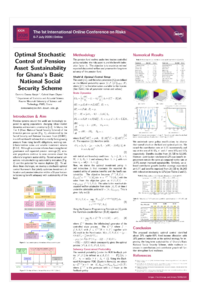
Ghana’s Basic National Social Security Scheme (Tier 1), managed by the Social Security and National Insurance Trust (SSNIT), faces sustainability challenges due to shifting pension demographics and macro-financial volatility. Using optimal control theory, our paper formulates a continuous-time stochastic control problem for a social planner (SSNIT) to determine optimal policies of investment and benefit indexation that maximize discounted expected utility of aggregate retiree benefits over a finite horizon, subject to ruin probability constraint with a solvency floor. The dynamics of the pension fund’s asset under management combine risky and risk-free investment returns with stochastic net cashflows driven by a CEV salary process and deterministic contributor and retiree population flows. Using the principle of dynamic programming (Bellman’s optimality condition), we derive the associated Hamilton–Jacobi–Bellman PDE and obtain feedback characterizations of the optimal portfolio and indexation policies under Karush–Kuhn–Tucker (KKT) control bounds. We couple the optimal feedback policy with a backward Kolmogorov survival probability to enforce the chance constraint. The numerical results, calibrated using the trustee’s (SSNIT) data and Ghana’s financial market inputs over a 30-year planning horizon, yielded an optimal asset allocation mix of 19.5% equity exposure and 9.9% benefit indexation at 96.7% survival probability for sustainability. The results further show that a 0.5% increase in the contribution rate as a policy modification doubles benefit adequacy at 10% equity exposure and 15% benefit indexation with 99% sustainability. Similarly, a 1% increase in contribution rate yielded no additional adequacy gains beyond the 0.5% increment but improved survival probability to 99.9%. These findings suggest that modest, targeted contribution-rate adjustments combined with disciplined asset allocation provide a quantitatively superior pathway to restoring long-term sustainability without sacrificing intergenerational benefit adequacy.
Keywords
Optimal investment
Optimal benefit indexation
Pension sustainability
Ruin probability
Stochastic optimal control theory
Ghana’s Basic National Social Security Scheme
Poster
iocr_poster_Dominic Owusu Abeyie.pdf
From Engineering Risk to Insurance Decisions: A Risk-Based Premium Model for Energy Assets
Regime-Adaptive Volatility Forecasting in Equity Markets