Event submissions
Published
This submission belongs to the session S2. Actuarial Science of the event The 1st International Online Conference on Risks
Published date
01 Jul, 2026
Academic Editor
'%3e%3cpath%20d='M12.6657%2010.9104C12.4185%2010.325%2012.0599%209.79327%2011.6097%209.34482C11.1609%208.89508%2010.6293%208.5365%2010.0442%208.28888C10.0389%208.28626%2010.0337%208.28495%2010.0285%208.28233C10.8446%207.69279%2011.3752%206.73249%2011.3752%205.64904C11.3752%203.8542%209.92103%202.39999%208.1262%202.39999C6.33136%202.39999%204.87715%203.8542%204.87715%205.64904C4.87715%206.73249%205.40774%207.69279%206.22393%208.28364C6.21869%208.28626%206.21345%208.28757%206.20821%208.29019C5.62129%208.5378%205.09463%208.89284%204.64265%209.34613C4.1929%209.79493%203.83432%2010.3266%203.58671%2010.9117C3.34345%2011.4845%203.21226%2012.0987%203.20023%2012.7209C3.19988%2012.7349%203.20233%2012.7488%203.20744%2012.7619C3.21255%2012.7749%203.22022%2012.7867%203.22998%2012.7968C3.23975%2012.8068%203.25142%2012.8147%203.26431%2012.8202C3.2772%2012.8256%203.29105%2012.8284%203.30504%2012.8284H4.09109C4.14874%2012.8284%204.19459%2012.7825%204.1959%2012.7262C4.2221%2011.7148%204.62823%2010.7676%205.34617%2010.0497C6.08899%209.30683%207.0755%208.89808%208.1262%208.89808C9.17689%208.89808%2010.1634%209.30683%2010.9062%2010.0497C11.6242%2010.7676%2012.0303%2011.7148%2012.0565%2012.7262C12.0578%2012.7838%2012.1037%2012.8284%2012.1613%2012.8284H12.9474C12.9613%2012.8284%2012.9752%2012.8256%2012.9881%2012.8202C13.001%2012.8147%2013.0126%2012.8068%2013.0224%2012.7968C13.0322%2012.7867%2013.0398%2012.7749%2013.0449%2012.7619C13.0501%2012.7488%2013.0525%2012.7349%2013.0522%2012.7209C13.0391%2012.0947%2012.9094%2011.4855%2012.6657%2010.9104ZM8.1262%207.9024C7.52486%207.9024%206.9589%207.6679%206.53312%207.24211C6.10733%206.81633%205.87283%206.25037%205.87283%205.64904C5.87283%205.0477%206.10733%204.48174%206.53312%204.05596C6.9589%203.63018%207.52486%203.39567%208.1262%203.39567C8.72753%203.39567%209.29349%203.63018%209.71927%204.05596C10.1451%204.48174%2010.3796%205.0477%2010.3796%205.64904C10.3796%206.25037%2010.1451%206.81633%209.71927%207.24211C9.29349%207.6679%208.72753%207.9024%208.1262%207.9024Z'%20fill='%235D1EE1'/%3e%3c/g%3e%3c/svg%3e) Hailiang Yang
Hailiang YangCitation
Ivan Gallo, Giovanna Bimonte, Maria Russolillo, Period vs Cohort Longevity: SRE-based Forecasts for Fair Pensions, in Proceedings of The 1st International Online Conference on Risks, 6 July–7 July 2026, MDPI: Basel, Switzerland
Share
Email
Facebook
Twitter
LinkedIn
Period vs Cohort Longevity: SRE-based Forecasts for Fair Pensions
'%3e%3cpath%20d='M12.6647%2010.9104C12.4176%2010.325%2012.0589%209.7933%2011.6088%209.34485C11.16%208.89511%2010.6283%208.53653%2010.0432%208.28891C10.038%208.28629%2010.0327%208.28498%2010.0275%208.28236C10.8437%207.69282%2011.3743%206.73252%2011.3743%205.64907C11.3743%203.85423%209.92005%202.40002%208.12522%202.40002C6.33038%202.40002%204.87618%203.85423%204.87618%205.64907C4.87618%206.73252%205.40677%207.69282%206.22296%208.28367C6.21772%208.28629%206.21248%208.2876%206.20724%208.29022C5.62031%208.53783%205.09365%208.89287%204.64167%209.34616C4.19192%209.79496%203.83334%2010.3266%203.58573%2010.9117C3.34247%2011.4846%203.21128%2012.0987%203.19925%2012.721C3.1989%2012.735%203.20135%2012.7489%203.20646%2012.7619C3.21157%2012.7749%203.21924%2012.7868%203.22901%2012.7968C3.23877%2012.8068%203.25045%2012.8148%203.26334%2012.8202C3.27623%2012.8256%203.29007%2012.8284%203.30406%2012.8284H4.09012C4.14776%2012.8284%204.19362%2012.7825%204.19493%2012.7262C4.22113%2011.7148%204.62726%2010.7676%205.34519%2010.0497C6.08802%209.30686%207.07452%208.89811%208.12522%208.89811C9.17592%208.89811%2010.1624%209.30686%2010.9052%2010.0497C11.6232%2010.7676%2012.0293%2011.7148%2012.0555%2012.7262C12.0568%2012.7839%2012.1027%2012.8284%2012.1603%2012.8284H12.9464C12.9604%2012.8284%2012.9742%2012.8256%2012.9871%2012.8202C13%2012.8148%2013.0117%2012.8068%2013.0214%2012.7968C13.0312%2012.7868%2013.0389%2012.7749%2013.044%2012.7619C13.0491%2012.7489%2013.0515%2012.735%2013.0512%2012.721C13.0381%2012.0947%2012.9084%2011.4856%2012.6647%2010.9104ZM8.12522%207.90243C7.52388%207.90243%206.95792%207.66793%206.53214%207.24215C6.10636%206.81636%205.87185%206.2504%205.87185%205.64907C5.87185%205.04773%206.10636%204.48177%206.53214%204.05599C6.95792%203.63021%207.52388%203.3957%208.12522%203.3957C8.72655%203.3957%209.29252%203.63021%209.7183%204.05599C10.1441%204.48177%2010.3786%205.04773%2010.3786%205.64907C10.3786%206.2504%2010.1441%206.81636%209.7183%207.24215C9.29252%207.66793%208.72655%207.90243%208.12522%207.90243Z'%20fill='%235D1EE1'/%3e%3c/g%3e%3c/svg%3e)
Ivan Gallo 1
Giovanna Bimonte 2

Maria Russolillo 2
1. DICAM, Alma MaterSstudiorum- University of Bologna, Bologna, Italy, Italy
2. DISES-University of Salerno, Fisciano, Italy, Italy
Abstract
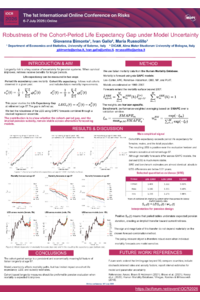
Longevity risk represents a structural source of uncertainty for modern pension systems and longevity-linked financial arrangements. Under persistent mortality improvements, period life expectancy evaluated at retirement age systematically understates the effective lifetime of real cohorts, generating a wedge between period and cohort measures. The magnitude and dynamics of this Life Expectancy Gap (LEG) depend critically on how future mortality rates are projected, since cohort life expectancy aggregates mortality along the diagonal of the Lexis surface and is therefore inherently forward-looking.
This paper investigates how model uncertainty and forecast combination design affect the measurement of cohort-based longevity indicators and the implied intergenerational transfers embedded in pension rules. Rather than proposing a new structural mortality specification, we focus on the aggregation layer within the class of generalized age–period–cohort (GAPC) mortality models. We implement a horizon-specific stacked regression ensemble (SRE), where combination weights are estimated via blocked time-series cross-validation and allowed to vary across forecasting horizons. This approach explicitly targets multi-step predictive risk and accounts for the instability of model performance across horizons.
To interpret the sources of predictive gains, we introduce a cooperative game–theoretic attribution based on the Shapley value. For each forecasting horizon, Shapley values provide an axiomatically grounded decomposition of out-of-sample risk reduction relative to an equal-weight benchmark, linking ensemble weights to the marginal informational contribution of each mortality specification.
Using Italian mortality data from the Human Mortality Database for ages 60–100 over 1960–2022, we construct extended mortality surfaces to compute period and cohort life expectancy at retirement age and the associated longevity gap. Results show that while a positive cohort–period wedge is robust across aggregation schemes, its magnitude and long-run dynamics differ materially between horizon-adaptive stacking and static forecast averaging, implying non-trivial consequences for the measurement of intergenerational transfers and actuarial fairness in pension systems.
Keywords
Life expectancy gap | Mortality forecasting | Stacked regression ensembles | Shapley value attribution | Pension policy
Poster
IOCR-Poster_Gallo.pdf
Diagnosing cryptocurrency security vulnerability through time-series decomposition
Reverse Mortgage in Italy: Life-Cycle Theoretical Approach vs Empirical Evidences