Event submissions
Published
This submission belongs to the session S2. Actuarial Science of the event The 1st International Online Conference on Risks
Published date
01 Jul, 2026
Academic Editor
'%3e%3cpath%20d='M12.6657%2010.9104C12.4185%2010.325%2012.0599%209.79327%2011.6097%209.34482C11.1609%208.89508%2010.6293%208.5365%2010.0442%208.28888C10.0389%208.28626%2010.0337%208.28495%2010.0285%208.28233C10.8446%207.69279%2011.3752%206.73249%2011.3752%205.64904C11.3752%203.8542%209.92103%202.39999%208.1262%202.39999C6.33136%202.39999%204.87715%203.8542%204.87715%205.64904C4.87715%206.73249%205.40774%207.69279%206.22393%208.28364C6.21869%208.28626%206.21345%208.28757%206.20821%208.29019C5.62129%208.5378%205.09463%208.89284%204.64265%209.34613C4.1929%209.79493%203.83432%2010.3266%203.58671%2010.9117C3.34345%2011.4845%203.21226%2012.0987%203.20023%2012.7209C3.19988%2012.7349%203.20233%2012.7488%203.20744%2012.7619C3.21255%2012.7749%203.22022%2012.7867%203.22998%2012.7968C3.23975%2012.8068%203.25142%2012.8147%203.26431%2012.8202C3.2772%2012.8256%203.29105%2012.8284%203.30504%2012.8284H4.09109C4.14874%2012.8284%204.19459%2012.7825%204.1959%2012.7262C4.2221%2011.7148%204.62823%2010.7676%205.34617%2010.0497C6.08899%209.30683%207.0755%208.89808%208.1262%208.89808C9.17689%208.89808%2010.1634%209.30683%2010.9062%2010.0497C11.6242%2010.7676%2012.0303%2011.7148%2012.0565%2012.7262C12.0578%2012.7838%2012.1037%2012.8284%2012.1613%2012.8284H12.9474C12.9613%2012.8284%2012.9752%2012.8256%2012.9881%2012.8202C13.001%2012.8147%2013.0126%2012.8068%2013.0224%2012.7968C13.0322%2012.7867%2013.0398%2012.7749%2013.0449%2012.7619C13.0501%2012.7488%2013.0525%2012.7349%2013.0522%2012.7209C13.0391%2012.0947%2012.9094%2011.4855%2012.6657%2010.9104ZM8.1262%207.9024C7.52486%207.9024%206.9589%207.6679%206.53312%207.24211C6.10733%206.81633%205.87283%206.25037%205.87283%205.64904C5.87283%205.0477%206.10733%204.48174%206.53312%204.05596C6.9589%203.63018%207.52486%203.39567%208.1262%203.39567C8.72753%203.39567%209.29349%203.63018%209.71927%204.05596C10.1451%204.48174%2010.3796%205.0477%2010.3796%205.64904C10.3796%206.25037%2010.1451%206.81633%209.71927%207.24211C9.29349%207.6679%208.72753%207.9024%208.1262%207.9024Z'%20fill='%235D1EE1'/%3e%3c/g%3e%3c/svg%3e) Hailiang Yang
Hailiang YangCitation
Maria Carannante, Valeria D'Amato, Massimiliano Menzietti, Steven Haberman, Dynamic Principal Component Analysis for Syndemic Factors in an Extended Lee–Carter Mortality Model, in Proceedings of The 1st International Online Conference on Risks, 6 July–7 July 2026, MDPI: Basel, Switzerland
Share
Email
Facebook
Twitter
LinkedIn
Dynamic Principal Component Analysis for Syndemic Factors in an Extended Lee–Carter Mortality Model
'%3e%3cpath%20d='M12.6647%2010.9104C12.4176%2010.325%2012.0589%209.7933%2011.6088%209.34485C11.16%208.89511%2010.6283%208.53653%2010.0432%208.28891C10.038%208.28629%2010.0327%208.28498%2010.0275%208.28236C10.8437%207.69282%2011.3743%206.73252%2011.3743%205.64907C11.3743%203.85423%209.92005%202.40002%208.12522%202.40002C6.33038%202.40002%204.87618%203.85423%204.87618%205.64907C4.87618%206.73252%205.40677%207.69282%206.22296%208.28367C6.21772%208.28629%206.21248%208.2876%206.20724%208.29022C5.62031%208.53783%205.09365%208.89287%204.64167%209.34616C4.19192%209.79496%203.83334%2010.3266%203.58573%2010.9117C3.34247%2011.4846%203.21128%2012.0987%203.19925%2012.721C3.1989%2012.735%203.20135%2012.7489%203.20646%2012.7619C3.21157%2012.7749%203.21924%2012.7868%203.22901%2012.7968C3.23877%2012.8068%203.25045%2012.8148%203.26334%2012.8202C3.27623%2012.8256%203.29007%2012.8284%203.30406%2012.8284H4.09012C4.14776%2012.8284%204.19362%2012.7825%204.19493%2012.7262C4.22113%2011.7148%204.62726%2010.7676%205.34519%2010.0497C6.08802%209.30686%207.07452%208.89811%208.12522%208.89811C9.17592%208.89811%2010.1624%209.30686%2010.9052%2010.0497C11.6232%2010.7676%2012.0293%2011.7148%2012.0555%2012.7262C12.0568%2012.7839%2012.1027%2012.8284%2012.1603%2012.8284H12.9464C12.9604%2012.8284%2012.9742%2012.8256%2012.9871%2012.8202C13%2012.8148%2013.0117%2012.8068%2013.0214%2012.7968C13.0312%2012.7868%2013.0389%2012.7749%2013.044%2012.7619C13.0491%2012.7489%2013.0515%2012.735%2013.0512%2012.721C13.0381%2012.0947%2012.9084%2011.4856%2012.6647%2010.9104ZM8.12522%207.90243C7.52388%207.90243%206.95792%207.66793%206.53214%207.24215C6.10636%206.81636%205.87185%206.2504%205.87185%205.64907C5.87185%205.04773%206.10636%204.48177%206.53214%204.05599C6.95792%203.63021%207.52388%203.3957%208.12522%203.3957C8.72655%203.3957%209.29252%203.63021%209.7183%204.05599C10.1441%204.48177%2010.3786%205.04773%2010.3786%205.64907C10.3786%206.2504%2010.1441%206.81636%209.7183%207.24215C9.29252%207.66793%208.72655%207.90243%208.12522%207.90243Z'%20fill='%235D1EE1'/%3e%3c/g%3e%3c/svg%3e)
Maria Carannante 1
Valeria D'Amato 2

Steven Haberman 3

Massimiliano Menzietti 4
1. Department of Human Science, Link Campus University, Rome, 00165, Italy, Italy
2. Memotef Department, Sapienza University of Rome, Rome, 00161, Italy, Italy
3. Faculty of Actuarial Science and Insurance, Bayes Business School, City St. George’s, University of London, London, EC1Y 8TZ, UK, UK
4. Department of Economical and Statistical Sciences, University of Salerno, Fisciano, 84084, Italy, Italy
Abstract
Introduction
The interaction between socioeconomic conditions, lifestyle factors, and mortality is a crucial issue for improving mortality modeling and
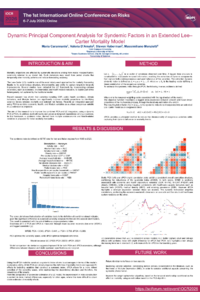
forecasting. The traditional Lee–Carter family models capture long-term mortality dynamics through a latent time index but do not explicitly incorporate exogenous determinants. This study proposes an extension of the Lee–Carter framework that integrates a composite
syndemic index derived from multiple socioeconomic and health-related variables. To address multicollinearity and preserve temporal dependence among covariates, a dynamic dimensionality-reduction approach based on Dynamic Principal Component Analysis (dPCA) is introduced.
Methods
Central mortality rates are modeled as a function of age-specific parameters, a latent mortality trend, and an additional exogenous component representing a syndemic index. Identification constraints ensure the uniqueness of the model parameters. A set of socioeconomic,
behavioral, and healthcare indicators for Italy and its regions from 1995 to 2023 is used to determine the multidimensional index. Standard Principal Component Analysis (PCA) and dPCA are applied to reduce the dimensionality of the covariates. While PCA identifies latent factors based on variance maximization, dPCA explicitly accounts for temporal dependence by extracting orthogonal dynamic components from lagged data matrices.
Results
Exploratory analysis reveals a strong clustering of economic and health expenditure variables, with obesity and alcohol consumption associated with higher income levels, while smoking and hospital-based healthcare structures are linked to more traditional socioeconomic contexts. The dPCA-based specification further enhances the robustness of the index by preserving temporal relationships among variables.
Conclusions
Integrating a dynamically derived syndemic index into the Lee–Carter framework improves the representation of mortality dynamics by explicitly linking mortality trends to evolving socioeconomic and health environments. The dPCA approach offers a more robust method for dimensionality reduction, thanks to the preservation of the temporal structure, leading to more stable parameter estimations and a more in-depth interpretation of mortality drivers.
Keywords
dynamic principal component analysis
syndemic index
mortality drivers
Lee-Carter family models
Poster
IOCR CDHM.pdf
A Hybrid Framework to Model Insurance Mortality Rates: Graduation and Ensemble Models
Directional predictability of financial instability under climate transition scenarios