Event submissions
Published
This submission belongs to the session S1. Insurance of the event The 1st International Online Conference on Risks
Published date
01 Jul, 2026
Academic Editor
'%3e%3cpath%20d='M12.6657%2010.9104C12.4185%2010.325%2012.0599%209.79327%2011.6097%209.34482C11.1609%208.89508%2010.6293%208.5365%2010.0442%208.28888C10.0389%208.28626%2010.0337%208.28495%2010.0285%208.28233C10.8446%207.69279%2011.3752%206.73249%2011.3752%205.64904C11.3752%203.8542%209.92103%202.39999%208.1262%202.39999C6.33136%202.39999%204.87715%203.8542%204.87715%205.64904C4.87715%206.73249%205.40774%207.69279%206.22393%208.28364C6.21869%208.28626%206.21345%208.28757%206.20821%208.29019C5.62129%208.5378%205.09463%208.89284%204.64265%209.34613C4.1929%209.79493%203.83432%2010.3266%203.58671%2010.9117C3.34345%2011.4845%203.21226%2012.0987%203.20023%2012.7209C3.19988%2012.7349%203.20233%2012.7488%203.20744%2012.7619C3.21255%2012.7749%203.22022%2012.7867%203.22998%2012.7968C3.23975%2012.8068%203.25142%2012.8147%203.26431%2012.8202C3.2772%2012.8256%203.29105%2012.8284%203.30504%2012.8284H4.09109C4.14874%2012.8284%204.19459%2012.7825%204.1959%2012.7262C4.2221%2011.7148%204.62823%2010.7676%205.34617%2010.0497C6.08899%209.30683%207.0755%208.89808%208.1262%208.89808C9.17689%208.89808%2010.1634%209.30683%2010.9062%2010.0497C11.6242%2010.7676%2012.0303%2011.7148%2012.0565%2012.7262C12.0578%2012.7838%2012.1037%2012.8284%2012.1613%2012.8284H12.9474C12.9613%2012.8284%2012.9752%2012.8256%2012.9881%2012.8202C13.001%2012.8147%2013.0126%2012.8068%2013.0224%2012.7968C13.0322%2012.7867%2013.0398%2012.7749%2013.0449%2012.7619C13.0501%2012.7488%2013.0525%2012.7349%2013.0522%2012.7209C13.0391%2012.0947%2012.9094%2011.4855%2012.6657%2010.9104ZM8.1262%207.9024C7.52486%207.9024%206.9589%207.6679%206.53312%207.24211C6.10733%206.81633%205.87283%206.25037%205.87283%205.64904C5.87283%205.0477%206.10733%204.48174%206.53312%204.05596C6.9589%203.63018%207.52486%203.39567%208.1262%203.39567C8.72753%203.39567%209.29349%203.63018%209.71927%204.05596C10.1451%204.48174%2010.3796%205.0477%2010.3796%205.64904C10.3796%206.25037%2010.1451%206.81633%209.71927%207.24211C9.29349%207.6679%208.72753%207.9024%208.1262%207.9024Z'%20fill='%235D1EE1'/%3e%3c/g%3e%3c/svg%3e) Mercedes Ayuso
Mercedes AyusoCitation
Alexander Shatskiy, Adverse Risk Selection in the Russian Health Insurance Model: Evidence from Cardiovascular Surgery, in Proceedings of The 1st International Online Conference on Risks, 6 July–7 July 2026, MDPI: Basel, Switzerland
Share
Email
Facebook
Twitter
LinkedIn
Adverse Risk Selection in the Russian Health Insurance Model: Evidence from Cardiovascular Surgery
'%3e%3cpath%20d='M12.6647%2010.9104C12.4176%2010.325%2012.0589%209.7933%2011.6088%209.34485C11.16%208.89511%2010.6283%208.53653%2010.0432%208.28891C10.038%208.28629%2010.0327%208.28498%2010.0275%208.28236C10.8437%207.69282%2011.3743%206.73252%2011.3743%205.64907C11.3743%203.85423%209.92005%202.40002%208.12522%202.40002C6.33038%202.40002%204.87618%203.85423%204.87618%205.64907C4.87618%206.73252%205.40677%207.69282%206.22296%208.28367C6.21772%208.28629%206.21248%208.2876%206.20724%208.29022C5.62031%208.53783%205.09365%208.89287%204.64167%209.34616C4.19192%209.79496%203.83334%2010.3266%203.58573%2010.9117C3.34247%2011.4846%203.21128%2012.0987%203.19925%2012.721C3.1989%2012.735%203.20135%2012.7489%203.20646%2012.7619C3.21157%2012.7749%203.21924%2012.7868%203.22901%2012.7968C3.23877%2012.8068%203.25045%2012.8148%203.26334%2012.8202C3.27623%2012.8256%203.29007%2012.8284%203.30406%2012.8284H4.09012C4.14776%2012.8284%204.19362%2012.7825%204.19493%2012.7262C4.22113%2011.7148%204.62726%2010.7676%205.34519%2010.0497C6.08802%209.30686%207.07452%208.89811%208.12522%208.89811C9.17592%208.89811%2010.1624%209.30686%2010.9052%2010.0497C11.6232%2010.7676%2012.0293%2011.7148%2012.0555%2012.7262C12.0568%2012.7839%2012.1027%2012.8284%2012.1603%2012.8284H12.9464C12.9604%2012.8284%2012.9742%2012.8256%2012.9871%2012.8202C13%2012.8148%2013.0117%2012.8068%2013.0214%2012.7968C13.0312%2012.7868%2013.0389%2012.7749%2013.044%2012.7619C13.0491%2012.7489%2013.0515%2012.735%2013.0512%2012.721C13.0381%2012.0947%2012.9084%2011.4856%2012.6647%2010.9104ZM8.12522%207.90243C7.52388%207.90243%206.95792%207.66793%206.53214%207.24215C6.10636%206.81636%205.87185%206.2504%205.87185%205.64907C5.87185%205.04773%206.10636%204.48177%206.53214%204.05599C6.95792%203.63021%207.52388%203.3957%208.12522%203.3957C8.72655%203.3957%209.29252%203.63021%209.7183%204.05599C10.1441%204.48177%2010.3786%205.04773%2010.3786%205.64907C10.3786%206.2504%2010.1441%206.81636%209.7183%207.24215C9.29252%207.66793%208.72655%207.90243%208.12522%207.90243Z'%20fill='%235D1EE1'/%3e%3c/g%3e%3c/svg%3e)
Alexander Shatskiy 1
1. Faculty of Fundamental Medicine, Chelyabinsk State University, Chelyabinsk 454001, Russia, Russia
Abstract
Introduction
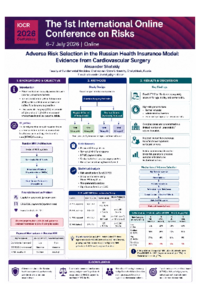
Adverse selection typically destabilizes voluntary insurance markets. In Russia, mandatory health insurance (MHI) dominates, but its dual structure—insurance medical organizations (IMOs) and territorial funds (TFMIFs)—shifts risk selection from insurers to providers. Cardiovascular surgery (CVS), a high-cost, high-risk field, reveals hidden mechanisms. This study examines provider-driven adverse selection in Russian MHI and high-tech medical care (HTMC), using evidence from cardiac surgery.
Methods
We analyzed Russian MHI regulations, payment models (capitation for primary care; clinical-statistical groups (CSG/DRG) for inpatient care; fixed tariffs for HTMC) using standard reporting of TFMIFs. Additionally, a quasi-experimental design was used, comparing two centers: a regional center and a single federal center. Four groups were formed based on insurance type (MHI vs. VHI) and care level (regional vs. federal). Clinical risk stratification was assessed using the EuroSCORE II and compared across groups.
Results
HTMC, fixed episode tariffs ignore age and comorbidity. To test this empirically, we employed a quasi-experimental design comparing regional (Chelyabinsk) and federal (Bakoulev, Moscow) cardiac centers. Distributions were compared via Mann–Whitney U test. Consequently, CVS centers avoid complex cases through formal refusal or informal barriers (excessive preoperative requirements). High-risk patients are redirected to a few "unavoidable" hospitals, worsening their unadjusted mortality statistics. Regional disparities push severe cases to federal centers, which further select low-risk patients to protect performance ratings.
Conclusions
Adverse selection in Russia is provider-driven, amplified by unadjusted capitation, incomplete CSG risk adjustment, and flat HTMC tariffs. In cardiovascular surgery, this results in hidden denial of care to high-risk patients. Transition to value-based healthcare (VBHC) with bundled payments, systematic risk adjustment (DCG/ACG), and outcomes measurement is necessary to align financial and clinical incentives.
Keywords
adverse selection
risk adjustment
mandatory health insurance
cardiovascular surgery
Russian healthcare
Poster
Poster Shatskiy Risks.pdf
Corporate Social Disclosure, Ownership Concentration, and Firm Risk: Evidence from Saudi Arabia
Evaluating Dynamic Hedging Strategies for American Options in Markets with Jumps