Event submissions
Published
This submission belongs to the session S1. Dental Biomaterials of the event The 2nd International Online Conference on Functional Biomaterials
Published date
03 Jul, 2026
Academic Editor
'%3e%3cpath%20d='M12.6657%2010.9104C12.4185%2010.325%2012.0599%209.79327%2011.6097%209.34482C11.1609%208.89508%2010.6293%208.5365%2010.0442%208.28888C10.0389%208.28626%2010.0337%208.28495%2010.0285%208.28233C10.8446%207.69279%2011.3752%206.73249%2011.3752%205.64904C11.3752%203.8542%209.92103%202.39999%208.1262%202.39999C6.33136%202.39999%204.87715%203.8542%204.87715%205.64904C4.87715%206.73249%205.40774%207.69279%206.22393%208.28364C6.21869%208.28626%206.21345%208.28757%206.20821%208.29019C5.62129%208.5378%205.09463%208.89284%204.64265%209.34613C4.1929%209.79493%203.83432%2010.3266%203.58671%2010.9117C3.34345%2011.4845%203.21226%2012.0987%203.20023%2012.7209C3.19988%2012.7349%203.20233%2012.7488%203.20744%2012.7619C3.21255%2012.7749%203.22022%2012.7867%203.22998%2012.7968C3.23975%2012.8068%203.25142%2012.8147%203.26431%2012.8202C3.2772%2012.8256%203.29105%2012.8284%203.30504%2012.8284H4.09109C4.14874%2012.8284%204.19459%2012.7825%204.1959%2012.7262C4.2221%2011.7148%204.62823%2010.7676%205.34617%2010.0497C6.08899%209.30683%207.0755%208.89808%208.1262%208.89808C9.17689%208.89808%2010.1634%209.30683%2010.9062%2010.0497C11.6242%2010.7676%2012.0303%2011.7148%2012.0565%2012.7262C12.0578%2012.7838%2012.1037%2012.8284%2012.1613%2012.8284H12.9474C12.9613%2012.8284%2012.9752%2012.8256%2012.9881%2012.8202C13.001%2012.8147%2013.0126%2012.8068%2013.0224%2012.7968C13.0322%2012.7867%2013.0398%2012.7749%2013.0449%2012.7619C13.0501%2012.7488%2013.0525%2012.7349%2013.0522%2012.7209C13.0391%2012.0947%2012.9094%2011.4855%2012.6657%2010.9104ZM8.1262%207.9024C7.52486%207.9024%206.9589%207.6679%206.53312%207.24211C6.10733%206.81633%205.87283%206.25037%205.87283%205.64904C5.87283%205.0477%206.10733%204.48174%206.53312%204.05596C6.9589%203.63018%207.52486%203.39567%208.1262%203.39567C8.72753%203.39567%209.29349%203.63018%209.71927%204.05596C10.1451%204.48174%2010.3796%205.0477%2010.3796%205.64904C10.3796%206.25037%2010.1451%206.81633%209.71927%207.24211C9.29349%207.6679%208.72753%207.9024%208.1262%207.9024Z'%20fill='%235D1EE1'/%3e%3c/g%3e%3c/svg%3e) Gianrico Spagnuolo
Gianrico SpagnuoloCitation
Iriczalli Cruz Maya, Rosaria Altobelli, Teresa Russo, Marco Antonio Álvarez-Pérez, Vincenzo Guarino, In Vitro Validation of Calcium Phosphate-Loaded Microgels as In Vitro Niche Model for Dental Applications, in Proceedings of The 2nd International Online Conference on Functional Biomaterials, 8 July–10 July 2026, MDPI: Basel, Switzerland
Share
Email
Facebook
Twitter
LinkedIn
In Vitro Validation of Calcium Phosphate-Loaded Microgels as In Vitro Niche Model for Dental Applications

Iriczalli Cruz Maya 1,2
'%3e%3cpath%20d='M12.6647%2010.9104C12.4176%2010.325%2012.0589%209.7933%2011.6088%209.34485C11.16%208.89511%2010.6283%208.53653%2010.0432%208.28891C10.038%208.28629%2010.0327%208.28498%2010.0275%208.28236C10.8437%207.69282%2011.3743%206.73252%2011.3743%205.64907C11.3743%203.85423%209.92005%202.40002%208.12522%202.40002C6.33038%202.40002%204.87618%203.85423%204.87618%205.64907C4.87618%206.73252%205.40677%207.69282%206.22296%208.28367C6.21772%208.28629%206.21248%208.2876%206.20724%208.29022C5.62031%208.53783%205.09365%208.89287%204.64167%209.34616C4.19192%209.79496%203.83334%2010.3266%203.58573%2010.9117C3.34247%2011.4846%203.21128%2012.0987%203.19925%2012.721C3.1989%2012.735%203.20135%2012.7489%203.20646%2012.7619C3.21157%2012.7749%203.21924%2012.7868%203.22901%2012.7968C3.23877%2012.8068%203.25045%2012.8148%203.26334%2012.8202C3.27623%2012.8256%203.29007%2012.8284%203.30406%2012.8284H4.09012C4.14776%2012.8284%204.19362%2012.7825%204.19493%2012.7262C4.22113%2011.7148%204.62726%2010.7676%205.34519%2010.0497C6.08802%209.30686%207.07452%208.89811%208.12522%208.89811C9.17592%208.89811%2010.1624%209.30686%2010.9052%2010.0497C11.6232%2010.7676%2012.0293%2011.7148%2012.0555%2012.7262C12.0568%2012.7839%2012.1027%2012.8284%2012.1603%2012.8284H12.9464C12.9604%2012.8284%2012.9742%2012.8256%2012.9871%2012.8202C13%2012.8148%2013.0117%2012.8068%2013.0214%2012.7968C13.0312%2012.7868%2013.0389%2012.7749%2013.044%2012.7619C13.0491%2012.7489%2013.0515%2012.735%2013.0512%2012.721C13.0381%2012.0947%2012.9084%2011.4856%2012.6647%2010.9104ZM8.12522%207.90243C7.52388%207.90243%206.95792%207.66793%206.53214%207.24215C6.10636%206.81636%205.87185%206.2504%205.87185%205.64907C5.87185%205.04773%206.10636%204.48177%206.53214%204.05599C6.95792%203.63021%207.52388%203.3957%208.12522%203.3957C8.72655%203.3957%209.29252%203.63021%209.7183%204.05599C10.1441%204.48177%2010.3786%205.04773%2010.3786%205.64907C10.3786%206.2504%2010.1441%206.81636%209.7183%207.24215C9.29252%207.66793%208.72655%207.90243%208.12522%207.90243Z'%20fill='%235D1EE1'/%3e%3c/g%3e%3c/svg%3e)
Rosaria Altobelli 1

Teresa Russo 1
Marco Antonio Álvarez-Pérez 3

Vincenzo Guarino 1
1. Institute of Polymers, Composites and Biomaterials of the National Research
Council of Italy (IPCB-CNR), Mostra d’Oltremare Pad. 20, Viale J.F. Kennedy 54,
80125 Naples, Italy, Italy
2. Tissue Bioengineering Laboratory, Department of Posgraduate Studies and
Research (DEPeI), School of Dentistry, Universidad Nacional Autonoma de Mexico
(UNAM), Circuito Exterior s/n, Mexico City 04510, Mexico
3. Tissue Bioengineering Laboratory, Department of Posgraduate Studies and
Research (DEPeI), School of Dentistry, Universidad Nacional Autonoma de Mexico
(UNAM), Circuito Exterior s/n, Mexico City 04510, Mexico, Mexico
Abstract
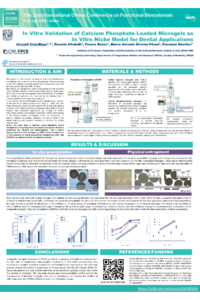
Recently, research on biomaterials has been focused on the development of platforms able to mimic the three-dimensional microenvironment of cells with bioactive signals to support cellular processes such as cell adhesion, proliferation and differentiation. In this regard, there is an increased interest in the use of hydrogels—particularly with the confinement of bioactive cues at the microscale—to mimic the cell niche through accurate control of cell-to-cell and cell–material interactions. In this work, we propose the design and fabrication of bioactive microgels containing sodium alginate loaded with calcium phosphate particles with micro- or sub-micrometric sizes via electrohydrodynamic atomization (EHDA) for use as in vitro models of hard tissue regeneration. Different processing strategies, from physical entrapment to in situ precipitation, were optimized. Morphological analyses (optical, SEM, TEM, and MicroCT) showed a narrow distribution of perfectly rounded particles with different spatial distributions of calcium phosphates and average diameters ranging from 223 ± 18 µm to 850 ± 64 µm as a function of mineral phase content and EHDA process conditions. Chemical/physical analyses (FTIR, TGA, and EDS) confirmed the presence of calcium phosphates in terms of chemical composition (i.e., Ca/P ratio) and relative volume fraction. In vitro studies were carried out to thoroughly investigate the response of dental pulp mesenchymal stem cells (DP-MSCs). Results demonstrated that the presence of calcium phosphates with different chemical compositions and/or particle sizes play an active role in the mechanisms of cells in terms of increased proliferation for up to 14 days and mineralization, as shown by alkaline phosphatase activity, thus contributing to mimicking the cell microenvironment. These results are promising for the development of in vitro models for the study of cellular behavior and for use as bioactive scaffolds for the regeneration of hard tissues, such as bone or dental-pulp complexes.
Keywords
Composite Microgels
Electro hydro dinamica atomization
dental-pulp complex
Dental Pulp Mesenchymal Stem Cells
Poster
poster iocfb_ICM.pdf
Plasma-Assisted Bifunctionalization of Glass Fillers to Develop Contact-Active Antibacterial Dental Composites
Graphene Oxide-Modified Portland Cement Enhances Bioactivity and Periapical Healing: An In Vitro and In Vivo Study