Event submissions
Published
This submission belongs to the session S2. Bone Biomaterials of the event The 2nd International Online Conference on Functional Biomaterials
Published date
03 Jul, 2026
Academic Editor
'%3e%3cpath%20d='M12.6657%2010.9104C12.4185%2010.325%2012.0599%209.79327%2011.6097%209.34482C11.1609%208.89508%2010.6293%208.5365%2010.0442%208.28888C10.0389%208.28626%2010.0337%208.28495%2010.0285%208.28233C10.8446%207.69279%2011.3752%206.73249%2011.3752%205.64904C11.3752%203.8542%209.92103%202.39999%208.1262%202.39999C6.33136%202.39999%204.87715%203.8542%204.87715%205.64904C4.87715%206.73249%205.40774%207.69279%206.22393%208.28364C6.21869%208.28626%206.21345%208.28757%206.20821%208.29019C5.62129%208.5378%205.09463%208.89284%204.64265%209.34613C4.1929%209.79493%203.83432%2010.3266%203.58671%2010.9117C3.34345%2011.4845%203.21226%2012.0987%203.20023%2012.7209C3.19988%2012.7349%203.20233%2012.7488%203.20744%2012.7619C3.21255%2012.7749%203.22022%2012.7867%203.22998%2012.7968C3.23975%2012.8068%203.25142%2012.8147%203.26431%2012.8202C3.2772%2012.8256%203.29105%2012.8284%203.30504%2012.8284H4.09109C4.14874%2012.8284%204.19459%2012.7825%204.1959%2012.7262C4.2221%2011.7148%204.62823%2010.7676%205.34617%2010.0497C6.08899%209.30683%207.0755%208.89808%208.1262%208.89808C9.17689%208.89808%2010.1634%209.30683%2010.9062%2010.0497C11.6242%2010.7676%2012.0303%2011.7148%2012.0565%2012.7262C12.0578%2012.7838%2012.1037%2012.8284%2012.1613%2012.8284H12.9474C12.9613%2012.8284%2012.9752%2012.8256%2012.9881%2012.8202C13.001%2012.8147%2013.0126%2012.8068%2013.0224%2012.7968C13.0322%2012.7867%2013.0398%2012.7749%2013.0449%2012.7619C13.0501%2012.7488%2013.0525%2012.7349%2013.0522%2012.7209C13.0391%2012.0947%2012.9094%2011.4855%2012.6657%2010.9104ZM8.1262%207.9024C7.52486%207.9024%206.9589%207.6679%206.53312%207.24211C6.10733%206.81633%205.87283%206.25037%205.87283%205.64904C5.87283%205.0477%206.10733%204.48174%206.53312%204.05596C6.9589%203.63018%207.52486%203.39567%208.1262%203.39567C8.72753%203.39567%209.29349%203.63018%209.71927%204.05596C10.1451%204.48174%2010.3796%205.0477%2010.3796%205.64904C10.3796%206.25037%2010.1451%206.81633%209.71927%207.24211C9.29349%207.6679%208.72753%207.9024%208.1262%207.9024Z'%20fill='%235D1EE1'/%3e%3c/g%3e%3c/svg%3e) Elisa Boanini
Elisa BoaniniCitation
Bernadette Akalé AKON-LABA, Ange-Patrick KOUASSI, Gilles Thierry MAROUA, Landry Abou Joël OKON, CAN A CLAY MATERIAL (GREEN CLAY FROM ANYAMA) IMPROVE BONE HEALING? STUDY BY DETERMINING THE ALKALINE PHOSPHATASE LEVEL IN WISTAR RATS, in Proceedings of The 2nd International Online Conference on Functional Biomaterials, 8 July–10 July 2026, MDPI: Basel, Switzerland
Share
Email
Facebook
Twitter
LinkedIn
CAN A CLAY MATERIAL (GREEN CLAY FROM ANYAMA) IMPROVE BONE HEALING? STUDY BY DETERMINING THE ALKALINE PHOSPHATASE LEVEL IN WISTAR RATS
'%3e%3cpath%20d='M12.6647%2010.9104C12.4176%2010.325%2012.0589%209.7933%2011.6088%209.34485C11.16%208.89511%2010.6283%208.53653%2010.0432%208.28891C10.038%208.28629%2010.0327%208.28498%2010.0275%208.28236C10.8437%207.69282%2011.3743%206.73252%2011.3743%205.64907C11.3743%203.85423%209.92005%202.40002%208.12522%202.40002C6.33038%202.40002%204.87618%203.85423%204.87618%205.64907C4.87618%206.73252%205.40677%207.69282%206.22296%208.28367C6.21772%208.28629%206.21248%208.2876%206.20724%208.29022C5.62031%208.53783%205.09365%208.89287%204.64167%209.34616C4.19192%209.79496%203.83334%2010.3266%203.58573%2010.9117C3.34247%2011.4846%203.21128%2012.0987%203.19925%2012.721C3.1989%2012.735%203.20135%2012.7489%203.20646%2012.7619C3.21157%2012.7749%203.21924%2012.7868%203.22901%2012.7968C3.23877%2012.8068%203.25045%2012.8148%203.26334%2012.8202C3.27623%2012.8256%203.29007%2012.8284%203.30406%2012.8284H4.09012C4.14776%2012.8284%204.19362%2012.7825%204.19493%2012.7262C4.22113%2011.7148%204.62726%2010.7676%205.34519%2010.0497C6.08802%209.30686%207.07452%208.89811%208.12522%208.89811C9.17592%208.89811%2010.1624%209.30686%2010.9052%2010.0497C11.6232%2010.7676%2012.0293%2011.7148%2012.0555%2012.7262C12.0568%2012.7839%2012.1027%2012.8284%2012.1603%2012.8284H12.9464C12.9604%2012.8284%2012.9742%2012.8256%2012.9871%2012.8202C13%2012.8148%2013.0117%2012.8068%2013.0214%2012.7968C13.0312%2012.7868%2013.0389%2012.7749%2013.044%2012.7619C13.0491%2012.7489%2013.0515%2012.735%2013.0512%2012.721C13.0381%2012.0947%2012.9084%2011.4856%2012.6647%2010.9104ZM8.12522%207.90243C7.52388%207.90243%206.95792%207.66793%206.53214%207.24215C6.10636%206.81636%205.87185%206.2504%205.87185%205.64907C5.87185%205.04773%206.10636%204.48177%206.53214%204.05599C6.95792%203.63021%207.52388%203.3957%208.12522%203.3957C8.72655%203.3957%209.29252%203.63021%209.7183%204.05599C10.1441%204.48177%2010.3786%205.04773%2010.3786%205.64907C10.3786%206.2504%2010.1441%206.81636%209.7183%207.24215C9.29252%207.66793%208.72655%207.90243%208.12522%207.90243Z'%20fill='%235D1EE1'/%3e%3c/g%3e%3c/svg%3e)
Bernadette Akalé AKON-LABA 1
Ange-Patrick KOUASSI 1
Gilles Thierry MAROUA 1
Landry Abou Joël OKON 2
1. Dental School of Félix Houphouët-Boigny University, UP Biomaterials, Ivory Coast, Côte d'Ivoire
2. School of medicine of Félix Houphouët-Boigny University, laboratory of histology, embryology, and cytogenetics, Ivory Coast, Côte d'Ivoire
Abstract
Introduction:
Implantology has revolutionized dentistry, and we are therefore witnessing a renewed interest in biomaterials inserted into the alveolar bone. Anyama is a city in Ivory Coast. Alkaline phosphatase is used as a marker of bone activity during bone healing.
The objective was to analyze the effects of Anyama green clay (AVA) on the alkaline phosphatase level during the healing of the alveolar bone of Wistar rats.
Methods:
Bone defects were created in 36 Wistar rats. The wounds were treated or not (control rats) with fine fractions of AVA (particle diameter < 2 µ) at different pH levels (acidic, neutral, basic) in dry or paste form. Blood samples were collected on D0, D15, and D30 from the tail for the measurement of alkaline phosphatase.
A Kruskal-Wallis rank test was used to analyze the results.
Results:
The dry form of AVA causes an increase in alkaline phosphatase activity from day 0 to day 15 and stabilizes between day 15 and day 30, except at an acidic pH where we observed a strong increase from day 0 to day 30.
The acidic paste clay seemed to cause an abnormal increase in ALP levels.
However, there was no significant correlation between the pH of the clay and the fluctuations in alkaline phosphatase levels (p-value = 0.2268).
Conclusion:
Within the limits of this study, the dry form of AVA at basic pH could promote good bone formation.
The measurement of PAL must be completed by histological studies.
Keywords
Green clay
healing
alveolar bone
Wistar rat
Poster
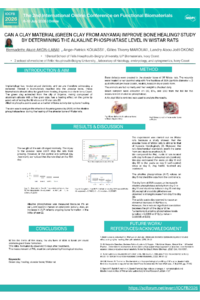
POSTER AKON.pdf
Metrological assessment of the trueness of prosthetic metal frameworks manufactured through digital techniques.
Polyetheretherketone as an alternative to titanium alloys in the additive manufacturing of orthopedic implants