Event submissions
Published
This submission belongs to the session S2. Bone Biomaterials of the event The 2nd International Online Conference on Functional Biomaterials
Published date
03 Jul, 2026
Academic Editor
'%3e%3cpath%20d='M12.6657%2010.9104C12.4185%2010.325%2012.0599%209.79327%2011.6097%209.34482C11.1609%208.89508%2010.6293%208.5365%2010.0442%208.28888C10.0389%208.28626%2010.0337%208.28495%2010.0285%208.28233C10.8446%207.69279%2011.3752%206.73249%2011.3752%205.64904C11.3752%203.8542%209.92103%202.39999%208.1262%202.39999C6.33136%202.39999%204.87715%203.8542%204.87715%205.64904C4.87715%206.73249%205.40774%207.69279%206.22393%208.28364C6.21869%208.28626%206.21345%208.28757%206.20821%208.29019C5.62129%208.5378%205.09463%208.89284%204.64265%209.34613C4.1929%209.79493%203.83432%2010.3266%203.58671%2010.9117C3.34345%2011.4845%203.21226%2012.0987%203.20023%2012.7209C3.19988%2012.7349%203.20233%2012.7488%203.20744%2012.7619C3.21255%2012.7749%203.22022%2012.7867%203.22998%2012.7968C3.23975%2012.8068%203.25142%2012.8147%203.26431%2012.8202C3.2772%2012.8256%203.29105%2012.8284%203.30504%2012.8284H4.09109C4.14874%2012.8284%204.19459%2012.7825%204.1959%2012.7262C4.2221%2011.7148%204.62823%2010.7676%205.34617%2010.0497C6.08899%209.30683%207.0755%208.89808%208.1262%208.89808C9.17689%208.89808%2010.1634%209.30683%2010.9062%2010.0497C11.6242%2010.7676%2012.0303%2011.7148%2012.0565%2012.7262C12.0578%2012.7838%2012.1037%2012.8284%2012.1613%2012.8284H12.9474C12.9613%2012.8284%2012.9752%2012.8256%2012.9881%2012.8202C13.001%2012.8147%2013.0126%2012.8068%2013.0224%2012.7968C13.0322%2012.7867%2013.0398%2012.7749%2013.0449%2012.7619C13.0501%2012.7488%2013.0525%2012.7349%2013.0522%2012.7209C13.0391%2012.0947%2012.9094%2011.4855%2012.6657%2010.9104ZM8.1262%207.9024C7.52486%207.9024%206.9589%207.6679%206.53312%207.24211C6.10733%206.81633%205.87283%206.25037%205.87283%205.64904C5.87283%205.0477%206.10733%204.48174%206.53312%204.05596C6.9589%203.63018%207.52486%203.39567%208.1262%203.39567C8.72753%203.39567%209.29349%203.63018%209.71927%204.05596C10.1451%204.48174%2010.3796%205.0477%2010.3796%205.64904C10.3796%206.25037%2010.1451%206.81633%209.71927%207.24211C9.29349%207.6679%208.72753%207.9024%208.1262%207.9024Z'%20fill='%235D1EE1'/%3e%3c/g%3e%3c/svg%3e) Elisa Boanini
Elisa BoaniniCitation
Gabriela Alicja Wielgus, Wojciech Kajzer, Anita Kajzer, Polyetheretherketone as an alternative to titanium alloys in the additive manufacturing of orthopedic implants, in Proceedings of The 2nd International Online Conference on Functional Biomaterials, 8 July–10 July 2026, MDPI: Basel, Switzerland
Share
Email
Facebook
Twitter
LinkedIn
Polyetheretherketone as an alternative to titanium alloys in the additive manufacturing of orthopedic implants
'%3e%3cpath%20d='M12.6647%2010.9104C12.4176%2010.325%2012.0589%209.7933%2011.6088%209.34485C11.16%208.89511%2010.6283%208.53653%2010.0432%208.28891C10.038%208.28629%2010.0327%208.28498%2010.0275%208.28236C10.8437%207.69282%2011.3743%206.73252%2011.3743%205.64907C11.3743%203.85423%209.92005%202.40002%208.12522%202.40002C6.33038%202.40002%204.87618%203.85423%204.87618%205.64907C4.87618%206.73252%205.40677%207.69282%206.22296%208.28367C6.21772%208.28629%206.21248%208.2876%206.20724%208.29022C5.62031%208.53783%205.09365%208.89287%204.64167%209.34616C4.19192%209.79496%203.83334%2010.3266%203.58573%2010.9117C3.34247%2011.4846%203.21128%2012.0987%203.19925%2012.721C3.1989%2012.735%203.20135%2012.7489%203.20646%2012.7619C3.21157%2012.7749%203.21924%2012.7868%203.22901%2012.7968C3.23877%2012.8068%203.25045%2012.8148%203.26334%2012.8202C3.27623%2012.8256%203.29007%2012.8284%203.30406%2012.8284H4.09012C4.14776%2012.8284%204.19362%2012.7825%204.19493%2012.7262C4.22113%2011.7148%204.62726%2010.7676%205.34519%2010.0497C6.08802%209.30686%207.07452%208.89811%208.12522%208.89811C9.17592%208.89811%2010.1624%209.30686%2010.9052%2010.0497C11.6232%2010.7676%2012.0293%2011.7148%2012.0555%2012.7262C12.0568%2012.7839%2012.1027%2012.8284%2012.1603%2012.8284H12.9464C12.9604%2012.8284%2012.9742%2012.8256%2012.9871%2012.8202C13%2012.8148%2013.0117%2012.8068%2013.0214%2012.7968C13.0312%2012.7868%2013.0389%2012.7749%2013.044%2012.7619C13.0491%2012.7489%2013.0515%2012.735%2013.0512%2012.721C13.0381%2012.0947%2012.9084%2011.4856%2012.6647%2010.9104ZM8.12522%207.90243C7.52388%207.90243%206.95792%207.66793%206.53214%207.24215C6.10636%206.81636%205.87185%206.2504%205.87185%205.64907C5.87185%205.04773%206.10636%204.48177%206.53214%204.05599C6.95792%203.63021%207.52388%203.3957%208.12522%203.3957C8.72655%203.3957%209.29252%203.63021%209.7183%204.05599C10.1441%204.48177%2010.3786%205.04773%2010.3786%205.64907C10.3786%206.2504%2010.1441%206.81636%209.7183%207.24215C9.29252%207.66793%208.72655%207.90243%208.12522%207.90243Z'%20fill='%235D1EE1'/%3e%3c/g%3e%3c/svg%3e)
Gabriela Alicja Wielgus 1
Wojciech Kajzer 2
Anita Kajzer 1
1. Department of Biomaterials and Medical Devices Engineering, Faculty of Biomedical Engineering, Silesian University of Technology, Zabrze, 41-800, Poland, Poland
2. Department of Biomechanics, Faculty of Biomedical Engineering, Silesian University of Technology, Zabrze, 41-800, Poland, Poland
Abstract
Background
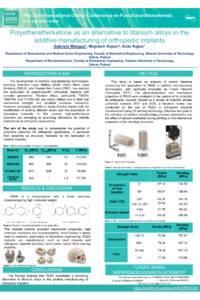
The development of additive manufacturing technologies, including Selective Laser Melting (SLM), Direct Metal Laser Sintering (DMLS), and Powder Bed Fusion (PBF), has enabled the production of patient-specific orthopedic implants with complex geometries. Titanium alloys, particularly Ti6Al4V, Ti6Al7Nb, and Ti13Nb13Zr, are widely utilized due to their high mechanical strength and excellent corrosion resistance. However, increasing attention is being directed toward both the modification of existing titanium alloys and the exploration of alternative materials. In this context, high-performance polymers are emerging as a promising alternative to metallic biomaterials in orthopedic applications.
Methods
This study is based on an analysis of the current literature concerning the application of polyetheretherketone (PEEK) in additive manufacturing technologies, with particular emphasis on Fused Filament Fabrication (FFF). The physicochemical and mechanical properties of PEEK were evaluated in the context of its suitability for orthopedic implants. Based on a review of scientific articles published between 2017 and 2026, a literature review was conducted on the use of PEEK in orthopedic implants manufactured using 3D printing technology. Particular attention was paid to the selection of additive manufacturing process parameters and the effect of sample orientation during printing on the mechanical properties of the resulting structures.
Results
Polyetheretherketone (PEEK) is a homopolymer with a linear structure, characterized by high molecular weight. This material exhibits excellent mechanical properties, high chemical resistance and biocompatibility, which makes it suitable for wide use in medicine, particularly in biomedical engineering. PEEK implants, such as skull implants and orthopedic implants, are manufactured for the following purposes: bone plates and spinal, knee and hip implants.
Conclusions
The findings indicate that PEEK constitutes a promising alternative to titanium alloys in the additive manufacturing of orthopedic implants. Its favorable mechanical compatibility with bone tissue, combined with its chemical inertness and suitability for personalized fabrication, supports its growing role in modern implantology.
Keywords
biomaterials
polymers
additive technologies
orthopedic implants
Poster
G.Wielgus _IOCFB.pdf
CAN A CLAY MATERIAL (GREEN CLAY FROM ANYAMA) IMPROVE BONE HEALING? STUDY BY DETERMINING THE ALKALINE PHOSPHATASE LEVEL IN WISTAR RATS
Bioprinting of Imaging-Derived Bone Geometries: Toward Patient-Specific Alginate Hydrogel Femur Phantoms for Mechanical and Functional Testing