Event submissions
Published
This submission belongs to the session S2. Bone Biomaterials of the event The 2nd International Online Conference on Functional Biomaterials
Published date
03 Jul, 2026
Academic Editor
'%3e%3cpath%20d='M12.6657%2010.9104C12.4185%2010.325%2012.0599%209.79327%2011.6097%209.34482C11.1609%208.89508%2010.6293%208.5365%2010.0442%208.28888C10.0389%208.28626%2010.0337%208.28495%2010.0285%208.28233C10.8446%207.69279%2011.3752%206.73249%2011.3752%205.64904C11.3752%203.8542%209.92103%202.39999%208.1262%202.39999C6.33136%202.39999%204.87715%203.8542%204.87715%205.64904C4.87715%206.73249%205.40774%207.69279%206.22393%208.28364C6.21869%208.28626%206.21345%208.28757%206.20821%208.29019C5.62129%208.5378%205.09463%208.89284%204.64265%209.34613C4.1929%209.79493%203.83432%2010.3266%203.58671%2010.9117C3.34345%2011.4845%203.21226%2012.0987%203.20023%2012.7209C3.19988%2012.7349%203.20233%2012.7488%203.20744%2012.7619C3.21255%2012.7749%203.22022%2012.7867%203.22998%2012.7968C3.23975%2012.8068%203.25142%2012.8147%203.26431%2012.8202C3.2772%2012.8256%203.29105%2012.8284%203.30504%2012.8284H4.09109C4.14874%2012.8284%204.19459%2012.7825%204.1959%2012.7262C4.2221%2011.7148%204.62823%2010.7676%205.34617%2010.0497C6.08899%209.30683%207.0755%208.89808%208.1262%208.89808C9.17689%208.89808%2010.1634%209.30683%2010.9062%2010.0497C11.6242%2010.7676%2012.0303%2011.7148%2012.0565%2012.7262C12.0578%2012.7838%2012.1037%2012.8284%2012.1613%2012.8284H12.9474C12.9613%2012.8284%2012.9752%2012.8256%2012.9881%2012.8202C13.001%2012.8147%2013.0126%2012.8068%2013.0224%2012.7968C13.0322%2012.7867%2013.0398%2012.7749%2013.0449%2012.7619C13.0501%2012.7488%2013.0525%2012.7349%2013.0522%2012.7209C13.0391%2012.0947%2012.9094%2011.4855%2012.6657%2010.9104ZM8.1262%207.9024C7.52486%207.9024%206.9589%207.6679%206.53312%207.24211C6.10733%206.81633%205.87283%206.25037%205.87283%205.64904C5.87283%205.0477%206.10733%204.48174%206.53312%204.05596C6.9589%203.63018%207.52486%203.39567%208.1262%203.39567C8.72753%203.39567%209.29349%203.63018%209.71927%204.05596C10.1451%204.48174%2010.3796%205.0477%2010.3796%205.64904C10.3796%206.25037%2010.1451%206.81633%209.71927%207.24211C9.29349%207.6679%208.72753%207.9024%208.1262%207.9024Z'%20fill='%235D1EE1'/%3e%3c/g%3e%3c/svg%3e) Elisa Boanini
Elisa BoaniniCitation
Wiktoria Dragan, Katarzyna Mikucka, Ewelina Kulla, Martyna Lipka, Jolanta Krupa, Balbina Makurat-Kasprolewicz, Tailoring MAO Coatings on Pure Magnesium via Electrical Parameters in a Multi-Component Electrolyte, in Proceedings of The 2nd International Online Conference on Functional Biomaterials, 8 July–10 July 2026, MDPI: Basel, Switzerland
Share
Email
Facebook
Twitter
LinkedIn
Tailoring MAO Coatings on Pure Magnesium via Electrical Parameters in a Multi-Component Electrolyte
'%3e%3cpath%20d='M12.6647%2010.9104C12.4176%2010.325%2012.0589%209.7933%2011.6088%209.34485C11.16%208.89511%2010.6283%208.53653%2010.0432%208.28891C10.038%208.28629%2010.0327%208.28498%2010.0275%208.28236C10.8437%207.69282%2011.3743%206.73252%2011.3743%205.64907C11.3743%203.85423%209.92005%202.40002%208.12522%202.40002C6.33038%202.40002%204.87618%203.85423%204.87618%205.64907C4.87618%206.73252%205.40677%207.69282%206.22296%208.28367C6.21772%208.28629%206.21248%208.2876%206.20724%208.29022C5.62031%208.53783%205.09365%208.89287%204.64167%209.34616C4.19192%209.79496%203.83334%2010.3266%203.58573%2010.9117C3.34247%2011.4846%203.21128%2012.0987%203.19925%2012.721C3.1989%2012.735%203.20135%2012.7489%203.20646%2012.7619C3.21157%2012.7749%203.21924%2012.7868%203.22901%2012.7968C3.23877%2012.8068%203.25045%2012.8148%203.26334%2012.8202C3.27623%2012.8256%203.29007%2012.8284%203.30406%2012.8284H4.09012C4.14776%2012.8284%204.19362%2012.7825%204.19493%2012.7262C4.22113%2011.7148%204.62726%2010.7676%205.34519%2010.0497C6.08802%209.30686%207.07452%208.89811%208.12522%208.89811C9.17592%208.89811%2010.1624%209.30686%2010.9052%2010.0497C11.6232%2010.7676%2012.0293%2011.7148%2012.0555%2012.7262C12.0568%2012.7839%2012.1027%2012.8284%2012.1603%2012.8284H12.9464C12.9604%2012.8284%2012.9742%2012.8256%2012.9871%2012.8202C13%2012.8148%2013.0117%2012.8068%2013.0214%2012.7968C13.0312%2012.7868%2013.0389%2012.7749%2013.044%2012.7619C13.0491%2012.7489%2013.0515%2012.735%2013.0512%2012.721C13.0381%2012.0947%2012.9084%2011.4856%2012.6647%2010.9104ZM8.12522%207.90243C7.52388%207.90243%206.95792%207.66793%206.53214%207.24215C6.10636%206.81636%205.87185%206.2504%205.87185%205.64907C5.87185%205.04773%206.10636%204.48177%206.53214%204.05599C6.95792%203.63021%207.52388%203.3957%208.12522%203.3957C8.72655%203.3957%209.29252%203.63021%209.7183%204.05599C10.1441%204.48177%2010.3786%205.04773%2010.3786%205.64907C10.3786%206.2504%2010.1441%206.81636%209.7183%207.24215C9.29252%207.66793%208.72655%207.90243%208.12522%207.90243Z'%20fill='%235D1EE1'/%3e%3c/g%3e%3c/svg%3e)
Wiktoria Dragan 1
Katarzyna Mikucka 1
Ewelina Kulla 1
Martyna Lipka 1
Jolanta Krupa 2

Balbina Makurat-Kasprolewicz 3
1. Students' Scientific Association ‘Materials in Medicine’, Department of Biomaterials Technology, Gdańsk University of Technology, 80-233 Gdańsk, Poland, Poland
2. Department of Machine Design and Operation, AGH University of Science and Technology, 30-059 Kraków, Poland, Poland
3. Department of Biomaterials Technology, Gdansk University of Technology, 80-233 Gdańsk, Poland, Poland
Abstract
Introduction
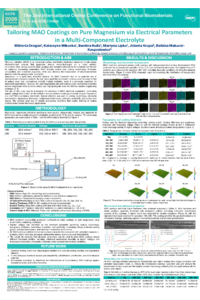
Micro-arc oxidation (MAO) is a promising technique for modifying magnesium surfaces, enabling the formation of multifunctional oxide coatings with improved corrosion resistance and bioactivity. This study investigates the influence of electrical parameters on the formation and properties of MAO coatings on pure magnesium.
Materials and Methods
MAO coatings were produced on pure magnesium in a K–Na–Si–Ca–P–Cu-containing electrolyte under varying electrical conditions (300–400 V, 180–280 mA). The coatings were characterized in terms of morphology, chemical composition, topography, thickness, mechanical properties, adhesion to the substrate, wettability, and surface free energy.
Results
The results demonstrated that applied voltage was the dominant factor governing coating formation and properties. Increasing voltage led to thicker coatings with a more developed porous morphology and enhanced incorporation of electrolyte-derived elements. These changes were accompanied by improved mechanical properties (hardness, scratch resistance) and increased wettability and surface free energy compared with bare magnesium. Different electrical conditions yielded distinct functional profiles: higher voltages favored mechanical performance, while intermediate conditions promoted greater incorporation of calcium and phosphorus, suggesting enhanced bioactive potential.
Conclusions
The obtained MAO coatings exhibited properties relevant for biomaterial applications, including calcium and phosphorus incorporation, developed morphology, and improved wettability. Precise control of electrical parameters enables targeted design of coating structure and performance. These findings highlight the potential of MAO-treated magnesium for biodegradable implant applications. Future work will focus on corrosion behavior under physiological conditions and biological and antibacterial performance.
Funding
This work was supported by the National Science Centre (Poland) under grant no. 2023/49/N/ST5/03551 (B.M.-K.).
Acknowledgments
The authors acknowledge Dawid Zieliński (Gdańsk University of Technology) for technical support. This work was supported by internal student funding at Gdańsk University of Technology (project no. 037323) and by the Ministry of Education and Science (Poland) within the BioMed Lab project.
Keywords
Mg
MAO
coating
scanning electron microscopy (SEM)
chemical composition
indentation
scratch test
Poster
poster_Dragan.pdf
Bioactive and magnetic apatitic bone cement for bone regeneration
Ionized Jet Deposition of bone-mimetic, complex biomaterials