Event submissions
Published
This submission belongs to the session S2. Bone Biomaterials of the event The 2nd International Online Conference on Functional Biomaterials
Published date
03 Jul, 2026
Academic Editor
'%3e%3cpath%20d='M12.6657%2010.9104C12.4185%2010.325%2012.0599%209.79327%2011.6097%209.34482C11.1609%208.89508%2010.6293%208.5365%2010.0442%208.28888C10.0389%208.28626%2010.0337%208.28495%2010.0285%208.28233C10.8446%207.69279%2011.3752%206.73249%2011.3752%205.64904C11.3752%203.8542%209.92103%202.39999%208.1262%202.39999C6.33136%202.39999%204.87715%203.8542%204.87715%205.64904C4.87715%206.73249%205.40774%207.69279%206.22393%208.28364C6.21869%208.28626%206.21345%208.28757%206.20821%208.29019C5.62129%208.5378%205.09463%208.89284%204.64265%209.34613C4.1929%209.79493%203.83432%2010.3266%203.58671%2010.9117C3.34345%2011.4845%203.21226%2012.0987%203.20023%2012.7209C3.19988%2012.7349%203.20233%2012.7488%203.20744%2012.7619C3.21255%2012.7749%203.22022%2012.7867%203.22998%2012.7968C3.23975%2012.8068%203.25142%2012.8147%203.26431%2012.8202C3.2772%2012.8256%203.29105%2012.8284%203.30504%2012.8284H4.09109C4.14874%2012.8284%204.19459%2012.7825%204.1959%2012.7262C4.2221%2011.7148%204.62823%2010.7676%205.34617%2010.0497C6.08899%209.30683%207.0755%208.89808%208.1262%208.89808C9.17689%208.89808%2010.1634%209.30683%2010.9062%2010.0497C11.6242%2010.7676%2012.0303%2011.7148%2012.0565%2012.7262C12.0578%2012.7838%2012.1037%2012.8284%2012.1613%2012.8284H12.9474C12.9613%2012.8284%2012.9752%2012.8256%2012.9881%2012.8202C13.001%2012.8147%2013.0126%2012.8068%2013.0224%2012.7968C13.0322%2012.7867%2013.0398%2012.7749%2013.0449%2012.7619C13.0501%2012.7488%2013.0525%2012.7349%2013.0522%2012.7209C13.0391%2012.0947%2012.9094%2011.4855%2012.6657%2010.9104ZM8.1262%207.9024C7.52486%207.9024%206.9589%207.6679%206.53312%207.24211C6.10733%206.81633%205.87283%206.25037%205.87283%205.64904C5.87283%205.0477%206.10733%204.48174%206.53312%204.05596C6.9589%203.63018%207.52486%203.39567%208.1262%203.39567C8.72753%203.39567%209.29349%203.63018%209.71927%204.05596C10.1451%204.48174%2010.3796%205.0477%2010.3796%205.64904C10.3796%206.25037%2010.1451%206.81633%209.71927%207.24211C9.29349%207.6679%208.72753%207.9024%208.1262%207.9024Z'%20fill='%235D1EE1'/%3e%3c/g%3e%3c/svg%3e) Elisa Boanini
Elisa BoaniniCitation
Emilly Mayara Alves Bulhões, Wagner Mauricio Pachekoski, Marcia Margarete Meier, Surface modification of n-HAp increases the compatibility with PLA scaffold composites., in Proceedings of The 2nd International Online Conference on Functional Biomaterials, 8 July–10 July 2026, MDPI: Basel, Switzerland
Share
Email
Facebook
Twitter
LinkedIn
Surface modification of n-HAp increases the compatibility with PLA scaffold composites.
'%3e%3cpath%20d='M12.6647%2010.9104C12.4176%2010.325%2012.0589%209.7933%2011.6088%209.34485C11.16%208.89511%2010.6283%208.53653%2010.0432%208.28891C10.038%208.28629%2010.0327%208.28498%2010.0275%208.28236C10.8437%207.69282%2011.3743%206.73252%2011.3743%205.64907C11.3743%203.85423%209.92005%202.40002%208.12522%202.40002C6.33038%202.40002%204.87618%203.85423%204.87618%205.64907C4.87618%206.73252%205.40677%207.69282%206.22296%208.28367C6.21772%208.28629%206.21248%208.2876%206.20724%208.29022C5.62031%208.53783%205.09365%208.89287%204.64167%209.34616C4.19192%209.79496%203.83334%2010.3266%203.58573%2010.9117C3.34247%2011.4846%203.21128%2012.0987%203.19925%2012.721C3.1989%2012.735%203.20135%2012.7489%203.20646%2012.7619C3.21157%2012.7749%203.21924%2012.7868%203.22901%2012.7968C3.23877%2012.8068%203.25045%2012.8148%203.26334%2012.8202C3.27623%2012.8256%203.29007%2012.8284%203.30406%2012.8284H4.09012C4.14776%2012.8284%204.19362%2012.7825%204.19493%2012.7262C4.22113%2011.7148%204.62726%2010.7676%205.34519%2010.0497C6.08802%209.30686%207.07452%208.89811%208.12522%208.89811C9.17592%208.89811%2010.1624%209.30686%2010.9052%2010.0497C11.6232%2010.7676%2012.0293%2011.7148%2012.0555%2012.7262C12.0568%2012.7839%2012.1027%2012.8284%2012.1603%2012.8284H12.9464C12.9604%2012.8284%2012.9742%2012.8256%2012.9871%2012.8202C13%2012.8148%2013.0117%2012.8068%2013.0214%2012.7968C13.0312%2012.7868%2013.0389%2012.7749%2013.044%2012.7619C13.0491%2012.7489%2013.0515%2012.735%2013.0512%2012.721C13.0381%2012.0947%2012.9084%2011.4856%2012.6647%2010.9104ZM8.12522%207.90243C7.52388%207.90243%206.95792%207.66793%206.53214%207.24215C6.10636%206.81636%205.87185%206.2504%205.87185%205.64907C5.87185%205.04773%206.10636%204.48177%206.53214%204.05599C6.95792%203.63021%207.52388%203.3957%208.12522%203.3957C8.72655%203.3957%209.29252%203.63021%209.7183%204.05599C10.1441%204.48177%2010.3786%205.04773%2010.3786%205.64907C10.3786%206.2504%2010.1441%206.81636%209.7183%207.24215C9.29252%207.66793%208.72655%207.90243%208.12522%207.90243Z'%20fill='%235D1EE1'/%3e%3c/g%3e%3c/svg%3e)
Emilly Mayara Alves Bulhões 1
Wagner Mauricio Pachekoski 2
Marcia Margarete Meier 1
1. Department of Chemistry, Santa Catarina State University (UDESC), College of Technological Science (CCT), Joinville, 89219-710, SC, Brazil., Brazil
2. Department of Materials Engineering, Federal University of Santa Catarina, Joinville, 89219-600, SC, Brazil., Brazil
Abstract
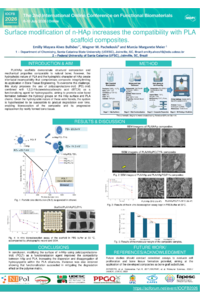
The biocompatibility, biodegradability, and osteoconductivity of composite scaffolds based on poly(lactic acid) (PLA) and nanohydroxyapatite (n-HAp) make them exceptional materials for bone tissue engineering applications. Nonetheless, there are still issues with the hydrophilic HAp particles' incompatibility with the hydrophobic PLA matrix, which could jeopardize the stability, mechanical strength, and homogeneity of the composite. In order to improve compatibility and interaction between HAp and PLA, this study proposed surface modification of n-HAp utilizing poly(caprolactone-triol) (PCLT) as a functionalizing agent. To promote the formation of ester linkages, PCL-T and HAp were mixed with a polyacid. TGA, FTIR, SEM, TEM, zeta potential, and DLS were used to analyze the n-HAp/PCL-T 1 wt% nanoparticles. An internal mixer was used to melt blend 20 wt% of the nanoparticles into PLA. Lastly, scaffolds were produced by additive manufacturing via 3D printing.
Characterization analyses demonstrated the effectiveness of the functionalization, as confirmed by zeta potential results that indicate alteration on particle surface charge from +23 mV (n-HAp) to -23 mV n-HAp/PCLT 1 wt%. The functionalization also prevents PLA molecular chains from degrading during melt processing. SEM and TEM images of the PLA composites show that functionalization also enhanced n-HAp/PCLT dispersion within the polymer matrix, an important characteristic for cell proliferation.
In vitro bioresorption studies were thermally accelerated at 45 and 55oC. Two degradation regimes were identified: an initial diffusion-controlled process followed by hydrolytic degradation. The degradation times (tdegrad) were estimated for each scaffold, and the following order was observed: tdegrad PLA/n-HAp » PLA/nHAP-PCLT > PLA. The n-HAP presence contributes to water diffusion through the composite and accelerates the hydrolytic degradation process.
In conclusion, the surface modification of n-HAp using poly(caprolactone-triol) (PCLT) as a functionalizing agent enhanced the compatibility between HAp and PLA, increasing the dispersion and disaggregation of hydroxyapatite within PLA scaffolds.
Keywords
Hydroxyapatite
Polycaprolactone triol
Poly(lactic acid)
3D printing
Scaffold.
Poster
IOCBF 2026 - Poster Emilly (2).pdf
Ionized Jet Deposition of bone-mimetic, complex biomaterials
Bisphosphonate Delivery via a pH-Responsive Bone Implant for Accelerated Repair of Osteoporotic Bone Fractures