Event submissions
Published
This submission belongs to the session S2. Bone Biomaterials of the event The 2nd International Online Conference on Functional Biomaterials
Published date
03 Jul, 2026
Academic Editor
'%3e%3cpath%20d='M12.6657%2010.9104C12.4185%2010.325%2012.0599%209.79327%2011.6097%209.34482C11.1609%208.89508%2010.6293%208.5365%2010.0442%208.28888C10.0389%208.28626%2010.0337%208.28495%2010.0285%208.28233C10.8446%207.69279%2011.3752%206.73249%2011.3752%205.64904C11.3752%203.8542%209.92103%202.39999%208.1262%202.39999C6.33136%202.39999%204.87715%203.8542%204.87715%205.64904C4.87715%206.73249%205.40774%207.69279%206.22393%208.28364C6.21869%208.28626%206.21345%208.28757%206.20821%208.29019C5.62129%208.5378%205.09463%208.89284%204.64265%209.34613C4.1929%209.79493%203.83432%2010.3266%203.58671%2010.9117C3.34345%2011.4845%203.21226%2012.0987%203.20023%2012.7209C3.19988%2012.7349%203.20233%2012.7488%203.20744%2012.7619C3.21255%2012.7749%203.22022%2012.7867%203.22998%2012.7968C3.23975%2012.8068%203.25142%2012.8147%203.26431%2012.8202C3.2772%2012.8256%203.29105%2012.8284%203.30504%2012.8284H4.09109C4.14874%2012.8284%204.19459%2012.7825%204.1959%2012.7262C4.2221%2011.7148%204.62823%2010.7676%205.34617%2010.0497C6.08899%209.30683%207.0755%208.89808%208.1262%208.89808C9.17689%208.89808%2010.1634%209.30683%2010.9062%2010.0497C11.6242%2010.7676%2012.0303%2011.7148%2012.0565%2012.7262C12.0578%2012.7838%2012.1037%2012.8284%2012.1613%2012.8284H12.9474C12.9613%2012.8284%2012.9752%2012.8256%2012.9881%2012.8202C13.001%2012.8147%2013.0126%2012.8068%2013.0224%2012.7968C13.0322%2012.7867%2013.0398%2012.7749%2013.0449%2012.7619C13.0501%2012.7488%2013.0525%2012.7349%2013.0522%2012.7209C13.0391%2012.0947%2012.9094%2011.4855%2012.6657%2010.9104ZM8.1262%207.9024C7.52486%207.9024%206.9589%207.6679%206.53312%207.24211C6.10733%206.81633%205.87283%206.25037%205.87283%205.64904C5.87283%205.0477%206.10733%204.48174%206.53312%204.05596C6.9589%203.63018%207.52486%203.39567%208.1262%203.39567C8.72753%203.39567%209.29349%203.63018%209.71927%204.05596C10.1451%204.48174%2010.3796%205.0477%2010.3796%205.64904C10.3796%206.25037%2010.1451%206.81633%209.71927%207.24211C9.29349%207.6679%208.72753%207.9024%208.1262%207.9024Z'%20fill='%235D1EE1'/%3e%3c/g%3e%3c/svg%3e) Elisa Boanini
Elisa BoaniniCitation
Edyta Kosińska, Julia Sadlik, Agata Tomaszewska, Pierluigi Bilotto, Hakan Göçerler, Agnieszka Tomala, MXENE-MODIFIED TI/HAP COMPOSITES AS A BIOMATERIAL PLATFORM FOR BONE TISSUE REGENERATION, in Proceedings of The 2nd International Online Conference on Functional Biomaterials, 8 July–10 July 2026, MDPI: Basel, Switzerland
Share
Email
Facebook
Twitter
LinkedIn
MXENE-MODIFIED TI/HAP COMPOSITES AS A BIOMATERIAL PLATFORM FOR BONE TISSUE REGENERATION
'%3e%3cpath%20d='M12.6647%2010.9104C12.4176%2010.325%2012.0589%209.7933%2011.6088%209.34485C11.16%208.89511%2010.6283%208.53653%2010.0432%208.28891C10.038%208.28629%2010.0327%208.28498%2010.0275%208.28236C10.8437%207.69282%2011.3743%206.73252%2011.3743%205.64907C11.3743%203.85423%209.92005%202.40002%208.12522%202.40002C6.33038%202.40002%204.87618%203.85423%204.87618%205.64907C4.87618%206.73252%205.40677%207.69282%206.22296%208.28367C6.21772%208.28629%206.21248%208.2876%206.20724%208.29022C5.62031%208.53783%205.09365%208.89287%204.64167%209.34616C4.19192%209.79496%203.83334%2010.3266%203.58573%2010.9117C3.34247%2011.4846%203.21128%2012.0987%203.19925%2012.721C3.1989%2012.735%203.20135%2012.7489%203.20646%2012.7619C3.21157%2012.7749%203.21924%2012.7868%203.22901%2012.7968C3.23877%2012.8068%203.25045%2012.8148%203.26334%2012.8202C3.27623%2012.8256%203.29007%2012.8284%203.30406%2012.8284H4.09012C4.14776%2012.8284%204.19362%2012.7825%204.19493%2012.7262C4.22113%2011.7148%204.62726%2010.7676%205.34519%2010.0497C6.08802%209.30686%207.07452%208.89811%208.12522%208.89811C9.17592%208.89811%2010.1624%209.30686%2010.9052%2010.0497C11.6232%2010.7676%2012.0293%2011.7148%2012.0555%2012.7262C12.0568%2012.7839%2012.1027%2012.8284%2012.1603%2012.8284H12.9464C12.9604%2012.8284%2012.9742%2012.8256%2012.9871%2012.8202C13%2012.8148%2013.0117%2012.8068%2013.0214%2012.7968C13.0312%2012.7868%2013.0389%2012.7749%2013.044%2012.7619C13.0491%2012.7489%2013.0515%2012.735%2013.0512%2012.721C13.0381%2012.0947%2012.9084%2011.4856%2012.6647%2010.9104ZM8.12522%207.90243C7.52388%207.90243%206.95792%207.66793%206.53214%207.24215C6.10636%206.81636%205.87185%206.2504%205.87185%205.64907C5.87185%205.04773%206.10636%204.48177%206.53214%204.05599C6.95792%203.63021%207.52388%203.3957%208.12522%203.3957C8.72655%203.3957%209.29252%203.63021%209.7183%204.05599C10.1441%204.48177%2010.3786%205.04773%2010.3786%205.64907C10.3786%206.2504%2010.1441%206.81636%209.7183%207.24215C9.29252%207.66793%208.72655%207.90243%208.12522%207.90243Z'%20fill='%235D1EE1'/%3e%3c/g%3e%3c/svg%3e)
Edyta Kosińska 1
Julia Sadlik 1
Agata Tomaszewska 2,3
Pierluigi Bilotto 4
Hakan Göçerler 4

Agnieszka Tomala 1
1. Department of Materials Science, Faculty of Materials Engineering and Physics, Cracow University of Technology, Krakow, Poland, Poland
2. Bio-Med-Chem Doctoral School of the University of Łódź and Łódź Institutes of the Polish
Academy of Sciences, ul. Banacha 12/16, 90-237 Łódź, Poland, Poland
3. Department of Immunology and Infectious Biology, Faculty of Biology and Environmental Protection, University of Łódź, ul. Banacha 12/16, 90-237 Łódź, Poland
4. Institute of Engineering Design and Product Development, Tribology Research Unit, TU Wien, Lehárgasse 6, Vienna, Austria, Austria
Abstract
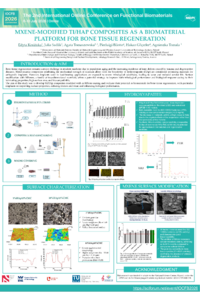
Problems related to the functioning of the skeletal system pose a significant challenge for modern regenerative medicine, which is due, among other things, to the progressive aging of the population and frequent injuries leading to bone damage. In many cases, it is necessary to use an implant that meets stringent requirements for biocompatibility, integration with the body, and interaction with surrounding tissues. For this reason, metal–ceramic composites are attracting increasing interest. Hydroxyapatite, thanks to its structure similar to natural bone tissue, exhibits bioactive properties and supports the bone regeneration process, while a metallic component, such as Ti6Al4V, ensures adequate mechanical strength. However, implants used in the hip and knee joints are subjected to significant tribological loads, which leads to their wear and may require revision surgery. One way to increase the durability of implants is to modify their surface in order to improve tribological properties and increase cell adhesion and proliferation. In this context, a promising solution is the use of MXene coatings, materials belonging to the group of two-dimensional structures that can reduce friction by forming stable tribological layers. MXenes are characterized by a large specific surface area, the possibility of incorporating medicinal substances, and high biocompatibility.
Ti/HAp composites were produced using powder metallurgy technology, with appropriately selected sintering parameters ensuring proper material consolidation. Next, a layer of MXene was applied to their surface to act as a lubricant, aimed at reducing friction and material wear during operation under load conditions. Physicochemical tests and structural analyses confirmed the validity of the adopted material concept and indicated the potential of the composites obtained in applications related to bone tissue regeneration.
This research was funded in whole by the National Science Centre, Poland, under the OPUS call in the Weave program under registration number 2022/47/I/ST8/01778.
Keywords
Ti6Al4V
hydroxyapatite
MXene
composite
Poster
IOCFB_2026.pdf
BMP7-Modified Polycaprolactone Nanofibrous Scaffolds Improve Osteoblast Activity
Engineering Trb3-Targeted Exosome Mimetics to Promote Bone Regeneration in Osteoporosis