Event submissions
Published
This submission belongs to the session S2. Bone Biomaterials of the event The 2nd International Online Conference on Functional Biomaterials
Published date
03 Jul, 2026
Academic Editor
'%3e%3cpath%20d='M12.6657%2010.9104C12.4185%2010.325%2012.0599%209.79327%2011.6097%209.34482C11.1609%208.89508%2010.6293%208.5365%2010.0442%208.28888C10.0389%208.28626%2010.0337%208.28495%2010.0285%208.28233C10.8446%207.69279%2011.3752%206.73249%2011.3752%205.64904C11.3752%203.8542%209.92103%202.39999%208.1262%202.39999C6.33136%202.39999%204.87715%203.8542%204.87715%205.64904C4.87715%206.73249%205.40774%207.69279%206.22393%208.28364C6.21869%208.28626%206.21345%208.28757%206.20821%208.29019C5.62129%208.5378%205.09463%208.89284%204.64265%209.34613C4.1929%209.79493%203.83432%2010.3266%203.58671%2010.9117C3.34345%2011.4845%203.21226%2012.0987%203.20023%2012.7209C3.19988%2012.7349%203.20233%2012.7488%203.20744%2012.7619C3.21255%2012.7749%203.22022%2012.7867%203.22998%2012.7968C3.23975%2012.8068%203.25142%2012.8147%203.26431%2012.8202C3.2772%2012.8256%203.29105%2012.8284%203.30504%2012.8284H4.09109C4.14874%2012.8284%204.19459%2012.7825%204.1959%2012.7262C4.2221%2011.7148%204.62823%2010.7676%205.34617%2010.0497C6.08899%209.30683%207.0755%208.89808%208.1262%208.89808C9.17689%208.89808%2010.1634%209.30683%2010.9062%2010.0497C11.6242%2010.7676%2012.0303%2011.7148%2012.0565%2012.7262C12.0578%2012.7838%2012.1037%2012.8284%2012.1613%2012.8284H12.9474C12.9613%2012.8284%2012.9752%2012.8256%2012.9881%2012.8202C13.001%2012.8147%2013.0126%2012.8068%2013.0224%2012.7968C13.0322%2012.7867%2013.0398%2012.7749%2013.0449%2012.7619C13.0501%2012.7488%2013.0525%2012.7349%2013.0522%2012.7209C13.0391%2012.0947%2012.9094%2011.4855%2012.6657%2010.9104ZM8.1262%207.9024C7.52486%207.9024%206.9589%207.6679%206.53312%207.24211C6.10733%206.81633%205.87283%206.25037%205.87283%205.64904C5.87283%205.0477%206.10733%204.48174%206.53312%204.05596C6.9589%203.63018%207.52486%203.39567%208.1262%203.39567C8.72753%203.39567%209.29349%203.63018%209.71927%204.05596C10.1451%204.48174%2010.3796%205.0477%2010.3796%205.64904C10.3796%206.25037%2010.1451%206.81633%209.71927%207.24211C9.29349%207.6679%208.72753%207.9024%208.1262%207.9024Z'%20fill='%235D1EE1'/%3e%3c/g%3e%3c/svg%3e) Pankaj Vadgama
Pankaj VadgamaCitation
Matteo Montesissa, Marco Boi, Francesca Perut, Alessandro Gambardella, Gianluca Giavaresi, Elisa Boanini, Katia Rubini, Rachele Modesti, Sofia Avnet, Nicola Baldini, Functionalization of Semicrystalline Hydroxyapatite Coatings with Citrate as New Approach in Orthopaedic Applications, in Proceedings of The 2nd International Online Conference on Functional Biomaterials, 8 July–10 July 2026, MDPI: Basel, Switzerland
Share
Email
Facebook
Twitter
LinkedIn
Functionalization of Semicrystalline Hydroxyapatite Coatings with Citrate as New Approach in Orthopaedic Applications
'%3e%3cpath%20d='M12.6647%2010.9104C12.4176%2010.325%2012.0589%209.7933%2011.6088%209.34485C11.16%208.89511%2010.6283%208.53653%2010.0432%208.28891C10.038%208.28629%2010.0327%208.28498%2010.0275%208.28236C10.8437%207.69282%2011.3743%206.73252%2011.3743%205.64907C11.3743%203.85423%209.92005%202.40002%208.12522%202.40002C6.33038%202.40002%204.87618%203.85423%204.87618%205.64907C4.87618%206.73252%205.40677%207.69282%206.22296%208.28367C6.21772%208.28629%206.21248%208.2876%206.20724%208.29022C5.62031%208.53783%205.09365%208.89287%204.64167%209.34616C4.19192%209.79496%203.83334%2010.3266%203.58573%2010.9117C3.34247%2011.4846%203.21128%2012.0987%203.19925%2012.721C3.1989%2012.735%203.20135%2012.7489%203.20646%2012.7619C3.21157%2012.7749%203.21924%2012.7868%203.22901%2012.7968C3.23877%2012.8068%203.25045%2012.8148%203.26334%2012.8202C3.27623%2012.8256%203.29007%2012.8284%203.30406%2012.8284H4.09012C4.14776%2012.8284%204.19362%2012.7825%204.19493%2012.7262C4.22113%2011.7148%204.62726%2010.7676%205.34519%2010.0497C6.08802%209.30686%207.07452%208.89811%208.12522%208.89811C9.17592%208.89811%2010.1624%209.30686%2010.9052%2010.0497C11.6232%2010.7676%2012.0293%2011.7148%2012.0555%2012.7262C12.0568%2012.7839%2012.1027%2012.8284%2012.1603%2012.8284H12.9464C12.9604%2012.8284%2012.9742%2012.8256%2012.9871%2012.8202C13%2012.8148%2013.0117%2012.8068%2013.0214%2012.7968C13.0312%2012.7868%2013.0389%2012.7749%2013.044%2012.7619C13.0491%2012.7489%2013.0515%2012.735%2013.0512%2012.721C13.0381%2012.0947%2012.9084%2011.4856%2012.6647%2010.9104ZM8.12522%207.90243C7.52388%207.90243%206.95792%207.66793%206.53214%207.24215C6.10636%206.81636%205.87185%206.2504%205.87185%205.64907C5.87185%205.04773%206.10636%204.48177%206.53214%204.05599C6.95792%203.63021%207.52388%203.3957%208.12522%203.3957C8.72655%203.3957%209.29252%203.63021%209.7183%204.05599C10.1441%204.48177%2010.3786%205.04773%2010.3786%205.64907C10.3786%206.2504%2010.1441%206.81636%209.7183%207.24215C9.29252%207.66793%208.72655%207.90243%208.12522%207.90243Z'%20fill='%235D1EE1'/%3e%3c/g%3e%3c/svg%3e)
Matteo Montesissa 1
Rachele Modesti 2
Marco Boi 3
Alessandro Gambardella 4
Francesca Perut 3
Katia Rubini 2

Gianluca Giavaresi 4

Sofia Avnet 5

Nicola Baldini 3,6

Elisa Boanini 2
1. Biomedical Sciences and Technologies and Nanobiotechnology Lab, IRCCS Istituto Ortopedico Rizzoli, Bologna, Italy, Italy
2. Department of Chemistry “Giacomo Ciamician”, University of Bologna, Bologna, Italy, Italy
3. Biomedical Science and Technologies and NanoBiotechnologies Lab, IRCCS Istituto Ortopedico Rizzoli, Bologna, Italy, Italy
4. Surgical Sciences and Technologies, IRCCS Istituto Ortopedico Rizzoli, Bologna, Italy, Italy
5. Department of Biomedical and Neuromotor Sciences, University of Bologna, Bologna, Italy, Italy
6. Department of Biomedical and Neuromotor Sciences, University of Bologna, Bologna, Italy
Abstract
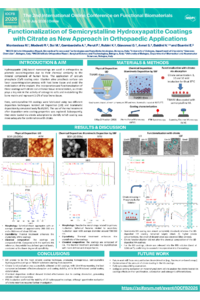
Introduction: Hydroxyapatite (HA)-based nanocoatings are used in orthopedics to promote osseointegration due to their chemical similarity to the mineral component of human bone. Functionalization of these coatings with citrate can enhance tissue mineralization, as citrate plays a key role in the activity of osteogenic cells and in stabilizing the bone matrix.
Methods: In this work, HA coatings were fabricated using Ionized Jet Deposition (IJD) and biomimetic deposition by simulated body fluid (SBF). Subsequently, they were loaded via citrate adsorption to identify which coating was more adequate for combination with citrate for future perspectives. Differences in morphology, roughness, and crystallinity between the two deposition techniques were evaluated. Citrate loading efficacy at three different concentrations (1, 10 and 50mM) was assessed by measuring citrate release in phosphate-buffered saline (PBS). Fibroblast cells (L929) were cultured for 24h with material extracts to test cytotoxicity.
Results: All coatings were composed of semicrystalline HA, as confirmed by FT-IR and XRD analyses. Moreover, post-deposition thermal treatment at 400°C increased the films' crystallinity. IJD-coatings are formed by globular aggregates, as observed by Atomic Force (AFM) and Scanning Electron Microscopy (SEM), with a thickness around 400nm. In contrast, SBF coatings exhibited similar morphology to IJD films and a needle-like shape, typical of HA crystals. SEM images, after citrate absorption, showed that IJD-made films maintained their original morphology, whereas SBF-coatings dissolved completely, making their functionalization impossible. FT-IR analysis of PBS collected after 5 days of immersion of IJD coatings confirmed the presence of a peak around 1550cm-1, corresponding to the antisymmetric stretching of COO- groups in citrate, more evident for loading concentrations of 10 and 50mM. L929 cells showed no cytotoxic effect against materials released from the coatings.
Conclusion: Based on these results, IJD-made coatings represent a suitable solution for citrate functionalization and may be used for further in-depth analysis and future orthopedic applications.
Keywords
Nanocoatings
Semicrystalline hydroxyapatite
Citrate loading
Orthopaedic
Poster
Poster IOCFB26 rev.pdf
Digital Light Processing for β-TCP/PDLLA-co-TMC Nanocomposite Bone Tissue Engineering Scaffolds with Different β-TCP Concentrations
Bacterial Biofilms and Titanium Implants: Current Understanding, Clinical Challenges, and Emerging Surface Modification Strategies