Event submissions
Published
This submission belongs to the session S3. Antibacterial Biomaterials and Surfaces of the event The 2nd International Online Conference on Functional Biomaterials
Published date
03 Jul, 2026
Academic Editor
'%3e%3cpath%20d='M12.6657%2010.9104C12.4185%2010.325%2012.0599%209.79327%2011.6097%209.34482C11.1609%208.89508%2010.6293%208.5365%2010.0442%208.28888C10.0389%208.28626%2010.0337%208.28495%2010.0285%208.28233C10.8446%207.69279%2011.3752%206.73249%2011.3752%205.64904C11.3752%203.8542%209.92103%202.39999%208.1262%202.39999C6.33136%202.39999%204.87715%203.8542%204.87715%205.64904C4.87715%206.73249%205.40774%207.69279%206.22393%208.28364C6.21869%208.28626%206.21345%208.28757%206.20821%208.29019C5.62129%208.5378%205.09463%208.89284%204.64265%209.34613C4.1929%209.79493%203.83432%2010.3266%203.58671%2010.9117C3.34345%2011.4845%203.21226%2012.0987%203.20023%2012.7209C3.19988%2012.7349%203.20233%2012.7488%203.20744%2012.7619C3.21255%2012.7749%203.22022%2012.7867%203.22998%2012.7968C3.23975%2012.8068%203.25142%2012.8147%203.26431%2012.8202C3.2772%2012.8256%203.29105%2012.8284%203.30504%2012.8284H4.09109C4.14874%2012.8284%204.19459%2012.7825%204.1959%2012.7262C4.2221%2011.7148%204.62823%2010.7676%205.34617%2010.0497C6.08899%209.30683%207.0755%208.89808%208.1262%208.89808C9.17689%208.89808%2010.1634%209.30683%2010.9062%2010.0497C11.6242%2010.7676%2012.0303%2011.7148%2012.0565%2012.7262C12.0578%2012.7838%2012.1037%2012.8284%2012.1613%2012.8284H12.9474C12.9613%2012.8284%2012.9752%2012.8256%2012.9881%2012.8202C13.001%2012.8147%2013.0126%2012.8068%2013.0224%2012.7968C13.0322%2012.7867%2013.0398%2012.7749%2013.0449%2012.7619C13.0501%2012.7488%2013.0525%2012.7349%2013.0522%2012.7209C13.0391%2012.0947%2012.9094%2011.4855%2012.6657%2010.9104ZM8.1262%207.9024C7.52486%207.9024%206.9589%207.6679%206.53312%207.24211C6.10733%206.81633%205.87283%206.25037%205.87283%205.64904C5.87283%205.0477%206.10733%204.48174%206.53312%204.05596C6.9589%203.63018%207.52486%203.39567%208.1262%203.39567C8.72753%203.39567%209.29349%203.63018%209.71927%204.05596C10.1451%204.48174%2010.3796%205.0477%2010.3796%205.64904C10.3796%206.25037%2010.1451%206.81633%209.71927%207.24211C9.29349%207.6679%208.72753%207.9024%208.1262%207.9024Z'%20fill='%235D1EE1'/%3e%3c/g%3e%3c/svg%3e) John Luong
John LuongCitation
Samir Zergat, Abir Katar Nada Morsi, Roberta Rovelli, Beatrice Amato, Semih Esin, Giovanna Batoni, Serena Danti, Manufacturing of tear resistant probiotic loaded membrane patches for application on eardrums in chronic otitis media treatment, in Proceedings of The 2nd International Online Conference on Functional Biomaterials, 8 July–10 July 2026, MDPI: Basel, Switzerland
Share
Email
Facebook
Twitter
LinkedIn
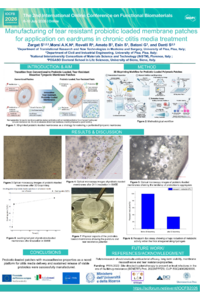
Manufacturing of tear resistant probiotic loaded membrane patches for application on eardrums in chronic otitis media treatment

Samir Zergat 1,2
'%3e%3cpath%20d='M12.6647%2010.9104C12.4176%2010.325%2012.0589%209.7933%2011.6088%209.34485C11.16%208.89511%2010.6283%208.53653%2010.0432%208.28891C10.038%208.28629%2010.0327%208.28498%2010.0275%208.28236C10.8437%207.69282%2011.3743%206.73252%2011.3743%205.64907C11.3743%203.85423%209.92005%202.40002%208.12522%202.40002C6.33038%202.40002%204.87618%203.85423%204.87618%205.64907C4.87618%206.73252%205.40677%207.69282%206.22296%208.28367C6.21772%208.28629%206.21248%208.2876%206.20724%208.29022C5.62031%208.53783%205.09365%208.89287%204.64167%209.34616C4.19192%209.79496%203.83334%2010.3266%203.58573%2010.9117C3.34247%2011.4846%203.21128%2012.0987%203.19925%2012.721C3.1989%2012.735%203.20135%2012.7489%203.20646%2012.7619C3.21157%2012.7749%203.21924%2012.7868%203.22901%2012.7968C3.23877%2012.8068%203.25045%2012.8148%203.26334%2012.8202C3.27623%2012.8256%203.29007%2012.8284%203.30406%2012.8284H4.09012C4.14776%2012.8284%204.19362%2012.7825%204.19493%2012.7262C4.22113%2011.7148%204.62726%2010.7676%205.34519%2010.0497C6.08802%209.30686%207.07452%208.89811%208.12522%208.89811C9.17592%208.89811%2010.1624%209.30686%2010.9052%2010.0497C11.6232%2010.7676%2012.0293%2011.7148%2012.0555%2012.7262C12.0568%2012.7839%2012.1027%2012.8284%2012.1603%2012.8284H12.9464C12.9604%2012.8284%2012.9742%2012.8256%2012.9871%2012.8202C13%2012.8148%2013.0117%2012.8068%2013.0214%2012.7968C13.0312%2012.7868%2013.0389%2012.7749%2013.044%2012.7619C13.0491%2012.7489%2013.0515%2012.735%2013.0512%2012.721C13.0381%2012.0947%2012.9084%2011.4856%2012.6647%2010.9104ZM8.12522%207.90243C7.52388%207.90243%206.95792%207.66793%206.53214%207.24215C6.10636%206.81636%205.87185%206.2504%205.87185%205.64907C5.87185%205.04773%206.10636%204.48177%206.53214%204.05599C6.95792%203.63021%207.52388%203.3957%208.12522%203.3957C8.72655%203.3957%209.29252%203.63021%209.7183%204.05599C10.1441%204.48177%2010.3786%205.04773%2010.3786%205.64907C10.3786%206.2504%2010.1441%206.81636%209.7183%207.24215C9.29252%207.66793%208.72655%207.90243%208.12522%207.90243Z'%20fill='%235D1EE1'/%3e%3c/g%3e%3c/svg%3e)
Abir Katar Nada Morsi 3
Roberta Rovelli 3
Beatrice Amato 4

Semih Esin 4

Giovanna Batoni 4

Serena Danti 2,5
1. Department of Translational Research and of New Surgical and Medical Technologies, University of Pisa
Via Savi 10, 56126 Pisa, Italy, Italy
2. Consorzio Interuniversitario Nazionale per la Scienza e Tecnologia dei Materiali (INSTM), Via G. Giusti 9,
50121 Florence, Italy
3. PEGASO Doctoral School of Life Sciences, University of Siena, 53100 Siena, Italy, Italy
4. Department of Translational Research and of New Surgical and Medical Technologies, University of Pisa,
Via Savi 10, 56126 Pisa, Italy, Italy
5. Department of Civil and Industrial Engineering, University of Pisa, 56122 Pisa, Italy, Italy
Abstract
Introduction:
Bioactive tympanic membrane patches currently incorporate antibiotics and growth factors to facilitate healing. However, due to the increasing issue of antibiotic resistance and the insufficient structural integrity of existing patches, tear-resistant membranes loaded with probiotics present an excellent alternative. These membranes can replace antibiotics while ensuring surgical manipulability.
Methods:
Sodium alginate MW= 100-200 kDa (3% w/v) served as the polymeric matrix, while gum Arabic (0.8% w/v) acted as an interpenetrating agent, alpha-lactalbumin (1.5%) improved probiotic survival, and sucrose (2% w/v) served multiple roles as a cryoprotectant, osmotic balancer, and porogen agent with water. Probiotics (10⁹ CFU/mL) were incorporated before 3D bioprinting. A D-optimal mixture design was used to optimize the formulation ratios. The PyRheo Python package predicted printability through simulations, modeling shear stress and filament stability. The 3D-printed patches were cross-linked with 1% (w/v) CaCl₂ water solution for 15 minutes. Optical microscopy was used to assess encapsulation post-printing, and a simulated middle ear effusion at various intervals evaluated polymeric network swelling and the ability of probiotics to withstand infection conditions, while Resazurin assay measured metabolic activity.
Results:
Optical microscopy images showed successful probiotic encapsulation with a homogeneous distribution over the membrane, ensuring adequate release of bioactive probiotic metabolites. Swelling test results in simulated middle ear fluid showed a slow increase, reaching approximately 30% after 24 h, leading to a more controlled, sustained release, confirming previous observations. Resazurin assay showed metabolic activity of released probiotics post-printing and after 24 hours.
Conclusion:
This study demonstrates the fabrication of probiotic-loaded patches with mucoadhesive properties as a novel platform for otitis media delivery and sustained release of viable probiotics. Future research should evaluate antibacterial efficacy, long-term viability, membrane mucoadhesive and tear resistance properties.
Funding: PRIN 2022: Site-directed bacteriotherapy to prevent or treat infections in the era of multidrug-resistance (BENEFIT) Prot. 2022M7PFZS; CUP I53C24002820006.
Keywords
Probiotic delivery
Tympanic membrane patch
Chronic otitis media
Tear-resistant biodegradable membrane
Controlled release.
Poster
IOCFB2026 Poster-Samir Zergat.pdf
Surface modification strategies for mitigating biofilm adhesion on glaucoma drainage devices in the intraocular environment: a systematic review
Bacterial-mediated synthesis of silver-doped ZnO nanocomposites for inhibition of biofilm formation and quorum sensing in Pseudomonas aeruginosa