Event submissions
Published
This submission belongs to the session S3. Antibacterial Biomaterials and Surfaces of the event The 2nd International Online Conference on Functional Biomaterials
Published date
03 Jul, 2026
Academic Editor
'%3e%3cpath%20d='M12.6657%2010.9104C12.4185%2010.325%2012.0599%209.79327%2011.6097%209.34482C11.1609%208.89508%2010.6293%208.5365%2010.0442%208.28888C10.0389%208.28626%2010.0337%208.28495%2010.0285%208.28233C10.8446%207.69279%2011.3752%206.73249%2011.3752%205.64904C11.3752%203.8542%209.92103%202.39999%208.1262%202.39999C6.33136%202.39999%204.87715%203.8542%204.87715%205.64904C4.87715%206.73249%205.40774%207.69279%206.22393%208.28364C6.21869%208.28626%206.21345%208.28757%206.20821%208.29019C5.62129%208.5378%205.09463%208.89284%204.64265%209.34613C4.1929%209.79493%203.83432%2010.3266%203.58671%2010.9117C3.34345%2011.4845%203.21226%2012.0987%203.20023%2012.7209C3.19988%2012.7349%203.20233%2012.7488%203.20744%2012.7619C3.21255%2012.7749%203.22022%2012.7867%203.22998%2012.7968C3.23975%2012.8068%203.25142%2012.8147%203.26431%2012.8202C3.2772%2012.8256%203.29105%2012.8284%203.30504%2012.8284H4.09109C4.14874%2012.8284%204.19459%2012.7825%204.1959%2012.7262C4.2221%2011.7148%204.62823%2010.7676%205.34617%2010.0497C6.08899%209.30683%207.0755%208.89808%208.1262%208.89808C9.17689%208.89808%2010.1634%209.30683%2010.9062%2010.0497C11.6242%2010.7676%2012.0303%2011.7148%2012.0565%2012.7262C12.0578%2012.7838%2012.1037%2012.8284%2012.1613%2012.8284H12.9474C12.9613%2012.8284%2012.9752%2012.8256%2012.9881%2012.8202C13.001%2012.8147%2013.0126%2012.8068%2013.0224%2012.7968C13.0322%2012.7867%2013.0398%2012.7749%2013.0449%2012.7619C13.0501%2012.7488%2013.0525%2012.7349%2013.0522%2012.7209C13.0391%2012.0947%2012.9094%2011.4855%2012.6657%2010.9104ZM8.1262%207.9024C7.52486%207.9024%206.9589%207.6679%206.53312%207.24211C6.10733%206.81633%205.87283%206.25037%205.87283%205.64904C5.87283%205.0477%206.10733%204.48174%206.53312%204.05596C6.9589%203.63018%207.52486%203.39567%208.1262%203.39567C8.72753%203.39567%209.29349%203.63018%209.71927%204.05596C10.1451%204.48174%2010.3796%205.0477%2010.3796%205.64904C10.3796%206.25037%2010.1451%206.81633%209.71927%207.24211C9.29349%207.6679%208.72753%207.9024%208.1262%207.9024Z'%20fill='%235D1EE1'/%3e%3c/g%3e%3c/svg%3e) John Luong
John LuongCitation
Ihtisham Ul Haq, Abdullah Abdullah, Kamran Ayaz, Janusz Szewczenko, Karolina Wilk, Katarzyna Krukiewicz, Antimicrobial effects of sodium alginate/poly-L-lysine based films and their deposition onto urinary catheters using ultrasonic spray coating, in Proceedings of The 2nd International Online Conference on Functional Biomaterials, 8 July–10 July 2026, MDPI: Basel, Switzerland
Share
Email
Facebook
Twitter
LinkedIn
Antimicrobial effects of sodium alginate/poly-L-lysine based films and their deposition onto urinary catheters using ultrasonic spray coating
'%3e%3cpath%20d='M12.6647%2010.9104C12.4176%2010.325%2012.0589%209.7933%2011.6088%209.34485C11.16%208.89511%2010.6283%208.53653%2010.0432%208.28891C10.038%208.28629%2010.0327%208.28498%2010.0275%208.28236C10.8437%207.69282%2011.3743%206.73252%2011.3743%205.64907C11.3743%203.85423%209.92005%202.40002%208.12522%202.40002C6.33038%202.40002%204.87618%203.85423%204.87618%205.64907C4.87618%206.73252%205.40677%207.69282%206.22296%208.28367C6.21772%208.28629%206.21248%208.2876%206.20724%208.29022C5.62031%208.53783%205.09365%208.89287%204.64167%209.34616C4.19192%209.79496%203.83334%2010.3266%203.58573%2010.9117C3.34247%2011.4846%203.21128%2012.0987%203.19925%2012.721C3.1989%2012.735%203.20135%2012.7489%203.20646%2012.7619C3.21157%2012.7749%203.21924%2012.7868%203.22901%2012.7968C3.23877%2012.8068%203.25045%2012.8148%203.26334%2012.8202C3.27623%2012.8256%203.29007%2012.8284%203.30406%2012.8284H4.09012C4.14776%2012.8284%204.19362%2012.7825%204.19493%2012.7262C4.22113%2011.7148%204.62726%2010.7676%205.34519%2010.0497C6.08802%209.30686%207.07452%208.89811%208.12522%208.89811C9.17592%208.89811%2010.1624%209.30686%2010.9052%2010.0497C11.6232%2010.7676%2012.0293%2011.7148%2012.0555%2012.7262C12.0568%2012.7839%2012.1027%2012.8284%2012.1603%2012.8284H12.9464C12.9604%2012.8284%2012.9742%2012.8256%2012.9871%2012.8202C13%2012.8148%2013.0117%2012.8068%2013.0214%2012.7968C13.0312%2012.7868%2013.0389%2012.7749%2013.044%2012.7619C13.0491%2012.7489%2013.0515%2012.735%2013.0512%2012.721C13.0381%2012.0947%2012.9084%2011.4856%2012.6647%2010.9104ZM8.12522%207.90243C7.52388%207.90243%206.95792%207.66793%206.53214%207.24215C6.10636%206.81636%205.87185%206.2504%205.87185%205.64907C5.87185%205.04773%206.10636%204.48177%206.53214%204.05599C6.95792%203.63021%207.52388%203.3957%208.12522%203.3957C8.72655%203.3957%209.29252%203.63021%209.7183%204.05599C10.1441%204.48177%2010.3786%205.04773%2010.3786%205.64907C10.3786%206.2504%2010.1441%206.81636%209.7183%207.24215C9.29252%207.66793%208.72655%207.90243%208.12522%207.90243Z'%20fill='%235D1EE1'/%3e%3c/g%3e%3c/svg%3e)
Ihtisham Ul Haq 1
Abdullah Abdullah 1
Kamran Ayaz 2
Janusz Szewczenko 3
Karolina Wilk 3
Katarzyna Krukiewicz 1
1. Department of Physical Chemistry and Technology of Polymers, Silesian University of Technology, M. Strzody 9, 44-100 Gliwice, Poland, Poland
2. Department of Air Protection, Faculty of Energy and Environmental Engineering, Silesian University of Technology, Konarskiego 22B, 44-100 Gliwice, Poland, Poland
3. Faculty of Biomedical Engineering, Department of Biomaterials and Medical Device Engineering, Silesian University of Technology, Roosevelta 40, 41-800 Zabrze, Poland, Poland
Abstract
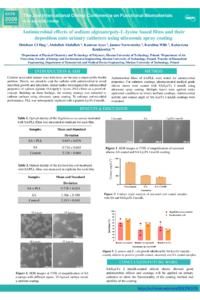
Introduction: Urinary catheters have revolutionized modern medicine by restoring organ function and positively affecting patients' quality of life; however, the process of catheter insertion gives microorganisms a chance to attach and cause infections known as catheter-associated urinary tract infections (CAUTI). The antimicrobial coatings on urinary catheters are a central focus for reducing microbial attachment on catheters and CAUTI. Methodology: To address this issue, we have developed antimicrobial coatings based on sodium alginate and poly-L-lysine. Antimicrobial films were prepared by dissolving sodium alginate (SA) in deionized water, followed by the addition of poly-L-lysine (PLL), corresponding to an SA:PLL volume ratio of 40:1, and mixed thoroughly. The solution was cast on Petri plates, and films were peeled off the next day and soaked in 5% CaCl2 solution for cross-linking. The films were tested against two standard reference strains, Staphylococcus aureus (ATCC 25923) and Escherichia coli (ATCC 25922). Bacterial cultures incubated in the absence of any films were used as the untreated control. Results: Cross-linking increased the stability of CaCl₂–SA/PLL films, since they remained intact after immersing in PBS solution for 7 days. The resulting CaCl₂–SA/PLL inhibited Escherichia coli growth by 60-42% relative to SA films and by 64-68% relative to the control, while SA film alone showed 17-45% inhibition compared to the control. Regarding Staphylococcus aureus, CaCl₂–SA/PLL slightly reduced its growth compared to SA alone (4-14% inhibition), but both SA+PLL and SA alone showed substantial inhibition relative to the control (66-71% inhibition). Conclusion: The observed differences between Gram-positive and Gram-negative bacteria may be attributed to structural variations in their cell envelopes. Since CaCl₂–SA/PLL films showed antimicrobial effects, they were used to coat commercially available urinary catheters using ultrasonic spraying, allowing for the formation of a uniform coating with antimicrobial activity.
Keywords
Sodium alginate
poly-L-lysine
antimicrobial films
urinary catheter
ultrasonic spray coating
Poster
Poster for functional biomaterial conf 2026.pdf
Neat Chitosan Films that Release Polyhexanide for Use in Antibacterial Wound Dressings
Functionalized surface of a ceramic carbonated apatite substrate with an antibacterial α-tocopheryl phosphate organic layer