Event submissions
Published
This submission belongs to the session S3. Antibacterial Biomaterials and Surfaces of the event The 2nd International Online Conference on Functional Biomaterials
Published date
03 Jul, 2026
Academic Editor
'%3e%3cpath%20d='M12.6657%2010.9104C12.4185%2010.325%2012.0599%209.79327%2011.6097%209.34482C11.1609%208.89508%2010.6293%208.5365%2010.0442%208.28888C10.0389%208.28626%2010.0337%208.28495%2010.0285%208.28233C10.8446%207.69279%2011.3752%206.73249%2011.3752%205.64904C11.3752%203.8542%209.92103%202.39999%208.1262%202.39999C6.33136%202.39999%204.87715%203.8542%204.87715%205.64904C4.87715%206.73249%205.40774%207.69279%206.22393%208.28364C6.21869%208.28626%206.21345%208.28757%206.20821%208.29019C5.62129%208.5378%205.09463%208.89284%204.64265%209.34613C4.1929%209.79493%203.83432%2010.3266%203.58671%2010.9117C3.34345%2011.4845%203.21226%2012.0987%203.20023%2012.7209C3.19988%2012.7349%203.20233%2012.7488%203.20744%2012.7619C3.21255%2012.7749%203.22022%2012.7867%203.22998%2012.7968C3.23975%2012.8068%203.25142%2012.8147%203.26431%2012.8202C3.2772%2012.8256%203.29105%2012.8284%203.30504%2012.8284H4.09109C4.14874%2012.8284%204.19459%2012.7825%204.1959%2012.7262C4.2221%2011.7148%204.62823%2010.7676%205.34617%2010.0497C6.08899%209.30683%207.0755%208.89808%208.1262%208.89808C9.17689%208.89808%2010.1634%209.30683%2010.9062%2010.0497C11.6242%2010.7676%2012.0303%2011.7148%2012.0565%2012.7262C12.0578%2012.7838%2012.1037%2012.8284%2012.1613%2012.8284H12.9474C12.9613%2012.8284%2012.9752%2012.8256%2012.9881%2012.8202C13.001%2012.8147%2013.0126%2012.8068%2013.0224%2012.7968C13.0322%2012.7867%2013.0398%2012.7749%2013.0449%2012.7619C13.0501%2012.7488%2013.0525%2012.7349%2013.0522%2012.7209C13.0391%2012.0947%2012.9094%2011.4855%2012.6657%2010.9104ZM8.1262%207.9024C7.52486%207.9024%206.9589%207.6679%206.53312%207.24211C6.10733%206.81633%205.87283%206.25037%205.87283%205.64904C5.87283%205.0477%206.10733%204.48174%206.53312%204.05596C6.9589%203.63018%207.52486%203.39567%208.1262%203.39567C8.72753%203.39567%209.29349%203.63018%209.71927%204.05596C10.1451%204.48174%2010.3796%205.0477%2010.3796%205.64904C10.3796%206.25037%2010.1451%206.81633%209.71927%207.24211C9.29349%207.6679%208.72753%207.9024%208.1262%207.9024Z'%20fill='%235D1EE1'/%3e%3c/g%3e%3c/svg%3e) John Luong
John LuongCitation
Anastasia Ntolia, Michail Kalis, Chris Manglaris, Vassilios Zaspalis, Nikolaos Michailidis, Amalia Aggeli, Comparative Evaluation of Silver Nanoparticles Synthesized via Green and Chemical Routes: Size-Dependent Antibacterial Activity, in Proceedings of The 2nd International Online Conference on Functional Biomaterials, 8 July–10 July 2026, MDPI: Basel, Switzerland
Share
Email
Facebook
Twitter
LinkedIn
Comparative Evaluation of Silver Nanoparticles Synthesized via Green and Chemical Routes: Size-Dependent Antibacterial Activity
'%3e%3cpath%20d='M12.6647%2010.9104C12.4176%2010.325%2012.0589%209.7933%2011.6088%209.34485C11.16%208.89511%2010.6283%208.53653%2010.0432%208.28891C10.038%208.28629%2010.0327%208.28498%2010.0275%208.28236C10.8437%207.69282%2011.3743%206.73252%2011.3743%205.64907C11.3743%203.85423%209.92005%202.40002%208.12522%202.40002C6.33038%202.40002%204.87618%203.85423%204.87618%205.64907C4.87618%206.73252%205.40677%207.69282%206.22296%208.28367C6.21772%208.28629%206.21248%208.2876%206.20724%208.29022C5.62031%208.53783%205.09365%208.89287%204.64167%209.34616C4.19192%209.79496%203.83334%2010.3266%203.58573%2010.9117C3.34247%2011.4846%203.21128%2012.0987%203.19925%2012.721C3.1989%2012.735%203.20135%2012.7489%203.20646%2012.7619C3.21157%2012.7749%203.21924%2012.7868%203.22901%2012.7968C3.23877%2012.8068%203.25045%2012.8148%203.26334%2012.8202C3.27623%2012.8256%203.29007%2012.8284%203.30406%2012.8284H4.09012C4.14776%2012.8284%204.19362%2012.7825%204.19493%2012.7262C4.22113%2011.7148%204.62726%2010.7676%205.34519%2010.0497C6.08802%209.30686%207.07452%208.89811%208.12522%208.89811C9.17592%208.89811%2010.1624%209.30686%2010.9052%2010.0497C11.6232%2010.7676%2012.0293%2011.7148%2012.0555%2012.7262C12.0568%2012.7839%2012.1027%2012.8284%2012.1603%2012.8284H12.9464C12.9604%2012.8284%2012.9742%2012.8256%2012.9871%2012.8202C13%2012.8148%2013.0117%2012.8068%2013.0214%2012.7968C13.0312%2012.7868%2013.0389%2012.7749%2013.044%2012.7619C13.0491%2012.7489%2013.0515%2012.735%2013.0512%2012.721C13.0381%2012.0947%2012.9084%2011.4856%2012.6647%2010.9104ZM8.12522%207.90243C7.52388%207.90243%206.95792%207.66793%206.53214%207.24215C6.10636%206.81636%205.87185%206.2504%205.87185%205.64907C5.87185%205.04773%206.10636%204.48177%206.53214%204.05599C6.95792%203.63021%207.52388%203.3957%208.12522%203.3957C8.72655%203.3957%209.29252%203.63021%209.7183%204.05599C10.1441%204.48177%2010.3786%205.04773%2010.3786%205.64907C10.3786%206.2504%2010.1441%206.81636%209.7183%207.24215C9.29252%207.66793%208.72655%207.90243%208.12522%207.90243Z'%20fill='%235D1EE1'/%3e%3c/g%3e%3c/svg%3e)
Anastasia Ntolia 1
Michail Kalis 1
Chris Manglaris 1
Vassilios Zaspalis 1

Nikolaos Michailidis 2
Amalia Aggeli 1
1. Department of Chemical Engineering, Faculty of Engineering, Aristotle University of Thessalonikii, 57001 Thessaloniki, Greece, Greece
2. Department of Mechanical Engineering, Faculty of Engineering, Aristotle University of Thessaloniki, 57001 Thessaloniki, Greece, Greece
Abstract
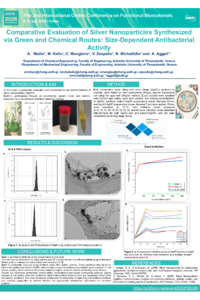
In this study, a systematic evaluation was conducted on two distinct batches of silver nanoparticles (AgNPs) — batch 3, synthesized through an eco-friendly (green) route, and batch 6, prepared via a conventional chemical reduction process. Both nanoparticle types, along with silver nitrate (AgNO₃) solutions as controls, were tested for their antibacterial efficacy against Escherichia coli using the agar well diffusion method. E. coli cultures were streaked onto nutrient agar plates, wells were created, and varying concentrations of AgNO₃ solutions, batch 3 AgNP suspensions (mean diameter 11 nm), and batch 6 AgNP suspensions (mean diameter 7 nm) were applied. Plates were incubated at 37 °C, with inhibition zones measured at 10, 12, 14, 16, 18, 20, 22, 24, 36, and 48 hours.
Inhibition zones stabilized after 24 hours for both AgNO₃ ions and batch 6 AgNPs, with the latter consistently producing larger zones. In marked contrast, batch 3 exhibited no inhibition at any concentration or time point, a result attributed to its larger particle size and the use of a different stabilizing agent that likely limited silver ion release and nanoparticle–cell interactions. Batch 6 AgNPs outperformed AgNO₃ possibly due to the sustained ion release relative to AgNO₃ solutions and thereby enhancing overall efficacy.
Overall, the chemically synthesized batch 6 AgNPs demonstrated pronounced antibacterial potential against resistant E. coli strains, while the eco-friendly batch 3 nanoparticles failed to exert any measurable effect under comparable conditions. This clear divergence emphasizes the importance of optimizing both synthesis pathway and stabilizer composition to achieve effective and reproducible antimicrobial performance in nanosilver systems.
Keywords
silver nanoparticles
antibacterial
E. coli
inhibition zone
Poster
sciforum-175410_Ntolia A.pdf
Enhanced Antimicrobial and Antibiofilm Functions of Fish Gelatin-Coated Maltol Gold Nanoformulations
Multifunctional Rhenium and Iridium Flavonoid Complexes for Antibacterial Biomaterials and Green Therapeutic Platforms