Event submissions
Published
This submission belongs to the session S3. Antibacterial Biomaterials and Surfaces of the event The 2nd International Online Conference on Functional Biomaterials
Published date
03 Jul, 2026
Academic Editor
'%3e%3cpath%20d='M12.6657%2010.9104C12.4185%2010.325%2012.0599%209.79327%2011.6097%209.34482C11.1609%208.89508%2010.6293%208.5365%2010.0442%208.28888C10.0389%208.28626%2010.0337%208.28495%2010.0285%208.28233C10.8446%207.69279%2011.3752%206.73249%2011.3752%205.64904C11.3752%203.8542%209.92103%202.39999%208.1262%202.39999C6.33136%202.39999%204.87715%203.8542%204.87715%205.64904C4.87715%206.73249%205.40774%207.69279%206.22393%208.28364C6.21869%208.28626%206.21345%208.28757%206.20821%208.29019C5.62129%208.5378%205.09463%208.89284%204.64265%209.34613C4.1929%209.79493%203.83432%2010.3266%203.58671%2010.9117C3.34345%2011.4845%203.21226%2012.0987%203.20023%2012.7209C3.19988%2012.7349%203.20233%2012.7488%203.20744%2012.7619C3.21255%2012.7749%203.22022%2012.7867%203.22998%2012.7968C3.23975%2012.8068%203.25142%2012.8147%203.26431%2012.8202C3.2772%2012.8256%203.29105%2012.8284%203.30504%2012.8284H4.09109C4.14874%2012.8284%204.19459%2012.7825%204.1959%2012.7262C4.2221%2011.7148%204.62823%2010.7676%205.34617%2010.0497C6.08899%209.30683%207.0755%208.89808%208.1262%208.89808C9.17689%208.89808%2010.1634%209.30683%2010.9062%2010.0497C11.6242%2010.7676%2012.0303%2011.7148%2012.0565%2012.7262C12.0578%2012.7838%2012.1037%2012.8284%2012.1613%2012.8284H12.9474C12.9613%2012.8284%2012.9752%2012.8256%2012.9881%2012.8202C13.001%2012.8147%2013.0126%2012.8068%2013.0224%2012.7968C13.0322%2012.7867%2013.0398%2012.7749%2013.0449%2012.7619C13.0501%2012.7488%2013.0525%2012.7349%2013.0522%2012.7209C13.0391%2012.0947%2012.9094%2011.4855%2012.6657%2010.9104ZM8.1262%207.9024C7.52486%207.9024%206.9589%207.6679%206.53312%207.24211C6.10733%206.81633%205.87283%206.25037%205.87283%205.64904C5.87283%205.0477%206.10733%204.48174%206.53312%204.05596C6.9589%203.63018%207.52486%203.39567%208.1262%203.39567C8.72753%203.39567%209.29349%203.63018%209.71927%204.05596C10.1451%204.48174%2010.3796%205.0477%2010.3796%205.64904C10.3796%206.25037%2010.1451%206.81633%209.71927%207.24211C9.29349%207.6679%208.72753%207.9024%208.1262%207.9024Z'%20fill='%235D1EE1'/%3e%3c/g%3e%3c/svg%3e) John Luong
John LuongCitation
Monica Trif, Jelena Poljarević, Stefan Nikolić, Ljiljana Mihajlović, Ana Kandić, Jörg Schachner, Milan Milovanović, Multifunctional Rhenium and Iridium Flavonoid Complexes for Antibacterial Biomaterials and Green Therapeutic Platforms, in Proceedings of The 2nd International Online Conference on Functional Biomaterials, 8 July–10 July 2026, MDPI: Basel, Switzerland
Share
Email
Facebook
Twitter
LinkedIn
Multifunctional Rhenium and Iridium Flavonoid Complexes for Antibacterial Biomaterials and Green Therapeutic Platforms
'%3e%3cpath%20d='M12.6647%2010.9104C12.4176%2010.325%2012.0589%209.7933%2011.6088%209.34485C11.16%208.89511%2010.6283%208.53653%2010.0432%208.28891C10.038%208.28629%2010.0327%208.28498%2010.0275%208.28236C10.8437%207.69282%2011.3743%206.73252%2011.3743%205.64907C11.3743%203.85423%209.92005%202.40002%208.12522%202.40002C6.33038%202.40002%204.87618%203.85423%204.87618%205.64907C4.87618%206.73252%205.40677%207.69282%206.22296%208.28367C6.21772%208.28629%206.21248%208.2876%206.20724%208.29022C5.62031%208.53783%205.09365%208.89287%204.64167%209.34616C4.19192%209.79496%203.83334%2010.3266%203.58573%2010.9117C3.34247%2011.4846%203.21128%2012.0987%203.19925%2012.721C3.1989%2012.735%203.20135%2012.7489%203.20646%2012.7619C3.21157%2012.7749%203.21924%2012.7868%203.22901%2012.7968C3.23877%2012.8068%203.25045%2012.8148%203.26334%2012.8202C3.27623%2012.8256%203.29007%2012.8284%203.30406%2012.8284H4.09012C4.14776%2012.8284%204.19362%2012.7825%204.19493%2012.7262C4.22113%2011.7148%204.62726%2010.7676%205.34519%2010.0497C6.08802%209.30686%207.07452%208.89811%208.12522%208.89811C9.17592%208.89811%2010.1624%209.30686%2010.9052%2010.0497C11.6232%2010.7676%2012.0293%2011.7148%2012.0555%2012.7262C12.0568%2012.7839%2012.1027%2012.8284%2012.1603%2012.8284H12.9464C12.9604%2012.8284%2012.9742%2012.8256%2012.9871%2012.8202C13%2012.8148%2013.0117%2012.8068%2013.0214%2012.7968C13.0312%2012.7868%2013.0389%2012.7749%2013.044%2012.7619C13.0491%2012.7489%2013.0515%2012.735%2013.0512%2012.721C13.0381%2012.0947%2012.9084%2011.4856%2012.6647%2010.9104ZM8.12522%207.90243C7.52388%207.90243%206.95792%207.66793%206.53214%207.24215C6.10636%206.81636%205.87185%206.2504%205.87185%205.64907C5.87185%205.04773%206.10636%204.48177%206.53214%204.05599C6.95792%203.63021%207.52388%203.3957%208.12522%203.3957C8.72655%203.3957%209.29252%203.63021%209.7183%204.05599C10.1441%204.48177%2010.3786%205.04773%2010.3786%205.64907C10.3786%206.2504%2010.1441%206.81636%209.7183%207.24215C9.29252%207.66793%208.72655%207.90243%208.12522%207.90243Z'%20fill='%235D1EE1'/%3e%3c/g%3e%3c/svg%3e)
Jelena Poljarević 1
Stefan Nikolić 2
Ljiljana Mihajlović 2
Ana Kandić 2
Jörg Schachner 3
Milan Milovanović 2

Monica Trif 4
1. Faculty of Chemistry, University of Belgrade, Belgrade, Serbia, Serbia
2. Innovative Centre Faculty of Chemistry Belgrade Ltd., Belgrade, Serbia, Serbia
3. Department of Inorganic Chemistry, Institute of Chemistry, University of Graz, Schubertstrasse 1, Graz 8010, Austria, Austria
4. Centre for Innovative Process Engineering GmbH, 28857 Syke, Germany, Germany
Abstract
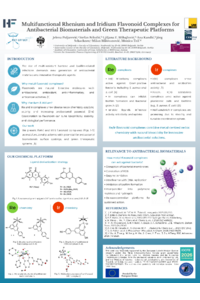
Introduction: The development of multifunctional biomaterials integrating therapeutic and antimicrobial functions represents a major challenge. The MET-EFFECT project aimed to design novel rhenium and iridium flavonoid-based complexes with dual biological and catalytic activity, while incorporating them into sustainable drug delivery systems suitable for advanced antibacterial surfaces and personalized therapies.
Methods: New O,O-bidentate flavonoid-derived ligands were synthesized and optimized to enhance water tolerance and enable green synthetic methodologies. A water-soluble apg-type ligand was developed, allowing the preparation of a series of Re(V)-oxo complexes, including structurally characterized monosubstituted species. Ongoing efforts target disubstituted derivatives and modified ligands for Ir(III) coordination. The complexes were evaluated through cytotoxicity assays in cancer cell lines, supported by bioinformatics-based structure–activity relationship (SAR) analysis and molecular docking studies. Catalytic activity was assessed in olefin epoxidation under environmentally friendly conditions. Selected compounds are being incorporated into biocompatible microcapsules using green valorization approaches.
Results: Re(V) complexes exhibited moderate to significant cytotoxicity, particularly against Jurkat leukemia cells. In silico studies predicted interactions with multiple biologically relevant targets. The complexes demonstrated catalytic activity in green olefin epoxidation, marking the first application of flavonoid-type O,O-bidentate rhenium complexes in this reaction. Preliminary formulation studies indicate improved stability and controlled release potential upon microencapsulation.
Conclusions: The integration of multifunctional metal–flavonoid complexes into sustainable delivery platforms provides a promising route toward next-generation antibacterial biomaterials with combined therapeutic and catalytic functionality.
Keywords
flavonoid-based complexes
biomaterial
drug delivery
antibacterial
Poster
Multifunctional Rhenium and Iridium Flavonoid Complexes for Antibacterial Biomaterials and Green Therapeutic Platforms.pdf
Comparative Evaluation of Silver Nanoparticles Synthesized via Green and Chemical Routes: Size-Dependent Antibacterial Activity
Water-Stable Electrospun PVA Nanofibers via Vapor Crosslinking and Controlled In Situ Silver Nanoparticle Incorporation for Antimicrobial Applications