Event submissions
Published
This submission belongs to the session S3. Antibacterial Biomaterials and Surfaces of the event The 2nd International Online Conference on Functional Biomaterials
Published date
03 Jul, 2026
Academic Editor
'%3e%3cpath%20d='M12.6657%2010.9104C12.4185%2010.325%2012.0599%209.79327%2011.6097%209.34482C11.1609%208.89508%2010.6293%208.5365%2010.0442%208.28888C10.0389%208.28626%2010.0337%208.28495%2010.0285%208.28233C10.8446%207.69279%2011.3752%206.73249%2011.3752%205.64904C11.3752%203.8542%209.92103%202.39999%208.1262%202.39999C6.33136%202.39999%204.87715%203.8542%204.87715%205.64904C4.87715%206.73249%205.40774%207.69279%206.22393%208.28364C6.21869%208.28626%206.21345%208.28757%206.20821%208.29019C5.62129%208.5378%205.09463%208.89284%204.64265%209.34613C4.1929%209.79493%203.83432%2010.3266%203.58671%2010.9117C3.34345%2011.4845%203.21226%2012.0987%203.20023%2012.7209C3.19988%2012.7349%203.20233%2012.7488%203.20744%2012.7619C3.21255%2012.7749%203.22022%2012.7867%203.22998%2012.7968C3.23975%2012.8068%203.25142%2012.8147%203.26431%2012.8202C3.2772%2012.8256%203.29105%2012.8284%203.30504%2012.8284H4.09109C4.14874%2012.8284%204.19459%2012.7825%204.1959%2012.7262C4.2221%2011.7148%204.62823%2010.7676%205.34617%2010.0497C6.08899%209.30683%207.0755%208.89808%208.1262%208.89808C9.17689%208.89808%2010.1634%209.30683%2010.9062%2010.0497C11.6242%2010.7676%2012.0303%2011.7148%2012.0565%2012.7262C12.0578%2012.7838%2012.1037%2012.8284%2012.1613%2012.8284H12.9474C12.9613%2012.8284%2012.9752%2012.8256%2012.9881%2012.8202C13.001%2012.8147%2013.0126%2012.8068%2013.0224%2012.7968C13.0322%2012.7867%2013.0398%2012.7749%2013.0449%2012.7619C13.0501%2012.7488%2013.0525%2012.7349%2013.0522%2012.7209C13.0391%2012.0947%2012.9094%2011.4855%2012.6657%2010.9104ZM8.1262%207.9024C7.52486%207.9024%206.9589%207.6679%206.53312%207.24211C6.10733%206.81633%205.87283%206.25037%205.87283%205.64904C5.87283%205.0477%206.10733%204.48174%206.53312%204.05596C6.9589%203.63018%207.52486%203.39567%208.1262%203.39567C8.72753%203.39567%209.29349%203.63018%209.71927%204.05596C10.1451%204.48174%2010.3796%205.0477%2010.3796%205.64904C10.3796%206.25037%2010.1451%206.81633%209.71927%207.24211C9.29349%207.6679%208.72753%207.9024%208.1262%207.9024Z'%20fill='%235D1EE1'/%3e%3c/g%3e%3c/svg%3e) John Luong
John LuongCitation
Jiatai Chen, Peng Chen, Aya Niimura, Mingqi Dong, Weiwei Zhou, Naoyuki Nomura, Hiroyasu Kanetaka, Additive Manufacturing of Bio-Functionalized Ti-CuO Alloys: Mechanical and Biological Insights, in Proceedings of The 2nd International Online Conference on Functional Biomaterials, 8 July–10 July 2026, MDPI: Basel, Switzerland
Share
Email
Facebook
Twitter
LinkedIn
Additive Manufacturing of Bio-Functionalized Ti-CuO Alloys: Mechanical and Biological Insights
'%3e%3cpath%20d='M12.6647%2010.9104C12.4176%2010.325%2012.0589%209.7933%2011.6088%209.34485C11.16%208.89511%2010.6283%208.53653%2010.0432%208.28891C10.038%208.28629%2010.0327%208.28498%2010.0275%208.28236C10.8437%207.69282%2011.3743%206.73252%2011.3743%205.64907C11.3743%203.85423%209.92005%202.40002%208.12522%202.40002C6.33038%202.40002%204.87618%203.85423%204.87618%205.64907C4.87618%206.73252%205.40677%207.69282%206.22296%208.28367C6.21772%208.28629%206.21248%208.2876%206.20724%208.29022C5.62031%208.53783%205.09365%208.89287%204.64167%209.34616C4.19192%209.79496%203.83334%2010.3266%203.58573%2010.9117C3.34247%2011.4846%203.21128%2012.0987%203.19925%2012.721C3.1989%2012.735%203.20135%2012.7489%203.20646%2012.7619C3.21157%2012.7749%203.21924%2012.7868%203.22901%2012.7968C3.23877%2012.8068%203.25045%2012.8148%203.26334%2012.8202C3.27623%2012.8256%203.29007%2012.8284%203.30406%2012.8284H4.09012C4.14776%2012.8284%204.19362%2012.7825%204.19493%2012.7262C4.22113%2011.7148%204.62726%2010.7676%205.34519%2010.0497C6.08802%209.30686%207.07452%208.89811%208.12522%208.89811C9.17592%208.89811%2010.1624%209.30686%2010.9052%2010.0497C11.6232%2010.7676%2012.0293%2011.7148%2012.0555%2012.7262C12.0568%2012.7839%2012.1027%2012.8284%2012.1603%2012.8284H12.9464C12.9604%2012.8284%2012.9742%2012.8256%2012.9871%2012.8202C13%2012.8148%2013.0117%2012.8068%2013.0214%2012.7968C13.0312%2012.7868%2013.0389%2012.7749%2013.044%2012.7619C13.0491%2012.7489%2013.0515%2012.735%2013.0512%2012.721C13.0381%2012.0947%2012.9084%2011.4856%2012.6647%2010.9104ZM8.12522%207.90243C7.52388%207.90243%206.95792%207.66793%206.53214%207.24215C6.10636%206.81636%205.87185%206.2504%205.87185%205.64907C5.87185%205.04773%206.10636%204.48177%206.53214%204.05599C6.95792%203.63021%207.52388%203.3957%208.12522%203.3957C8.72655%203.3957%209.29252%203.63021%209.7183%204.05599C10.1441%204.48177%2010.3786%205.04773%2010.3786%205.64907C10.3786%206.2504%2010.1441%206.81636%209.7183%207.24215C9.29252%207.66793%208.72655%207.90243%208.12522%207.90243Z'%20fill='%235D1EE1'/%3e%3c/g%3e%3c/svg%3e)
Jiatai Chen 1

Peng Chen 1
Aya Niimura 2
Mingqi Dong 2

Weiwei Zhou 2
Naoyuki Nomura 2
Hiroyasu Kanetaka 1,3
1. Graduate School of Dentistry, Tohoku University, Sendai, Japan, Japan
2. Graduate School of Engineering, Tohoku University, Sendai, Japan, Japan
3. Graduate School of Biomedical Engineering, Tohoku University, Sendai, Japan
Abstract
Introduction
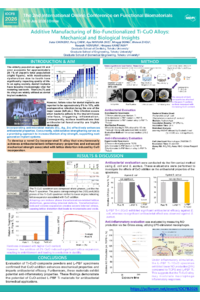
Titanium (Ti) and its alloys are widely used as clinical implant materials in the medical and dental fields due to their excellent corrosion resistance and biocompatibility. However, peri-implant infection remains a major clinical challenge, creating a strong demand for inherent antibacterial functions in materials. Recently, alloying with antibacterial effect of Copper (Cu) has gained attention, but excessive Cu addition raises concerns regarding decreased mechanical properties and cytotoxicity. This study aimed to investigate the optimal composition of Ti-CuO alloys fabricated via the L-PBF method, focusing on CuO content in terms of antibacterial properties, mechanical performance, and cellular response.
Experimental Methods
Ti-CuO alloy specimens with CuO contents of 1.0, 1.5, and 2.0 mass% were fabricated by the L-PBF (Laser Powder Bed Fusion) method. Antibacterial evaluation was conducted using the film attachment method (compliant with JIS Z 2801) against E. coli and S. aureus. Mechanical properties were evaluated via Vickers hardness and tensile tests. Cell compatibility was assessed using MC3T3-E1 cells through proliferation assays and morphological observation. Furthermore, gene expression of peri-implantitis-related biomarkers was analyzed using real-time RT-PCR.
Results
The 1 mass% CuO-added material showed clear antibacterial activity against E. coli, though no significant effect was observed against S. aureus. Regarding mechanical properties, a decrease in ductility was confirmed with increasing CuO content; thus, 1 mass% CuO was determined as the optimal composition considering the balance of properties. Evaluation with MC3T3-E1 cells showed that the 1 mass% CuO group exhibited cell proliferation behavior comparable to pure Ti, with no evidence of significant cytotoxicity or excessive inflammatory response.
Conclusion
The 1 mass% CuO-added Ti alloy fabricated in this study demonstrated the potential to balance antibacterial activity against E. coli and favorable biocompatibility while maintaining mechanical properties. This alloy is considered a promising candidate for additive-manufactured implant materials aiming to achieve both antibacterial function and biocompatibility.
Keywords
Additive Manufacturing
CuO-doped Titanium
Osteoblast Response
Antibacterial activity
Mechanical properties
Poster
IOCFB 2026 Poster-Jiatai_Chen_300dpi.pdf
Electrochemically Synthesized Multifunctional PEDOT–Ceftazidime Films for Electrically Triggered, Advanced Bacteria-Responsive Antibacterial Coatings
Microenvironment-Responsive Polyethylene Glycol-Based Hydrogel Scaffolds for Vascularized Tissue Engineering.