Event submissions
Published
This submission belongs to the session S4. Biomaterials for Tissue Engineering and Regenerative Medicine of the event The 2nd International Online Conference on Functional Biomaterials
Published date
03 Jul, 2026
Academic Editor
'%3e%3cpath%20d='M12.6657%2010.9104C12.4185%2010.325%2012.0599%209.79327%2011.6097%209.34482C11.1609%208.89508%2010.6293%208.5365%2010.0442%208.28888C10.0389%208.28626%2010.0337%208.28495%2010.0285%208.28233C10.8446%207.69279%2011.3752%206.73249%2011.3752%205.64904C11.3752%203.8542%209.92103%202.39999%208.1262%202.39999C6.33136%202.39999%204.87715%203.8542%204.87715%205.64904C4.87715%206.73249%205.40774%207.69279%206.22393%208.28364C6.21869%208.28626%206.21345%208.28757%206.20821%208.29019C5.62129%208.5378%205.09463%208.89284%204.64265%209.34613C4.1929%209.79493%203.83432%2010.3266%203.58671%2010.9117C3.34345%2011.4845%203.21226%2012.0987%203.20023%2012.7209C3.19988%2012.7349%203.20233%2012.7488%203.20744%2012.7619C3.21255%2012.7749%203.22022%2012.7867%203.22998%2012.7968C3.23975%2012.8068%203.25142%2012.8147%203.26431%2012.8202C3.2772%2012.8256%203.29105%2012.8284%203.30504%2012.8284H4.09109C4.14874%2012.8284%204.19459%2012.7825%204.1959%2012.7262C4.2221%2011.7148%204.62823%2010.7676%205.34617%2010.0497C6.08899%209.30683%207.0755%208.89808%208.1262%208.89808C9.17689%208.89808%2010.1634%209.30683%2010.9062%2010.0497C11.6242%2010.7676%2012.0303%2011.7148%2012.0565%2012.7262C12.0578%2012.7838%2012.1037%2012.8284%2012.1613%2012.8284H12.9474C12.9613%2012.8284%2012.9752%2012.8256%2012.9881%2012.8202C13.001%2012.8147%2013.0126%2012.8068%2013.0224%2012.7968C13.0322%2012.7867%2013.0398%2012.7749%2013.0449%2012.7619C13.0501%2012.7488%2013.0525%2012.7349%2013.0522%2012.7209C13.0391%2012.0947%2012.9094%2011.4855%2012.6657%2010.9104ZM8.1262%207.9024C7.52486%207.9024%206.9589%207.6679%206.53312%207.24211C6.10733%206.81633%205.87283%206.25037%205.87283%205.64904C5.87283%205.0477%206.10733%204.48174%206.53312%204.05596C6.9589%203.63018%207.52486%203.39567%208.1262%203.39567C8.72753%203.39567%209.29349%203.63018%209.71927%204.05596C10.1451%204.48174%2010.3796%205.0477%2010.3796%205.64904C10.3796%206.25037%2010.1451%206.81633%209.71927%207.24211C9.29349%207.6679%208.72753%207.9024%208.1262%207.9024Z'%20fill='%235D1EE1'/%3e%3c/g%3e%3c/svg%3e) Piergiorgio Gentile
Piergiorgio GentileCitation
Ayah Binrajab, Adnan Alsaei, Fatema Rahimi, Ahmad Zarwi, G. Roshan Deen, Microenvironment-Responsive Polyethylene Glycol-Based Hydrogel Scaffolds for Vascularized Tissue Engineering., in Proceedings of The 2nd International Online Conference on Functional Biomaterials, 8 July–10 July 2026, MDPI: Basel, Switzerland
Share
Email
Facebook
Twitter
LinkedIn
Microenvironment-Responsive Polyethylene Glycol-Based Hydrogel Scaffolds for Vascularized Tissue Engineering.
'%3e%3cpath%20d='M12.6647%2010.9104C12.4176%2010.325%2012.0589%209.7933%2011.6088%209.34485C11.16%208.89511%2010.6283%208.53653%2010.0432%208.28891C10.038%208.28629%2010.0327%208.28498%2010.0275%208.28236C10.8437%207.69282%2011.3743%206.73252%2011.3743%205.64907C11.3743%203.85423%209.92005%202.40002%208.12522%202.40002C6.33038%202.40002%204.87618%203.85423%204.87618%205.64907C4.87618%206.73252%205.40677%207.69282%206.22296%208.28367C6.21772%208.28629%206.21248%208.2876%206.20724%208.29022C5.62031%208.53783%205.09365%208.89287%204.64167%209.34616C4.19192%209.79496%203.83334%2010.3266%203.58573%2010.9117C3.34247%2011.4846%203.21128%2012.0987%203.19925%2012.721C3.1989%2012.735%203.20135%2012.7489%203.20646%2012.7619C3.21157%2012.7749%203.21924%2012.7868%203.22901%2012.7968C3.23877%2012.8068%203.25045%2012.8148%203.26334%2012.8202C3.27623%2012.8256%203.29007%2012.8284%203.30406%2012.8284H4.09012C4.14776%2012.8284%204.19362%2012.7825%204.19493%2012.7262C4.22113%2011.7148%204.62726%2010.7676%205.34519%2010.0497C6.08802%209.30686%207.07452%208.89811%208.12522%208.89811C9.17592%208.89811%2010.1624%209.30686%2010.9052%2010.0497C11.6232%2010.7676%2012.0293%2011.7148%2012.0555%2012.7262C12.0568%2012.7839%2012.1027%2012.8284%2012.1603%2012.8284H12.9464C12.9604%2012.8284%2012.9742%2012.8256%2012.9871%2012.8202C13%2012.8148%2013.0117%2012.8068%2013.0214%2012.7968C13.0312%2012.7868%2013.0389%2012.7749%2013.044%2012.7619C13.0491%2012.7489%2013.0515%2012.735%2013.0512%2012.721C13.0381%2012.0947%2012.9084%2011.4856%2012.6647%2010.9104ZM8.12522%207.90243C7.52388%207.90243%206.95792%207.66793%206.53214%207.24215C6.10636%206.81636%205.87185%206.2504%205.87185%205.64907C5.87185%205.04773%206.10636%204.48177%206.53214%204.05599C6.95792%203.63021%207.52388%203.3957%208.12522%203.3957C8.72655%203.3957%209.29252%203.63021%209.7183%204.05599C10.1441%204.48177%2010.3786%205.04773%2010.3786%205.64907C10.3786%206.2504%2010.1441%206.81636%209.7183%207.24215C9.29252%207.66793%208.72655%207.90243%208.12522%207.90243Z'%20fill='%235D1EE1'/%3e%3c/g%3e%3c/svg%3e)
Ayah Binrajab 1
Adnan Alsaei 1
Fatema Rahimi 1
Ahmad Zarwi 1

G. Roshan Deen 1
1. School of Medicine, Royal College of Surgeons in Ireland (RCSI) – Medical University of Bahrain, Busaiteen, Kingdom of Bahrain, Bahrain
Abstract
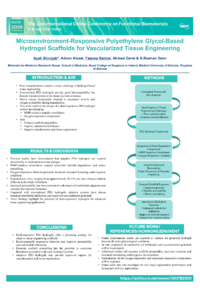
Introduction: A common limitation of hydrogel-based tissue engineering scaffolds is poor vascularization, mainly because oxygen and nutrient diffusion is restricted to about 100–200 µm. As a result, cells in thicker constructs often become hypoxic. Current approaches, such as microchannel-based designs or the use of growth factors like VEGF, have shown some benefit, but they are largely static and do not reflect the dynamic nature of the extracellular matrix (ECM). In this work, attention is placed on polyethylene glycol (PEG)-based hydrogels that can respond to their surrounding microenvironment.
Methods: An ECM-inspired PEG hydrogel scaffold was designed incorporating matrix metalloproteinase (MMP)-sensitive peptide crosslinkers and oxygen-responsive elements. The system introduces a dual-responsive mechanism in which cell-secreted enzymes trigger localized degradation, while hypoxic conditions promote further structural loosening. This response increases scaffold porosity and exposes embedded pro-angiogenic cues. The framework considers how these combined responses regulate pore size, permeability, and endothelial cell infiltration during tissue regeneration.
Results: Previous experimental studies on PEG-based hydrogels show that matrix stiffness and degradability influence vascularization. Compressive modulus values ranging from approximately 30 to 110 kPa, depending on PEG concentration, have been linked to differences in cell migration, with intermediate formulations supporting more stable endothelial networks. Endothelial structures have been reported to reach lengths of up to ~700 µm and penetrate beyond 1 mm into the scaffold, although fully lumenized vessels remain limited. Enzymatically degradable hydrogels consistently demonstrate improved cell infiltration compared to non-degradable PEG systems. These findings support the rationale for combining enzyme-sensitive degradation with additional environmental responsiveness.
Conclusion: PEG hydrogels that respond to both enzymatic activity and oxygen levels offer a more adaptable way to improve vascularization. By allowing the scaffold to change in response to local conditions, this approach supports increased permeability and better endothelial infiltration, providing a practical direction for future scaffold design.
Keywords
Tissue Engineering
Regenerative Medicine
Extracellular Matrix (ECM)-Inspired Biomaterials
Microenvironment-Responsive Biomaterials
Vascularization
Poster
Poster 1.pdf
Additive Manufacturing of Bio-Functionalized Ti-CuO Alloys: Mechanical and Biological Insights
Theravex Technology: A Systematic Review and Meta-Analysis of Its Effectiveness in Oral Surgical Procedures.