Event submissions
Published
This submission belongs to the session S4. Biomaterials for Tissue Engineering and Regenerative Medicine of the event The 2nd International Online Conference on Functional Biomaterials
Published date
03 Jul, 2026
Academic Editor
'%3e%3cpath%20d='M12.6657%2010.9104C12.4185%2010.325%2012.0599%209.79327%2011.6097%209.34482C11.1609%208.89508%2010.6293%208.5365%2010.0442%208.28888C10.0389%208.28626%2010.0337%208.28495%2010.0285%208.28233C10.8446%207.69279%2011.3752%206.73249%2011.3752%205.64904C11.3752%203.8542%209.92103%202.39999%208.1262%202.39999C6.33136%202.39999%204.87715%203.8542%204.87715%205.64904C4.87715%206.73249%205.40774%207.69279%206.22393%208.28364C6.21869%208.28626%206.21345%208.28757%206.20821%208.29019C5.62129%208.5378%205.09463%208.89284%204.64265%209.34613C4.1929%209.79493%203.83432%2010.3266%203.58671%2010.9117C3.34345%2011.4845%203.21226%2012.0987%203.20023%2012.7209C3.19988%2012.7349%203.20233%2012.7488%203.20744%2012.7619C3.21255%2012.7749%203.22022%2012.7867%203.22998%2012.7968C3.23975%2012.8068%203.25142%2012.8147%203.26431%2012.8202C3.2772%2012.8256%203.29105%2012.8284%203.30504%2012.8284H4.09109C4.14874%2012.8284%204.19459%2012.7825%204.1959%2012.7262C4.2221%2011.7148%204.62823%2010.7676%205.34617%2010.0497C6.08899%209.30683%207.0755%208.89808%208.1262%208.89808C9.17689%208.89808%2010.1634%209.30683%2010.9062%2010.0497C11.6242%2010.7676%2012.0303%2011.7148%2012.0565%2012.7262C12.0578%2012.7838%2012.1037%2012.8284%2012.1613%2012.8284H12.9474C12.9613%2012.8284%2012.9752%2012.8256%2012.9881%2012.8202C13.001%2012.8147%2013.0126%2012.8068%2013.0224%2012.7968C13.0322%2012.7867%2013.0398%2012.7749%2013.0449%2012.7619C13.0501%2012.7488%2013.0525%2012.7349%2013.0522%2012.7209C13.0391%2012.0947%2012.9094%2011.4855%2012.6657%2010.9104ZM8.1262%207.9024C7.52486%207.9024%206.9589%207.6679%206.53312%207.24211C6.10733%206.81633%205.87283%206.25037%205.87283%205.64904C5.87283%205.0477%206.10733%204.48174%206.53312%204.05596C6.9589%203.63018%207.52486%203.39567%208.1262%203.39567C8.72753%203.39567%209.29349%203.63018%209.71927%204.05596C10.1451%204.48174%2010.3796%205.0477%2010.3796%205.64904C10.3796%206.25037%2010.1451%206.81633%209.71927%207.24211C9.29349%207.6679%208.72753%207.9024%208.1262%207.9024Z'%20fill='%235D1EE1'/%3e%3c/g%3e%3c/svg%3e) Piergiorgio Gentile
Piergiorgio GentileCitation
Anna P. Abelova, Tatiana I. Vlasova, Konstantin S. Madonov, Ekaterina P. Brodovskaya, Characterization of Cellular and Molecular Responses to Platelet-Rich Plasma (PRP) from Elderly Patients with Acute Inflammatory Conditions in Cell Culture, in Proceedings of The 2nd International Online Conference on Functional Biomaterials, 8 July–10 July 2026, MDPI: Basel, Switzerland
Share
Email
Facebook
Twitter
LinkedIn
Characterization of Cellular and Molecular Responses to Platelet-Rich Plasma (PRP) from Elderly Patients with Acute Inflammatory Conditions in Cell Culture
'%3e%3cpath%20d='M12.6647%2010.9104C12.4176%2010.325%2012.0589%209.7933%2011.6088%209.34485C11.16%208.89511%2010.6283%208.53653%2010.0432%208.28891C10.038%208.28629%2010.0327%208.28498%2010.0275%208.28236C10.8437%207.69282%2011.3743%206.73252%2011.3743%205.64907C11.3743%203.85423%209.92005%202.40002%208.12522%202.40002C6.33038%202.40002%204.87618%203.85423%204.87618%205.64907C4.87618%206.73252%205.40677%207.69282%206.22296%208.28367C6.21772%208.28629%206.21248%208.2876%206.20724%208.29022C5.62031%208.53783%205.09365%208.89287%204.64167%209.34616C4.19192%209.79496%203.83334%2010.3266%203.58573%2010.9117C3.34247%2011.4846%203.21128%2012.0987%203.19925%2012.721C3.1989%2012.735%203.20135%2012.7489%203.20646%2012.7619C3.21157%2012.7749%203.21924%2012.7868%203.22901%2012.7968C3.23877%2012.8068%203.25045%2012.8148%203.26334%2012.8202C3.27623%2012.8256%203.29007%2012.8284%203.30406%2012.8284H4.09012C4.14776%2012.8284%204.19362%2012.7825%204.19493%2012.7262C4.22113%2011.7148%204.62726%2010.7676%205.34519%2010.0497C6.08802%209.30686%207.07452%208.89811%208.12522%208.89811C9.17592%208.89811%2010.1624%209.30686%2010.9052%2010.0497C11.6232%2010.7676%2012.0293%2011.7148%2012.0555%2012.7262C12.0568%2012.7839%2012.1027%2012.8284%2012.1603%2012.8284H12.9464C12.9604%2012.8284%2012.9742%2012.8256%2012.9871%2012.8202C13%2012.8148%2013.0117%2012.8068%2013.0214%2012.7968C13.0312%2012.7868%2013.0389%2012.7749%2013.044%2012.7619C13.0491%2012.7489%2013.0515%2012.735%2013.0512%2012.721C13.0381%2012.0947%2012.9084%2011.4856%2012.6647%2010.9104ZM8.12522%207.90243C7.52388%207.90243%206.95792%207.66793%206.53214%207.24215C6.10636%206.81636%205.87185%206.2504%205.87185%205.64907C5.87185%205.04773%206.10636%204.48177%206.53214%204.05599C6.95792%203.63021%207.52388%203.3957%208.12522%203.3957C8.72655%203.3957%209.29252%203.63021%209.7183%204.05599C10.1441%204.48177%2010.3786%205.04773%2010.3786%205.64907C10.3786%206.2504%2010.1441%206.81636%209.7183%207.24215C9.29252%207.66793%208.72655%207.90243%208.12522%207.90243Z'%20fill='%235D1EE1'/%3e%3c/g%3e%3c/svg%3e)
Tatiana I. Vlasova 1
Ekaterina P. Brodovskaya 2
Konstantin S. Madonov 3
Anna P. Abelova 3
1. Department of Normal and Pathological Physiology, National Research Ogarev Mordovia State University, Saransk, Russia, Russia
2. Research Laboratory of Cell Technologies, Federal Center for Biotechnology and Medicine, National Research Ogarev Mordovia State University, Saransk, Russia, Russia
3. Department of Physiology and Pathology, National Research Ogarev Mordovia State University, Saransk, Russia, Russia
Abstract
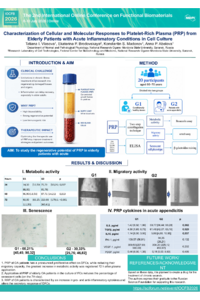
Introduction: Chronic illness treatment limitations drive the research on regeneration of damaged tissues and organs. Inflammation delays recovery in elders. PRP therapy offers promise with high bioavailability, regenerative power, and low immunity risks. Optimizing PRP's therapeutic use can improve treatment strategies for patients.
Methods: This study enrolled 20 participants divided into two groups: conditionally healthy donors aged 60-70 (G1) and patients with acute appendicitis in the same age range (G2). PRP was prepared using a two-step centrifugation technique. Cell metabolic activity was evaluated using the resazurin test on days 1-3 of the experiment. The oxidation level of 2′,7′-dichloro-dihydrofluorescein diacetate characterized the production of active oxygen species. The study of the cell's secescent phenotype was conducted using the Aging Cell β-galactosidase Staining Kit. The production level of biologically active substances was determined using the ELISA method: IL6, IL10, TGFB1, PAI-1, PDGF, VEGF.
Results: In G2, IL6 levels and TGFβ levels exceeded the ones in G1 by 42 and 13.7 times consecutively. and groups did not differ in the concentration of PAI-1, VEGF-1, or PDGF. The concentration of IL10 in G2 exceeded G1 by 5 times (p=0.037)). After 72 hours, proliferative and metabolic activities increased: G2 showed a 2.42-fold higher stimulatory effect compared to G1 (p<0.05). The antioxidant effect of G2’s PRP was less pronounced than that of G1’s. Statistically significant differences in senescent protein marker accumulation were absent. Addition of G2’s PRP tended to increase the proportion of senescent cells in culture.
Conclusions: The study of PRP in G2 showed significant differences in its effects compared to G1. After 72 hours, there was increased cell proliferation in the PRP series of G2. Stimulation of PRP in G2 led to increased production of reactive oxygen species, which correlated with the levels of IL6 and IL10 in the PRP and the percentage of senescent cells.
Keywords
platelet-rich plasma
regenerative medicine
personalized medicine
patient age
acute appendicitis
Oral Presentation
Постер IJMS.pdf
Poster
Постер IJMS.pdf
Hybrid 3D-Printed/Electrospun Honeycomb PCL Scaffolds Improve Mechanical Stability and Promote Osteoblast Colonization
Injectable and bioprintable RGD-functionalized hydrogels support chondrogenic differentiation of adipose mesenchymal stromal cells