Event submissions
Published
This submission belongs to the session S4. Biomaterials for Tissue Engineering and Regenerative Medicine of the event The 2nd International Online Conference on Functional Biomaterials
Published date
03 Jul, 2026
Academic Editor
'%3e%3cpath%20d='M12.6657%2010.9104C12.4185%2010.325%2012.0599%209.79327%2011.6097%209.34482C11.1609%208.89508%2010.6293%208.5365%2010.0442%208.28888C10.0389%208.28626%2010.0337%208.28495%2010.0285%208.28233C10.8446%207.69279%2011.3752%206.73249%2011.3752%205.64904C11.3752%203.8542%209.92103%202.39999%208.1262%202.39999C6.33136%202.39999%204.87715%203.8542%204.87715%205.64904C4.87715%206.73249%205.40774%207.69279%206.22393%208.28364C6.21869%208.28626%206.21345%208.28757%206.20821%208.29019C5.62129%208.5378%205.09463%208.89284%204.64265%209.34613C4.1929%209.79493%203.83432%2010.3266%203.58671%2010.9117C3.34345%2011.4845%203.21226%2012.0987%203.20023%2012.7209C3.19988%2012.7349%203.20233%2012.7488%203.20744%2012.7619C3.21255%2012.7749%203.22022%2012.7867%203.22998%2012.7968C3.23975%2012.8068%203.25142%2012.8147%203.26431%2012.8202C3.2772%2012.8256%203.29105%2012.8284%203.30504%2012.8284H4.09109C4.14874%2012.8284%204.19459%2012.7825%204.1959%2012.7262C4.2221%2011.7148%204.62823%2010.7676%205.34617%2010.0497C6.08899%209.30683%207.0755%208.89808%208.1262%208.89808C9.17689%208.89808%2010.1634%209.30683%2010.9062%2010.0497C11.6242%2010.7676%2012.0303%2011.7148%2012.0565%2012.7262C12.0578%2012.7838%2012.1037%2012.8284%2012.1613%2012.8284H12.9474C12.9613%2012.8284%2012.9752%2012.8256%2012.9881%2012.8202C13.001%2012.8147%2013.0126%2012.8068%2013.0224%2012.7968C13.0322%2012.7867%2013.0398%2012.7749%2013.0449%2012.7619C13.0501%2012.7488%2013.0525%2012.7349%2013.0522%2012.7209C13.0391%2012.0947%2012.9094%2011.4855%2012.6657%2010.9104ZM8.1262%207.9024C7.52486%207.9024%206.9589%207.6679%206.53312%207.24211C6.10733%206.81633%205.87283%206.25037%205.87283%205.64904C5.87283%205.0477%206.10733%204.48174%206.53312%204.05596C6.9589%203.63018%207.52486%203.39567%208.1262%203.39567C8.72753%203.39567%209.29349%203.63018%209.71927%204.05596C10.1451%204.48174%2010.3796%205.0477%2010.3796%205.64904C10.3796%206.25037%2010.1451%206.81633%209.71927%207.24211C9.29349%207.6679%208.72753%207.9024%208.1262%207.9024Z'%20fill='%235D1EE1'/%3e%3c/g%3e%3c/svg%3e) Piergiorgio Gentile
Piergiorgio GentileCitation
Inês Dias, Beatriz Serambeque, Beatriz Marques, Miguel Cardoso, Raquel Alves, Joana Jorge, Maria Filomena Botelho, Carlos Miguel Marto, Mafalda Laranjo, Photodynamic Therapy: A Promising Strategy for Alveolar Bone Regeneration, in Proceedings of The 2nd International Online Conference on Functional Biomaterials, 8 July–10 July 2026, MDPI: Basel, Switzerland
Share
Email
Facebook
Twitter
LinkedIn
Photodynamic Therapy: A Promising Strategy for Alveolar Bone Regeneration
'%3e%3cpath%20d='M12.6647%2010.9104C12.4176%2010.325%2012.0589%209.7933%2011.6088%209.34485C11.16%208.89511%2010.6283%208.53653%2010.0432%208.28891C10.038%208.28629%2010.0327%208.28498%2010.0275%208.28236C10.8437%207.69282%2011.3743%206.73252%2011.3743%205.64907C11.3743%203.85423%209.92005%202.40002%208.12522%202.40002C6.33038%202.40002%204.87618%203.85423%204.87618%205.64907C4.87618%206.73252%205.40677%207.69282%206.22296%208.28367C6.21772%208.28629%206.21248%208.2876%206.20724%208.29022C5.62031%208.53783%205.09365%208.89287%204.64167%209.34616C4.19192%209.79496%203.83334%2010.3266%203.58573%2010.9117C3.34247%2011.4846%203.21128%2012.0987%203.19925%2012.721C3.1989%2012.735%203.20135%2012.7489%203.20646%2012.7619C3.21157%2012.7749%203.21924%2012.7868%203.22901%2012.7968C3.23877%2012.8068%203.25045%2012.8148%203.26334%2012.8202C3.27623%2012.8256%203.29007%2012.8284%203.30406%2012.8284H4.09012C4.14776%2012.8284%204.19362%2012.7825%204.19493%2012.7262C4.22113%2011.7148%204.62726%2010.7676%205.34519%2010.0497C6.08802%209.30686%207.07452%208.89811%208.12522%208.89811C9.17592%208.89811%2010.1624%209.30686%2010.9052%2010.0497C11.6232%2010.7676%2012.0293%2011.7148%2012.0555%2012.7262C12.0568%2012.7839%2012.1027%2012.8284%2012.1603%2012.8284H12.9464C12.9604%2012.8284%2012.9742%2012.8256%2012.9871%2012.8202C13%2012.8148%2013.0117%2012.8068%2013.0214%2012.7968C13.0312%2012.7868%2013.0389%2012.7749%2013.044%2012.7619C13.0491%2012.7489%2013.0515%2012.735%2013.0512%2012.721C13.0381%2012.0947%2012.9084%2011.4856%2012.6647%2010.9104ZM8.12522%207.90243C7.52388%207.90243%206.95792%207.66793%206.53214%207.24215C6.10636%206.81636%205.87185%206.2504%205.87185%205.64907C5.87185%205.04773%206.10636%204.48177%206.53214%204.05599C6.95792%203.63021%207.52388%203.3957%208.12522%203.3957C8.72655%203.3957%209.29252%203.63021%209.7183%204.05599C10.1441%204.48177%2010.3786%205.04773%2010.3786%205.64907C10.3786%206.2504%2010.1441%206.81636%209.7183%207.24215C9.29252%207.66793%208.72655%207.90243%208.12522%207.90243Z'%20fill='%235D1EE1'/%3e%3c/g%3e%3c/svg%3e)
Inês Dias 1,2
Beatriz Serambeque 1,2
Beatriz Marques 3

Miguel Cardoso 1,2,4
Raquel Alves 5,6,7
Joana Jorge 5,6,7

Maria Filomena Botelho 1,2,6
Carlos Miguel Marto 1,2,6,8,9

Mafalda Laranjo 1,2,6
1. Institute of Biophysics, Faculty of Medicine, Area of Environment Genetics and Oncobiology (CIMAGO), Coimbra Institute for Clinical and Biomedical Research (iCBR), Univ Coimbra, 3000-548 Coimbra, Portugal, Portugal
2. Center for Innovative Biomedicine and Biotechnology (CIBB), Univ Coimbra, 3000-548 Coimbra, Portugal
3. Coimbra Agriculture School, Polytechnic Institute of Coimbra, Bencanta, 3045-601 Coimbra, Portugal, Portugal
4. Department of Chemistry, Coimbra Chemistry Centre-Institute of Molecular Sciences (CQC-IMS), University of Coimbra, 3000-548 Coimbra, Portugal
5. Center for Innovative Biomedicine and Biotechnology (CIBB), Univ Coimbra, 3000-548 Coimbra, Portugal, Portugal
6. Clinical Academic Center of Coimbra (CACC), 3000-548 Coimbra, Portugal
7. Laboratory of Oncobiology and Hematology (LOH) and University Clinics of Hematology and Oncology, Faculty of Medicine, University of Coimbra, 3000-548 Coimbra, Portugal
8. Institute of Experimental Pathology, Faculty of Medicine, University of Coimbra, 3000-548 Coimbra, Portugal
9. Centre for Mechanical Engineering, Materials and Processes (CEMMPRE), Advanced Production and Intelligent Systems (ARISE), University of Coimbra, 3000-548 Coimbra, Portugal
Abstract
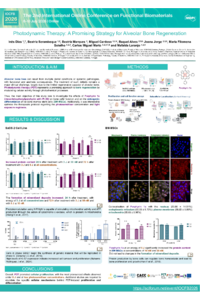
Introduction: Alveolar bone loss can result from multiple dental conditions or systemic pathologies, with functional and aesthetic consequences. The treatment of such defects remains a major clinical challenge, largely due to the limited regenerative capacity of alveolar bone. Photodynamic therapy (PDT) represents a promising approach to bone regeneration by modulating cellular activity through photochemical processes. Thus, the main objective of this study was to investigate the effects of Porphyrin 1a (meso-tetraphenylporphyrin with Pt (II)) on the function of bone cells and on the osteogenic differentiation of rat bone marrow stem cells (BM-MSCs). Additionally, this study intended to optimise the therapeutic protocol regarding the photosensitiser concentration and light exposure regimens.
Materials and Methods: The effect of the photosensitiser on the SaOS-2 cell line was assessed by testing 3 and 5 J irradiation regimens and a range of concentrations from 1 to 100 nM. The protein content (SRB assay), cell cycle (flow cytometry), Ki-67 expression (RT-PCR), and formation of mineralised deposits (Alizarin Red staining) were evaluated 24 and 72 hours after treatment. Additionally, the subcellular localisation of Porphyrin 1a was determined using confocal microscopy on BM-MSCs, and the impact of PDT on the proliferation and formation of mineralised deposits was evaluated in these cells 72 hours after treatment.
Results: Porphyrin 1a promoted a significant increase in protein content of SaOS-2 cells and BM-MSCs after irradiation at 5 J. After PDT, the cell populations were mainly in the G0/G1 phase of the cell cycle. Furthermore, increased Ki-67 expression and more mineralised deposits were observed in SaOS‑2 cells. Additionally, it was demonstrated that Porphyrin 1a colocalises with the nucleus, mitochondria, plasma membrane, and endoplasmic reticulum of BM-MSCs.
Conclusions: Overall, PDT promoted cellular proliferation, with the most pronounced effects observed under 5 J and at low photosensitiser concentrations. Additional studies are required to elucidate the specific cellular mechanisms behind PDT-induced proliferation and differentiation.
Keywords
Photodynamic Therapy
Bone Regeneration
Cell proliferation
Osteodifferentiation
Photobiomodulation
Poster
Photodynamic Therapy A promising Strategy for Alveolar Bone Regeneration.pdf
Mineralised Biopolymer-Based Scaffolds Containing Natural Bioactive Compounds for Bone Tissue Engineering
Semi-Solid Extrusion 3D Printing Enhances Epidermal Accumulation of Menthol from PVA-Based Transdermal Biomaterial Films: An Ex Vivo Comparative Permeation Study