Event submissions
Published
This submission belongs to the session S5. Biomaterials for Drug Delivery and Therapy of the event The 2nd International Online Conference on Functional Biomaterials
Published date
03 Jul, 2026
Academic Editor
'%3e%3cpath%20d='M12.6657%2010.9104C12.4185%2010.325%2012.0599%209.79327%2011.6097%209.34482C11.1609%208.89508%2010.6293%208.5365%2010.0442%208.28888C10.0389%208.28626%2010.0337%208.28495%2010.0285%208.28233C10.8446%207.69279%2011.3752%206.73249%2011.3752%205.64904C11.3752%203.8542%209.92103%202.39999%208.1262%202.39999C6.33136%202.39999%204.87715%203.8542%204.87715%205.64904C4.87715%206.73249%205.40774%207.69279%206.22393%208.28364C6.21869%208.28626%206.21345%208.28757%206.20821%208.29019C5.62129%208.5378%205.09463%208.89284%204.64265%209.34613C4.1929%209.79493%203.83432%2010.3266%203.58671%2010.9117C3.34345%2011.4845%203.21226%2012.0987%203.20023%2012.7209C3.19988%2012.7349%203.20233%2012.7488%203.20744%2012.7619C3.21255%2012.7749%203.22022%2012.7867%203.22998%2012.7968C3.23975%2012.8068%203.25142%2012.8147%203.26431%2012.8202C3.2772%2012.8256%203.29105%2012.8284%203.30504%2012.8284H4.09109C4.14874%2012.8284%204.19459%2012.7825%204.1959%2012.7262C4.2221%2011.7148%204.62823%2010.7676%205.34617%2010.0497C6.08899%209.30683%207.0755%208.89808%208.1262%208.89808C9.17689%208.89808%2010.1634%209.30683%2010.9062%2010.0497C11.6242%2010.7676%2012.0303%2011.7148%2012.0565%2012.7262C12.0578%2012.7838%2012.1037%2012.8284%2012.1613%2012.8284H12.9474C12.9613%2012.8284%2012.9752%2012.8256%2012.9881%2012.8202C13.001%2012.8147%2013.0126%2012.8068%2013.0224%2012.7968C13.0322%2012.7867%2013.0398%2012.7749%2013.0449%2012.7619C13.0501%2012.7488%2013.0525%2012.7349%2013.0522%2012.7209C13.0391%2012.0947%2012.9094%2011.4855%2012.6657%2010.9104ZM8.1262%207.9024C7.52486%207.9024%206.9589%207.6679%206.53312%207.24211C6.10733%206.81633%205.87283%206.25037%205.87283%205.64904C5.87283%205.0477%206.10733%204.48174%206.53312%204.05596C6.9589%203.63018%207.52486%203.39567%208.1262%203.39567C8.72753%203.39567%209.29349%203.63018%209.71927%204.05596C10.1451%204.48174%2010.3796%205.0477%2010.3796%205.64904C10.3796%206.25037%2010.1451%206.81633%209.71927%207.24211C9.29349%207.6679%208.72753%207.9024%208.1262%207.9024Z'%20fill='%235D1EE1'/%3e%3c/g%3e%3c/svg%3e) Filippo Rossi
Filippo RossiCitation
Anh Ngoc NGUYEN, Thuy Thi Thu THANH, Ha Thi Thu Nguyen, Yoshiaki YUGUCHI, Bioactivity-Guided Assembly of Fucoidan from Turbinaria decurrens for Enhanced Anticancer Performance, in Proceedings of The 2nd International Online Conference on Functional Biomaterials, 8 July–10 July 2026, MDPI: Basel, Switzerland
Share
Email
Facebook
Twitter
LinkedIn
Bioactivity-Guided Assembly of Fucoidan from Turbinaria decurrens for Enhanced Anticancer Performance
'%3e%3cpath%20d='M12.6647%2010.9104C12.4176%2010.325%2012.0589%209.7933%2011.6088%209.34485C11.16%208.89511%2010.6283%208.53653%2010.0432%208.28891C10.038%208.28629%2010.0327%208.28498%2010.0275%208.28236C10.8437%207.69282%2011.3743%206.73252%2011.3743%205.64907C11.3743%203.85423%209.92005%202.40002%208.12522%202.40002C6.33038%202.40002%204.87618%203.85423%204.87618%205.64907C4.87618%206.73252%205.40677%207.69282%206.22296%208.28367C6.21772%208.28629%206.21248%208.2876%206.20724%208.29022C5.62031%208.53783%205.09365%208.89287%204.64167%209.34616C4.19192%209.79496%203.83334%2010.3266%203.58573%2010.9117C3.34247%2011.4846%203.21128%2012.0987%203.19925%2012.721C3.1989%2012.735%203.20135%2012.7489%203.20646%2012.7619C3.21157%2012.7749%203.21924%2012.7868%203.22901%2012.7968C3.23877%2012.8068%203.25045%2012.8148%203.26334%2012.8202C3.27623%2012.8256%203.29007%2012.8284%203.30406%2012.8284H4.09012C4.14776%2012.8284%204.19362%2012.7825%204.19493%2012.7262C4.22113%2011.7148%204.62726%2010.7676%205.34519%2010.0497C6.08802%209.30686%207.07452%208.89811%208.12522%208.89811C9.17592%208.89811%2010.1624%209.30686%2010.9052%2010.0497C11.6232%2010.7676%2012.0293%2011.7148%2012.0555%2012.7262C12.0568%2012.7839%2012.1027%2012.8284%2012.1603%2012.8284H12.9464C12.9604%2012.8284%2012.9742%2012.8256%2012.9871%2012.8202C13%2012.8148%2013.0117%2012.8068%2013.0214%2012.7968C13.0312%2012.7868%2013.0389%2012.7749%2013.044%2012.7619C13.0491%2012.7489%2013.0515%2012.735%2013.0512%2012.721C13.0381%2012.0947%2012.9084%2011.4856%2012.6647%2010.9104ZM8.12522%207.90243C7.52388%207.90243%206.95792%207.66793%206.53214%207.24215C6.10636%206.81636%205.87185%206.2504%205.87185%205.64907C5.87185%205.04773%206.10636%204.48177%206.53214%204.05599C6.95792%203.63021%207.52388%203.3957%208.12522%203.3957C8.72655%203.3957%209.29252%203.63021%209.7183%204.05599C10.1441%204.48177%2010.3786%205.04773%2010.3786%205.64907C10.3786%206.2504%2010.1441%206.81636%209.7183%207.24215C9.29252%207.66793%208.72655%207.90243%208.12522%207.90243Z'%20fill='%235D1EE1'/%3e%3c/g%3e%3c/svg%3e)
Anh Ngoc NGUYEN 1,2
Ha Thi Thu Nguyen 3
Yoshiaki YUGUCHI 4
Thuy Thi Thu THANH 3
1. Faculty of Pharmaceutical Chemistry and Technology, Hanoi University of Pharmacy, Hanoi 100000, Vietnam, Vietnam
2. Graduate University of Science and Technology, Vietnam Academy of Science and Technology, Hanoi 100000, Vietnam
3. Institute of Chemistry, Vietnam Academy of Science and Technology, Hanoi 100000, Vietnam, Vietnam
4. Graduate School of Engineering, Osaka Electro-Communication University, Osaka 572-8530, Japan, Japan
Abstract
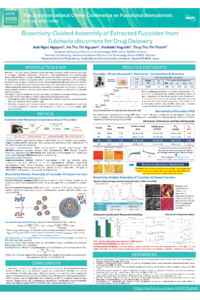
Fucoidan has emerged as a promising multifunctional biomaterial due to its diverse biological activities and inherent bioactivity. With low toxicity, excellent biocompatibility, and biodegradability, fucoidan has been widely explored as a bioactive polymer for drug delivery, particularly in targeted cancer therapy. However, its functional contribution within biomaterial systems and its role in modulating therapeutic efficacy remain poorly understood. This study aims to elucidate the structure of fucoidan extracted from Turbinaria decurrens and to evaluate its potential role as a bioactive component in enhancing anticancer efficacy. Its intrinsic bioactivity and ability to interact with therapeutic compounds suggest a functional contribution beyond that of a passive carrier.
The isolated fucoidan was identified as a sulfated galactofucan composed of alternating (1→3)/(1→4)-linked α-L-fucopyranose residues, with sulfate groups located at the C-2, C-3, and C-4 positions. Small-angle X-ray scattering (SAXS) analysis provided insight into its conformation. Fucoidan from T. decurrens exhibited multiple biological activities, including immunomodulatory and lipid-regulating effects. Notably, its anticancer activity against HT-29 cells suggests that this activity can be enhanced through structural modulation.
Fucoidan was assembled with chitosan via electrostatic interactions between sulfate (–SO₃⁻) and protonated amino (–NH₃⁺) groups to form FC complexes, which were loaded with curcumin to generate FCC systems. Characterization confirmed the formation of amorphous nanostructures. The FCC system exhibited enhanced anticancer activity compared to free curcumin in both MCF-7 and A549 cancer cell lines, indicating improved bioavailability.
Overall, these findings demonstrate that fucoidan from T. decurrens functions not only as a structurally defined polysaccharide but also as an active contributor to therapeutic performance. By integrating intrinsic bioactivity with rational assembly, this study highlights a bioactivity-guided approach for the development of fucoidan-based systems, providing a foundation for the future design of bioactive nanomaterials in cancer therapy.
Keywords
Fucoidan
Turbinaria decurrens
Bioactivity-guided assembly
Bioactive biomaterials
Anticancer activity
Nanomaterials
Poster
Poster 2nd IOCFB.pdf
Streamlined Nanodrug Delivery Systems for Localized Cancer Therapy via Electrospinning and Electrospray
Cardiomyocyte-Loaded Polymeric Microsphere Design For Treatment Of Cardiac Regeneration After Myocardial Ischemia And in vitro Evaluation