Event submissions
Published
This submission belongs to the session S5. Biomaterials for Drug Delivery and Therapy of the event The 2nd International Online Conference on Functional Biomaterials
Published date
03 Jul, 2026
Academic Editor
'%3e%3cpath%20d='M12.6657%2010.9104C12.4185%2010.325%2012.0599%209.79327%2011.6097%209.34482C11.1609%208.89508%2010.6293%208.5365%2010.0442%208.28888C10.0389%208.28626%2010.0337%208.28495%2010.0285%208.28233C10.8446%207.69279%2011.3752%206.73249%2011.3752%205.64904C11.3752%203.8542%209.92103%202.39999%208.1262%202.39999C6.33136%202.39999%204.87715%203.8542%204.87715%205.64904C4.87715%206.73249%205.40774%207.69279%206.22393%208.28364C6.21869%208.28626%206.21345%208.28757%206.20821%208.29019C5.62129%208.5378%205.09463%208.89284%204.64265%209.34613C4.1929%209.79493%203.83432%2010.3266%203.58671%2010.9117C3.34345%2011.4845%203.21226%2012.0987%203.20023%2012.7209C3.19988%2012.7349%203.20233%2012.7488%203.20744%2012.7619C3.21255%2012.7749%203.22022%2012.7867%203.22998%2012.7968C3.23975%2012.8068%203.25142%2012.8147%203.26431%2012.8202C3.2772%2012.8256%203.29105%2012.8284%203.30504%2012.8284H4.09109C4.14874%2012.8284%204.19459%2012.7825%204.1959%2012.7262C4.2221%2011.7148%204.62823%2010.7676%205.34617%2010.0497C6.08899%209.30683%207.0755%208.89808%208.1262%208.89808C9.17689%208.89808%2010.1634%209.30683%2010.9062%2010.0497C11.6242%2010.7676%2012.0303%2011.7148%2012.0565%2012.7262C12.0578%2012.7838%2012.1037%2012.8284%2012.1613%2012.8284H12.9474C12.9613%2012.8284%2012.9752%2012.8256%2012.9881%2012.8202C13.001%2012.8147%2013.0126%2012.8068%2013.0224%2012.7968C13.0322%2012.7867%2013.0398%2012.7749%2013.0449%2012.7619C13.0501%2012.7488%2013.0525%2012.7349%2013.0522%2012.7209C13.0391%2012.0947%2012.9094%2011.4855%2012.6657%2010.9104ZM8.1262%207.9024C7.52486%207.9024%206.9589%207.6679%206.53312%207.24211C6.10733%206.81633%205.87283%206.25037%205.87283%205.64904C5.87283%205.0477%206.10733%204.48174%206.53312%204.05596C6.9589%203.63018%207.52486%203.39567%208.1262%203.39567C8.72753%203.39567%209.29349%203.63018%209.71927%204.05596C10.1451%204.48174%2010.3796%205.0477%2010.3796%205.64904C10.3796%206.25037%2010.1451%206.81633%209.71927%207.24211C9.29349%207.6679%208.72753%207.9024%208.1262%207.9024Z'%20fill='%235D1EE1'/%3e%3c/g%3e%3c/svg%3e) Filippo Rossi
Filippo RossiCitation
Qingzhe Zhu, Xianghui Cao, Min He, Hao Su, Qihui Zhou, Angiogenic Peptide Hydrogels Delivering Neuronal Differentiators for Treatment of Traumatic Brain Injury, in Proceedings of The 2nd International Online Conference on Functional Biomaterials, 8 July–10 July 2026, MDPI: Basel, Switzerland
Share
Email
Facebook
Twitter
LinkedIn
Angiogenic Peptide Hydrogels Delivering Neuronal Differentiators for Treatment of Traumatic Brain Injury
'%3e%3cpath%20d='M12.6647%2010.9104C12.4176%2010.325%2012.0589%209.7933%2011.6088%209.34485C11.16%208.89511%2010.6283%208.53653%2010.0432%208.28891C10.038%208.28629%2010.0327%208.28498%2010.0275%208.28236C10.8437%207.69282%2011.3743%206.73252%2011.3743%205.64907C11.3743%203.85423%209.92005%202.40002%208.12522%202.40002C6.33038%202.40002%204.87618%203.85423%204.87618%205.64907C4.87618%206.73252%205.40677%207.69282%206.22296%208.28367C6.21772%208.28629%206.21248%208.2876%206.20724%208.29022C5.62031%208.53783%205.09365%208.89287%204.64167%209.34616C4.19192%209.79496%203.83334%2010.3266%203.58573%2010.9117C3.34247%2011.4846%203.21128%2012.0987%203.19925%2012.721C3.1989%2012.735%203.20135%2012.7489%203.20646%2012.7619C3.21157%2012.7749%203.21924%2012.7868%203.22901%2012.7968C3.23877%2012.8068%203.25045%2012.8148%203.26334%2012.8202C3.27623%2012.8256%203.29007%2012.8284%203.30406%2012.8284H4.09012C4.14776%2012.8284%204.19362%2012.7825%204.19493%2012.7262C4.22113%2011.7148%204.62726%2010.7676%205.34519%2010.0497C6.08802%209.30686%207.07452%208.89811%208.12522%208.89811C9.17592%208.89811%2010.1624%209.30686%2010.9052%2010.0497C11.6232%2010.7676%2012.0293%2011.7148%2012.0555%2012.7262C12.0568%2012.7839%2012.1027%2012.8284%2012.1603%2012.8284H12.9464C12.9604%2012.8284%2012.9742%2012.8256%2012.9871%2012.8202C13%2012.8148%2013.0117%2012.8068%2013.0214%2012.7968C13.0312%2012.7868%2013.0389%2012.7749%2013.044%2012.7619C13.0491%2012.7489%2013.0515%2012.735%2013.0512%2012.721C13.0381%2012.0947%2012.9084%2011.4856%2012.6647%2010.9104ZM8.12522%207.90243C7.52388%207.90243%206.95792%207.66793%206.53214%207.24215C6.10636%206.81636%205.87185%206.2504%205.87185%205.64907C5.87185%205.04773%206.10636%204.48177%206.53214%204.05599C6.95792%203.63021%207.52388%203.3957%208.12522%203.3957C8.72655%203.3957%209.29252%203.63021%209.7183%204.05599C10.1441%204.48177%2010.3786%205.04773%2010.3786%205.64907C10.3786%206.2504%2010.1441%206.81636%209.7183%207.24215C9.29252%207.66793%208.72655%207.90243%208.12522%207.90243Z'%20fill='%235D1EE1'/%3e%3c/g%3e%3c/svg%3e)
Qingzhe Zhu 1,2
Xianghui Cao 1
Min He 1

Hao Su 3
Qihui Zhou 1
1. Shandong Engineering Research Center for Tissue Rehabilitation Materials and Devices, School of Rehabilitation Sciences and Engineering, University of Health and Rehabilitation Sciences, Qingdao 266113, China., China
2. College of Polymer Science and Engineering, State Key Laboratory of Polymer Materials Engineering, Sichuan University, Chengdu 610065, China
3. College of Polymer Science and Engineering, State Key Laboratory of Polymer Materials Engineering, Sichuan University, Chengdu 610065, China, China
Abstract
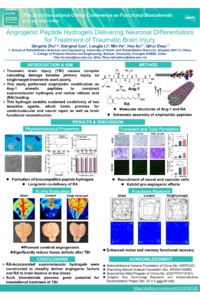
Introduction:Traumatic brain injury (TBI) remains a major global cause of injury-related mortality and long-term neurological disability. However, significant advances in therapeutic strategies have been limited in recent years.
Methods:Herein, we developed a supramolecular hydrogel based on amphiphilically modified angiopoietin-1 (Ang-1) mimetic peptide. Retinoic acid (RA) was subsequently encapsulated into the hydrogel system to achieve sustained co-delivery of angiogenic and neurogenic cues. The formation and structural properties of the fabricated hydrogels were characterized by transmission electron microscopy (TEM) and circular dichroism (CD) spectroscopy, while the critical micelle concentration (CMC) was determined by fluorescence spectroscopy with Nile red as a fluorescent probe. The biological performance of the hydrogel system was evaluated using cell scratch assays, tube formation assays, and in vitro RA release studies. To assess therapeutic efficacy, TBI was induced in mice via controlled cortical impact, followed by intracerebral injection of the RA-loaded hydrogels.
Results:In vitro assays demonstrated that the supramolecular hydrogels not only significantly promoted angiogenesis, but also enhanced the differentiation of neural stem cells into neurons. Furthermore, the Cell Counting Kit-8 (CCK-8) assay in a nerve cell co-culture system confirmed the neuroprotective effect. These findings were further corroborated in a mouse TBI model, where treatment with hydrogels significantly improved neuronal survival and reduced brain tissue loss.
Conclusions:In this study, supramolecular hydrogels loaded with RA were successfully constructed. These hydrogels enable the slow, continuous, and low-dose co-delivery of angiogenic growth factors and RA to local brain tissue, thereby demonstrating their potential for clinical translation in TBI treatment.
Keywords
Traumatic brain injury
Angiogenesis
Retinoic acid
Self-assembling peptide hydrogels
Amphiphilic Peptides
Poster
zqz poster-0617-pdf.pdf
Microstructural and Mechanical Characterization of PVA-Based Drug Delivery Films Containing Menthol: Correlation Between SEM Morphology and Texture Analysis Across Three Manufacturing Methods
Effect of pore size on physical properties of self-agglomerated and ultrasonicated lyogels